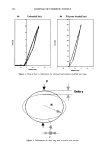
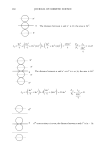
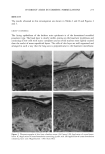
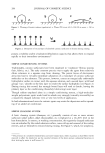
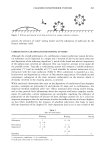
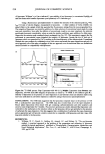
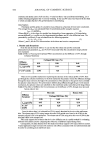
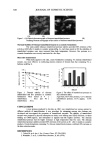
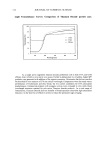
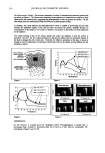
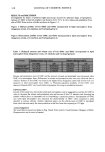
CLEANER/CONDITIONER SYSTEMS 285 II I I I i Iii'1 I I I ! I I Figure 3. Roll-up and removal of oil drop on keratin by anionic surfactant solutions. ignores the presence of "solid" soiling matter and the adsorption of surfactant by the keratin substrate itself. COMBINATION CLEANING/CONDITIONING SYSTEMS Although the overall performance of a combination cleaner/conditioner system for kera- tin substrates can be explained in a simple way ("removal of dirt by the main surfactant and deposition of the softening ingredient"), much of the detail and relative importance of the subprocesses involved are unknown. One can, however, attempt to list (some of) the possible events. Typically a conditioning system will comprise a soluble polymeric polycation ("1") and an insoluble oil ("2"), each alterable by mutual interaction or by interaction with the main surfactant (Table I). Here, adsorption is regarded as a mo- lecular event and deposition as a macro- or flocculation-type process. For simplicity and convenience, adsorption of the main (anionic) surfactant(s) on the keratin, which is obviously involved in the cleaning process, is omitted. While analytical information does exist on the deposition of conditioners from shampoo systems--examples are polycation (3) and silicone (4) alone and in combination--the analytical methods employed yield "net" effects measured after rinsing and/or drying, and so they provide little information about the stepwise and hence complete mecha- nisms. In particular, current explanations are incomplete regarding the influence of polycations on the deposition of silicone oil from shampoo systems (4). It is a fair but unproven assumption that the mechanism involves heteroflocculation of silicone droplets on hair fibers modified by the presence of adsorbed polycation this leads to more efficient deposition of the droplets (5). Such deposition may occur in one or both of the Table I Fate of Conditioners Washing Rinsing Drying Adsorption 1 (1 +S) Flocculation 1 + 2 (deposition) (1 + S) 2 Spreading (1 + S) 1+2 (1 + S) 2 (2 + S) 2 1: polycatiomc conditioner. 2: oil conditioner. S: surfactant (listed only in combinations with 1, 2).

286 JOURNAL OF COSMETIC SCIENCE washing and rinsing steps prior to the spreading step, which probably occurs mainly during drying (see Figure 1 c). The droplet size of the silicone may be critical for efficient deposition. The latter processes (deposition and spreading) are actually the reverse of those involved in ordinary detergency. It is thus likely that many model procedures (6), including optical microscopy, developed to study detergency could be suitably modified to provide further insight into the mechanisms involved in these "reverse" processes. CONCLUSION One has to conclude that, while the events and molecular mechanisms involved in simple detergency and simple softening/conditioning are quite well understood, this is not the case in more complicated "one-shot" cleaner/conditioner systems, especially if the con- ditioner itself is multi-component. More fundamental work is required to develop complete mechanisms and, hence, more efficient systems. REFERENCES (1) A. E1 Shimi and E. D. Goddard, Wettability of some low energy surfaces, Pts 1 and 2,J. Colloidlnterf SE., 48, 242-255 (1974). (2) Y.K. Kamath, C.J. Dansizer, and H. D. Weigmann, Wettability of keratin fiber surfaces, J. Soc. Cosmet. Chem., 28, 273-284 (1977). (3) E. D. Goddard, "Measuring and Interpreting Polycation Adsorption," in Principles of Polymer Science and Technology in Cosmetics and Personnal Care, E. D. Goddard and J. V. Gruber, Eds. (Marcel Dekker, New York, 1999), p. 503. (4) J. V. Gruber, B. R. Lamoureux, N. Joshi, and L. Moral, The use of x-ray fluorescent spectroscopy to study the influences of cationic polymers on silicone oil deposition from shampoo, J. Cosmet. Sci., 52, 131-136 (2001). (5) E.D. Goddard and K. P. Ananthapadmanabhan, "Applications of Polymer-Surfactant Systems," in Polymer-Surfactant SyJtems, J. C. T. Kwak, Ed. (Marcel Dekker, New York, 1998), p. 38. (6) K. Durham, Ed., Surface Activity and Detergency (MacMillan, London, 1961).
Purchased for the exclusive use of nofirst nolast (unknown)
From: SCC Media Library & Resource Center (library.scconline.org)