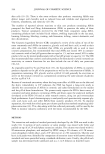
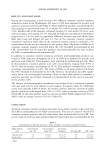
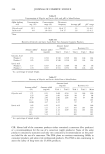
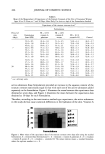
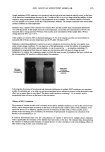
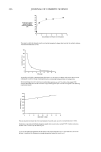
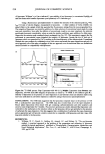
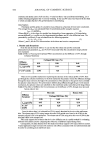
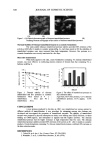
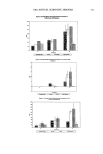
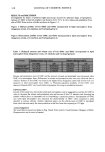
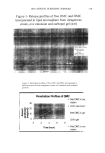
300 JOURNAL OF COSMETIC SCIENCE erythema and edema scores of all test sites. A value less then 2 was considered nonirritating, 2 to 5 mildly irritating and greater than 5 severely irritating. In our case PII value was found to be less than 2 which concludes that the CPA gel formulation is nonirritating. Data Analysis Penetration profiles (plots of cumulative mass released as a function of time) were constructed. The average flux•Ja,½) was calculated from the penetration profile using the equation J,,•= I/A dM/dt ] a,• (I) Where dM/dt [ •½ is the slope of a straight line obtained by a linear regression of M (cumulative amount diffused) rs. t profile over the experimental timeframe, and A is the diffusional area. The permeability coefficient P was calculated from the following equation P = J•,• / (Cd -- Cr)•,• (2) Where Ca and Cr are the CPA concentrations in the donor and receiver compartments. 3. Results and discussions From the data showed in Table 2 we can see that the release rate and the associated physicochemical parameters J•e, and P of CPA decreased when the concentration of gel polymer were increased. Table 2 Effect of Varying Gel (Carbopol 940) Concentrations on the Diffusion of CPA through Cellulose Membrane Carbopol 940 Conc. (%) Diffusion Parameter 0.10 0.20 0.40 J.ve (l•g/cm: h) 5.83 5.13 4.68 P x 10-: (cm/h) 13.90 7.45 6.90 There are two possible mechanisms explaining the decrease in the release profile of CPA from gel through the cellulose membrane. In the first mechanism the polymer resists the diffusion of drugs through the chain network the higher the concentration of the polymer in the gel the more crowded the polymer chains become. This phenomenon inhibits drug diffusion though the gel. In the second mechanism, the polymer chains are adsorbed on the membrane surface and obstruct the drug release. Table 3 The effect of Different Gel Concentrations on the diffusion of CPA through mice skin and human cadaver skin Mice skin I Human Skin Diffusion Parameter Carbopol 940 Conc. (%) 0.20 0.40 0.40 J.ve(pg/cm: h) 0.43 0.39 0.10 P x 10 '4 5.70 5.20 1.70 (cm/h) From the above data, it is indicated hat CPA is poorly absorbed in the mice skin and human skin. The release rates of CPA using human skin after 24 h period were found to be 0.20% in the receptor cell and 0.2% in the epidermis. The release rate of CPA using mice skin were 0.20% • the skin and 0.82% in the receptor cell. This study supports the evidence that the in vitro diffusion rate is a useful method for evaluating different formulations and for comparing the efficiency of different topical dosage form. Consequently, the data obtained from this study most likely support CPA topical delivery system. Topical application might overcome the systemic side effects associated with oral administration and be useful in combating male and female acne.

2002 ANNUAL SCIENTIFIC SEMINAR 301 References: I. Beth G. Goldstein, Practical Dermatology, 1997 46-47 2. F. Neumann, W. EIger, "The effect of a new antiandrogenic steroid, 6-Chloro-17-Hydroxy-lct, 2ct-Methylene-pregna-4, 6-Ddiene-3, 20 Dione Acetate (Cyproterone acetate) on the sebaceous glands &mice," J Invest Derre. 1966 46:56 I 3. A. Archibald, S. Shuster, "Bioassay of androgen using the rat sebaceous gland,"d. Endocr. !967 37:XXll 4. Cunliffe W. J., Shuster S., "The effect of topical cyproterone acetate on sebum secretion in patients with acne," Br. J Dermatol., 1969 81:200-201 5. Sciarra F., Toscano V., Concolino G., "Androgen: clinical applications," d. Steroid Blochem Mol Biol., 1990 37:349-362 6. James C. S., "Antiandrogen and hormonal treatment of ache," Dermatologic Clinics 1996 14:803- 811 7. C. Beylot, M. S. Doutre, "Oral contraceptives and cyproterone acetate in female acne treatment," Dermatology 1998 196:148-152 8. R.J. Scheuplein, "Mechanism &Percutaneous AbsorptionlI. Transient diffusion and the relative importance of various rates of skin penetration," J. !nvest. Dermatol. 1967 48:79-88 9. R.L. Bronaugh, R. F. Stewart, "Methods for in-vitro Percutaneous Absorption Studies VI. Preparation of the Barrier Layer," J. Pharm Sci., 1986 75:487-491 10• G. lmokawa, M. Hatton, .1. Invest. Dermatol., 1985 84:282
Purchased for the exclusive use of nofirst nolast (unknown)
From: SCC Media Library & Resource Center (library.scconline.org)