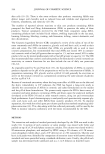
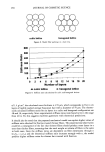
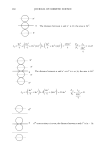
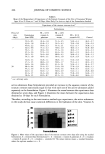
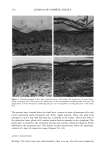
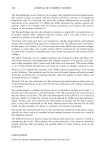
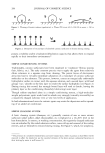
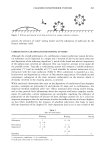
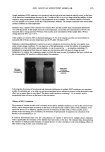
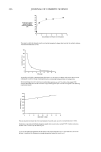
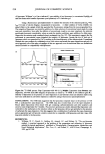
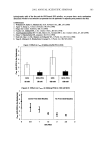
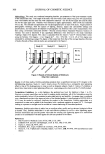
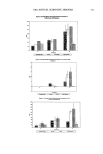
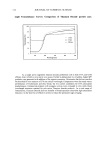
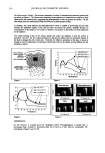
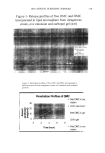
298 JOURNAL OF COSMETIC SCIENCE of liposomes. Williams' et al. have indicated 2 year stability of pro-liposomes (a concentrated lipid/glycol mix that forms multi-lamellar liposomes upon hydration) in 2% carbomer gel. Using a fluorescence spectrophotometer we studied the intensity of the emission peak ()•Ex=465, 3.Em=512 rim) of calcein (Sigma.) encapsulated in liposomes. A dilute solution of COC12 (10rnM) was added (50pl) to the sample (2ml) that quenched the fluorescence arising from the non-encapsulated dye. The integrity of liposomes was tested by addition of a dilute solution of conventional cream made by using non-ionic emulsifiers. Soon after the addition of conventional cream (a non-ionic emulsion), the emission peak height decreased considerably, where as under the similar conditions, upon addition of a dilute nano- dispersion, the emission peak remained almost unchanged (see Fig. 2C). This experiment suggests that the surfactants in conventional cream disturbed the integrity of liposomes, forcing the dye to leak out of liposomes which was quenched by COC12 resulting in decreased intensity of the emission peak. Formulating finished skin care products by combining actives with various surfactant-free nano-dispersions and gels is a novel approach one of the many advantages of this new approach over the traditional skin care formulation method includes its cofi•patibility with liposomes. St•blll• of Llpo•,m•t in C_dls i week s mooms [mc, c[ w/CarbemtaP•u• mc, c[ w/o CarbemcaP•u• ] Stability of Liposomes i •1 I:1%AMI00 j •o 2: nv tionlcream o $ to 15 •o 25 Figure 2A: 3,p NMR spectra: Top: Liposomes+AM 400 (1:1), Middle: Liposomes alone Bottom: nao- dispersion, AM 400 alone 2B: Integrity of liposomes as tested by 3'P NMR in two different gels 2C: Stability of liposomes in the presence of nano-dispersion or conventional cream (an emulsion made using non-ionic surfactants in convention manner) as studied by using a fluorescence spectrophotometer CONCLUSIONS: The NMR data suggested that the liposomes remained intact in the presence of AM 400, a surfactant-free nano-dispersion. The NMR data also revealed that all of the lipid remained in bilayer phase (liposomes) when mixed with gel containing carbomer/pemulen and other polymers and stored at room temperature for 8 months. Fluorescence spectroscopy studies indicated that liposomes were vulnerable to the surfactants in the emulsion where as the liposomes did not get perturbed in the presence of surfactant-free nano-dispersion. Our data suggests that a combination of surfactant-free nano-dispersions and an appropriate gel will provide a matrix system that is compatible with liposomes and that it may offer long term stability to the liposomes. REFERENCES: 1. Williams, W. P., Perrett, S., Golding, M., Amaud, J-P., and Michez, M. "The pro-liposome method: A practical approach to the problem of the preparation and utilization of liposomes suitable for topical applications" published in "Phospholipids: Characterization, Metabolism, and Novel Biological Applications", Eds. Cevc, G., and Paltauf, F., AOCS Press, Champaign, IL, 1995, pp.181-188

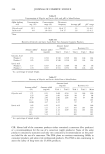
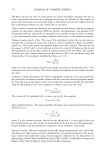
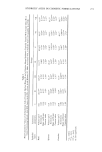
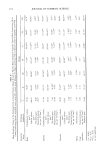
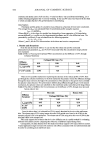
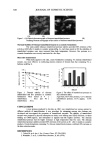
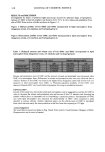
2002 ANNUAL SCIENTIFIC SEMINAR 299 CYPROTERONE ACETATE IN TOPICAL DELIVERY SYSTEM Zoia Lascu and Fotios M. Plakogiannis, Ph.D. Department of Cosmetic Science, College of Pharmacy, Long Island University, Brooklyn, NY 1.lntrod uction Cyproterone Acetate (CPA) is a potent steroidal antiandrogen with progestional activity. It is used alone or in combination with ethinyl estradiol or estradiol valerate in the treatment of women suffering from disorders associated with ache or hirsutism. It is known that CPA is effective when given orally. However, trials using topical CPA have not proved to be successful because of the lack of a suitable vehicle. Therefore, the objective of the present study is to develop a topical delivery system which is safe and easily administered onto the skin in a control way, thereby improving patient compliance and reducing systemic side effects, to examine the possibility of CPA preparation, which will provide a continuous dose over a 24-hour exposure. All of these will be accomplished by: 1) evaluating the diffusion profile (in vitro) of different CPA formulation through cellulose acetate membrane, freshly excised hairless mice skin and human cadaver skin 2) conducting a in vivo irritation test using rabbits 3) performing statistical analyses of the data using the t-test and one-way analysis of variances (ANOVA). 2. Methods A. CPA Gel Formulation CPA at 0. I% was incorporated into three different formulations, which were prepared by using Carbopol 940 (at 0. l, 0.2, 0.4%), propylene glycol, ethanol and water. (Table l) Table l- Composition of the CPA gels Ingredient formulation I formulation 2 formulation 3 Water 42.70 42.50 42. I 0 Carbopol 940 0. I 0 0.20 0.40 NaOH ( 10% sol) 0. I 0 0.20 0.40 Propylene glycol 47.00 47.00 47.00 Ethanol 10.00 10.00 10.00 CPA 0.10 0.10 0.10 CPA topical preparations need suitable vehicles to help improve diffusion rate through the skin. Propylene glycol and ethanol were used as co-solvents and enhancers in the system since they are safe and able to improve solubility of this hydrophobic compound at concentration of 0.10%. B. In Vitro Release Studies The in vitro release studies were carried out in Franz diffusion cells having a 15mm diameter and a 1.76 cm 2 diffusional area. Studies were performed using Spectra Por© 7 cellulose membranes, hairless mouse skin and human cadaver skin. The diffusion characteristics of CPA (0.10%) in different concentrations of Carbopo! at 0.10%, 0.2% and 0.40% were studied using the cellulose membrane as a screen. The data are shown in Table 2. On the basis of in vitro release studies conducted with Spectra Por© 7, the best formulation (0.40% Crabopol) of drug release from the cellulose membrane was selected for further diffusion studies using hairless mouse skin and human cadaver skin. The data are shown in Table 3. C. In Vivo Irritation In Vivo Irritation Test -Draize model - was conducted to assay the skin irritation when CPA formulation (0.40% Carbopol) has been applied on rabbits (24 h occlusion). A visual scoring system was applied to calculate the primary irritation index (PII). This is calculated by averaging the
Purchased for the exclusive use of nofirst nolast (unknown)
From: SCC Media Library & Resource Center (library.scconline.org)