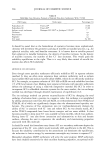
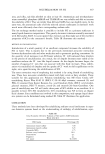
534 JOURNAL OF COSMETIC SCIENCE important for the evaluation of other attributes perceived by consumers, such as softness and gloss. Therefore, the results of subjective evaluations, which involve individual psychological and physiological differences (18,19), do not provide the necessary accu- racy to determine the level of hydration offered by hair products. Consequently, the assessment and quantification of water in hair by means of DSC and GC techniques become essential for substantiating the moisturizing properties of hair products in their development stage. CONCLUSIONS DSC is an effective technique for the evaluation of the thermal behavior of water in hair since it allows for determining the bonding strength of water to hair fibers. GC is a specific, sensitive, and accurate technique for the quantification of the water present in hair fibers. Sensory evaluations are inadequate for the assessment of the hydration levels provided by different cosmetic hair products. The association of DSC and GC techniques is appropriate, accurate, practical, and readily available, and yields accurate results for water content in hair. Because sensory evalua- tions have shown that consumer perceptions of moisturized hair are confused with other attributes that do not depend exclusively on hair fiber hydration, obtaining this type of analytical evidence is an essential requirement. ACKNOWLEDGMENTS The authors gratefully acknowledge the support provided by "O Boticirio" and the following Brazilian funding agencies: CNPq, CAPES, CEPID, FINEP, and FAPESP. REFERENCES (9) (10) (1) O. Freis, A. Charbonnelle, J. C. Audonneau, V. Gillon, and G. Pauly, Hair care active ingredients: Cosmetics properties and methods for evaluating their efficacy, www. sfc-online. com. (2) S. P. Chahal, N. I. Challoner, and R. T. Jones, Moisture regulation of hair by cosmetic proteins as demonstrated by dynamic vapor sorption: The novel efficacy testing technique, IFFCC Magazine, 3, 2 (2000). (3) J. H. Riedel, Use of modern efficacy tests for hair, Advances in Hair Research (IFFCC, 2000). (4) O.G. Marrisen, S. Grinnes, and E.S. Kongshaug, Ambient relative humidity and the electrical properties of human hair, Proc. Ann. Conf Eng. Med. Bid., 15 (1993). (5) J. L. Leveque, J. C. Garson, and G. Boudouris, Water in keratin: Electrical conductivity measurements, C.R. Acad Sci., D., 288, 22 (1979). (6) R. Drozdenko, C. Weinstein, and S. Weintein, Application of electrical hygrometric measures to the evaluation of hair moisturizing products, J. Soc. Cosmet. Chem., 43, 179-186 (1992). (7) C. R. Robbins, Chemical and Physical Behavior of Human Hair, 3rd ed. (Springer-Verlag, New York, 1994). (8) S. D. O'Connor, K. L. Komisarek, and J. D. Baldeschwieler, Atomic forces microscopy of human hair cuticles: The microscopic study of environmental effects on hair morphology,J. Invest. Dermatol., 105, 1 (1995). K. Martin, Near-Infrared reflectance for evaluation of chemical, physical and sensory properties of hair in the salon, IFSCC. P026 (1998). T.V. Marcelo, Application of a tensile-strength test method to the evaluation of hydrating hair products, Int. J. Cosmet. Sci., 20, 4 (1998).

HAIR FIBER HYDRATION 535 (11) J. Cao, Melting study of the o• form crystallites in human hair keratin by DSC, Thermodyn. Acta, 335 (1999). (12) F.J. Wortmann, C. Springob, and G. Sendelbach, Investigations of cosmetically treated human hair by differential scanning calorimetry in water, IFFCC. Ref 12 (2000). (13) S. Paterson, N. McLachlan-Troup, R. Cordero, M. Dohanal, and S. Carman, Qualitative screening for drug abuse in hair using GC-MS, J. Anal. Toxicol. 25, 3 (2001). (14) N. Tanada, S. Kashimura, M. Kageura, and K. Hara, Practical GC/MS analysis of oxidation dye components in hair fiber as a forensic investigative procedure,J. Forensic Sci, 44, 2 (1999). (15) P.S. Bonato, Introdug•o aos m•todos cromatogr•ficos [Introduction to chromatographic methods], 6th ed. (Ed Unicamp, 1995). (16) A. Agresti, Ed., Categorical data analysis (John Wiley & Sons, New York, 1990). (17) T. C. S. Dias, A. Donolato, and A. Gomes, Hidratag•o e proteg•o do cabelo & os silicones [Hair hydration and protection & silicones], Anais do Congresso ABC (2000). (18) J. Close, The concept of sensory quality, J. Soc Cosmet Chem., 45, 95-107 (1994). (19) L. Rigano, S. Sirigu, and S. Giogilli, Sensory evaluation in cosmetic fields: An overview, Cosmet. Toiletr. Manufac. Worldwide, 247-250 (1999).
Purchased for the exclusive use of nofirst nolast (unknown)
From: SCC Media Library & Resource Center (library.scconline.org)