147 Repairing Bleach-Damaged Hair
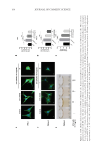
The specimens for the optical microscope were prepared in the following manner: the
natural hair, the bleached hair and chicoric acid, and the copper (II) chlorophyllin treated
bleached hairs, were cut to about 10mm in length. About 30 strands of the shortened
sample were then immersed in aqueous 5 M urea and warmed at 60°C for 1 hour. After
cooling to ambient temperature, 10 strands of the swollen sample were mounted parallel
to a microscope slide glass, where the medium was aqueous 5 M urea. No weight was
placed on the micro cover glass (22 mm × 22 mm thickness, 0.13–0.17 mm) (Matsunami
Glass, Osaka, Japan) while sealing the edges with UV Curable Urethane Acrylate
Oligomer (Mitsubishi Chemical, Tokyo, Japan) and irradiating with a 365 nm LED-light
for 3 minutes at ambient temperature.
MEASUREMENT OF SWELLING DEGREE OF HAIR FIBER
Various hair fibers (about 15mm in length) were warmed in aqueous 5 M urea solution at
60°C for 1 hour. The swollen fiber in the solution was kept at ambient temperature for
1 day, then gently placed on the slide glass with a cover glass using 5 M urea solution.
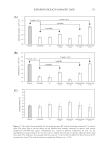
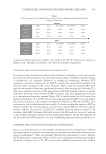
The cross-sectional length (Ls) was measured by means of the optical microscope using
the Plan ×20 objective lenses. The swelling degree (length−%) was calculated by 100×
(Ls − Ld) ÷ Ld, where Ld is the cross-sectional length of the fiber before swelling. 7
strands of the same hair sample were tested to average the swelling degree.
TENSILE TESTING OF HAIR SAMPLES
The polyphenol treated fibers (20–100 strands) were immersed in purified water for
12 hours, and then set in an ALS1500 +MTT690 automatic tensile tester (Dia-Stron,
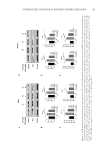
Hampshire, UK). Tensile measurement was performed at pulling speed of 3mm/min while
immersing the hair sample (30mm in length) in water. Under the testing condition, which
was similar to ones used previously,18,19 we experienced that the tensile data was obtainable
with small dispersion. 60 fibers per test cell (N =60, 3 persons, 20 fiber samples each)
were individually applied to the tests for estimating the mechanical properties (the breaking
stress, the breaking extension, and the elastic modulus in the initial pilling stage). The
breaking stress (J/m3) applied to breaking total work (J) per the volume of sample hair ((d
÷ 2)2 × π × L
0 ).In the denominator, d is an average value of a hair diameter at 5 points as
measured with a laser contour measuring device (FDAS770, Dia-Stron Hampshire, UK).
L
0 is the initial hair length.The breaking extension (%)is given by 100 × (L – L
0 )÷ L
0 ,
where L is the breaking length of hair specimen. The initial elastic modulus (J/m3) was the
Hookean slope of at the 3% extension.
RESULTS AND DISCUSSION
POLYMERIZATION OF THE POLYPHENOL TREATED PROTEINS
This study was first conducted to examine an action of various kinds of polyphenols
(0.9 mM) on lysozyme (0.28 mM, MW: 14,300), a model protein, in the presence of a
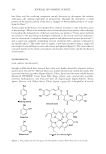
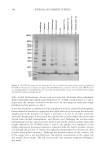
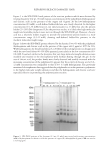
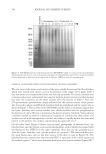
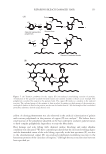
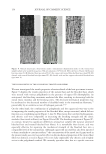
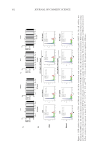
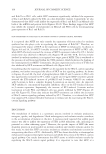
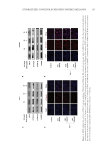
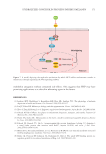
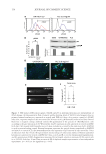
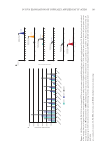
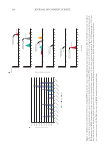
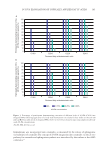
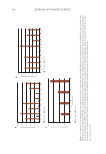
catalytic concentration (4 ppm) of copper (II) chlorophyllin (Figure 1). Figure 2 shows
the SDS-PAGE pattern of the reaction mixtures. When the model protein was treated
The specimens for the optical microscope were prepared in the following manner: the
natural hair, the bleached hair and chicoric acid, and the copper (II) chlorophyllin treated
bleached hairs, were cut to about 10mm in length. About 30 strands of the shortened
sample were then immersed in aqueous 5 M urea and warmed at 60°C for 1 hour. After
cooling to ambient temperature, 10 strands of the swollen sample were mounted parallel
to a microscope slide glass, where the medium was aqueous 5 M urea. No weight was
placed on the micro cover glass (22 mm × 22 mm thickness, 0.13–0.17 mm) (Matsunami
Glass, Osaka, Japan) while sealing the edges with UV Curable Urethane Acrylate
Oligomer (Mitsubishi Chemical, Tokyo, Japan) and irradiating with a 365 nm LED-light
for 3 minutes at ambient temperature.
MEASUREMENT OF SWELLING DEGREE OF HAIR FIBER
Various hair fibers (about 15mm in length) were warmed in aqueous 5 M urea solution at
60°C for 1 hour. The swollen fiber in the solution was kept at ambient temperature for
1 day, then gently placed on the slide glass with a cover glass using 5 M urea solution.
The cross-sectional length (Ls) was measured by means of the optical microscope using
the Plan ×20 objective lenses. The swelling degree (length−%) was calculated by 100×
(Ls − Ld) ÷ Ld, where Ld is the cross-sectional length of the fiber before swelling. 7
strands of the same hair sample were tested to average the swelling degree.
TENSILE TESTING OF HAIR SAMPLES
The polyphenol treated fibers (20–100 strands) were immersed in purified water for
12 hours, and then set in an ALS1500 +MTT690 automatic tensile tester (Dia-Stron,
Hampshire, UK). Tensile measurement was performed at pulling speed of 3mm/min while
immersing the hair sample (30mm in length) in water. Under the testing condition, which
was similar to ones used previously,18,19 we experienced that the tensile data was obtainable
with small dispersion. 60 fibers per test cell (N =60, 3 persons, 20 fiber samples each)
were individually applied to the tests for estimating the mechanical properties (the breaking
stress, the breaking extension, and the elastic modulus in the initial pilling stage). The
breaking stress (J/m3) applied to breaking total work (J) per the volume of sample hair ((d
÷ 2)2 × π × L
0 ).In the denominator, d is an average value of a hair diameter at 5 points as
measured with a laser contour measuring device (FDAS770, Dia-Stron Hampshire, UK).
L
0 is the initial hair length.The breaking extension (%)is given by 100 × (L – L
0 )÷ L
0 ,
where L is the breaking length of hair specimen. The initial elastic modulus (J/m3) was the
Hookean slope of at the 3% extension.
RESULTS AND DISCUSSION
POLYMERIZATION OF THE POLYPHENOL TREATED PROTEINS
This study was first conducted to examine an action of various kinds of polyphenols
(0.9 mM) on lysozyme (0.28 mM, MW: 14,300), a model protein, in the presence of a
catalytic concentration (4 ppm) of copper (II) chlorophyllin (Figure 1). Figure 2 shows
the SDS-PAGE pattern of the reaction mixtures. When the model protein was treated