153 Repairing Bleach-Damaged Hair
yellow. A coloring phenomenon was also observed in the artificial sclerotization of gelatin
with various polyphenols in the presence of copper (II) ion catalysis.12 We believe that a
small portion of the polyphenol adsorbed on the hair underwent oxidative polymerization
to form complex polyphenolic byproducts to stain the fiber shafts.
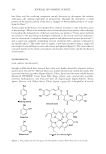
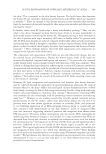
Hair damage and scale lifting with chemical oxidize bleaching and under alkaline
condition were discussed.1 We have currently speculated that the decreased swelling degree
and the diminished extent of the scale lifting, especially in the hair specimen (V), was due
to the aforementioned copper (II) ion-catalyzed polyphenol-crosslinking reaction in the
keratinous proteins of the cuticular cell regions,23 although the exact reaction sites have not
been specified yet.
(A)
HO
HO
O
O
N H
2
Protein
O
2 Cu 2+
H
2 O
O
HO
NH
H
*
O
2 Cu 2+
H
2
O
*
O
O
NH
SH
O
O
NH
S
Catechol representing
polyphenols
Quinone form
Quinone-Crosslinked Keratin
(B)
S
HO
O
O
OH
O
O
O
O
O
O
O
N
N
HN
S
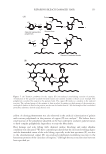
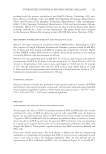
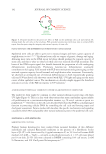
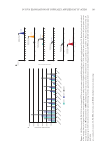
Figure 7. (A) Tentative pathways for the copper (II) ion-catalyzed cross-linking reaction of proteins.
A formation of the quinone-crosslink between lysine and cysteine residues is shown as an example. The
polyphenol is oxidized by oxygen to the quinone form. The copper (II) works as a catalysis in the oxidized
reaction. The carbonyl group of the quinone is then attacked by amines or thiol groups of the protein in a
nucleophilic fashion to bind to the protein see the text for further details.12 (B) An example of the crosslinked
proteinous substance derived using chicoric acid.
yellow. A coloring phenomenon was also observed in the artificial sclerotization of gelatin
with various polyphenols in the presence of copper (II) ion catalysis.12 We believe that a
small portion of the polyphenol adsorbed on the hair underwent oxidative polymerization
to form complex polyphenolic byproducts to stain the fiber shafts.
Hair damage and scale lifting with chemical oxidize bleaching and under alkaline
condition were discussed.1 We have currently speculated that the decreased swelling degree
and the diminished extent of the scale lifting, especially in the hair specimen (V), was due
to the aforementioned copper (II) ion-catalyzed polyphenol-crosslinking reaction in the
keratinous proteins of the cuticular cell regions,23 although the exact reaction sites have not
been specified yet.
(A)
HO
HO
O
O
N H
2
Protein
O
2 Cu 2+
H
2 O
O
HO
NH
H
*
O
2 Cu 2+
H
2
O
*
O
O
NH
SH
O
O
NH
S
Catechol representing
polyphenols
Quinone form
Quinone-Crosslinked Keratin
(B)
S
HO
O
O
OH
O
O
O
O
O
O
O
N
N
HN
S
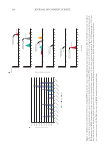
Figure 7. (A) Tentative pathways for the copper (II) ion-catalyzed cross-linking reaction of proteins.
A formation of the quinone-crosslink between lysine and cysteine residues is shown as an example. The
polyphenol is oxidized by oxygen to the quinone form. The copper (II) works as a catalysis in the oxidized
reaction. The carbonyl group of the quinone is then attacked by amines or thiol groups of the protein in a
nucleophilic fashion to bind to the protein see the text for further details.12 (B) An example of the crosslinked
proteinous substance derived using chicoric acid.