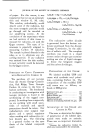
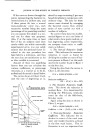
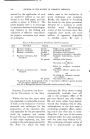
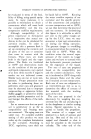
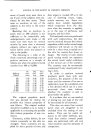
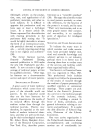
MECHANISMS AND EVALUATION OF ANTISEPTIC ACTIONS 297 amounts of appropriate anions or cations is often the key to enhanced activities or precipitations. The suitability of each procedure is con- ditioned by the actual application, but various attacks are available if the general colloidal principles be applied. Assuming the availability of effective antiseptics and the appro- priate systems from which they will be adsorbed on bacteria, the next step is to discover just how well these chemicals do their job. It is not at all clear that the regularly followed bacteriological procedures give any adequate answer to this fundamental problem. If good antiseptics are strongly and essen- tially irreversibly adsorbed on bacteria, it follows that no amount of washing or dilution will remove the antiseptic, and that inhibitory effects will persist through the usual tests to give false negative results. Only if such an antiseptic be specifically attacked by an appro- priate chemical will its effect be neutralized and the organism be capable of growing. In 1948 we published (2) a paper concerning surgical catgut inoculated with four different organisms and tubed (without the usual heat sterili- zation) in 76 per cent isopropanol, 20 per cent ethanol, and 0.025 per cent phenylmercuric benzoate. When tested without neutralization, eleven out of 24 tubes showed no growth in the oflScial fifteen days, no tube showing growth in less than eleven days. When tested by the then oflScial U.S.P. thiosulfate- carbonate neutralization, there was considerable delay in growth, and three of the tubes showed no growth in 15 days. Strands neutralized in a thioglycolate-carbonate bath or transferred directly to a medium containing sodium thioglycolate all showed growth promptly. In earlier days catgut was treated with iodine, hypochlorite, and other oxi- dizing agents for which thiosulfate was appropriate the thioglycolate media had previously demonstrated their effectiveness against mercu- rials, so that such solutions were adopted for U.S.P. XIII. Thio- glycolate media are appropriate so long as most sutures are tubed with mercurials, but would not necessarily be effective against some other antiseptics, and it is highly desirable that reliable neutralization techniques and criteria be evolved and validated. The work just de- scribed led us to a more extensive scrutiny of the mechanism by which antiseptics produce their effects. It is not necessary to go into much detail on this but a listing of the more obvious reactions is justifiable: TABLE 1--MECHANISMS OF ANTISEPTIC ACTION 1. Protoplasm coagulation--by heat and some chemicals 2. Poisoning of enzyme systems in bac- teria-probably most general 3. Modification of cell membrane perme- ability-especially by surfactants Although mercury compounds can coagulate protoplasm, the fact that they show their effects at such extreme dilutions suggests that such

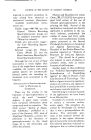
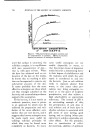
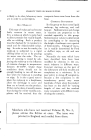
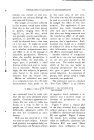
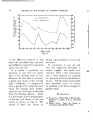
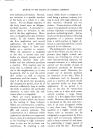
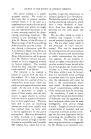
298 JOURNAL OF THE SOCIETY OF COSMETIC CHEMISTS effects belong in the second class. The permeability influence appears relatively new and may justify more extended study as a bactericidal technique (3). neutralize the antiseptic, you cannot get growth started again. Then, and only then, does it appear you are justified in applying the terms "sterile" and "bactericidal." In / i ANTISEPTIC CONCENTRATION Figure 2.--Relation between antiseptic concentrations and effects on bacterial growth. Criteria of sterility. In Fig. 2 is shown a scheme believed to be generally applicable for the study of antiseptic actions. This suggests that when all other conditions are maintained constant, as the concentration of the anti- septic in a series of medication tubes is increased there is first an exci- tation of growth, then a gradual reduction in plate counts, and then plates showing no colonies. If one chooses the correct chemical, either as a separate intermediate neutral- izing bath or as a component of the culture medium, it will be found that organisms so treated can be "revived." Finally with increasing concentration of antiseptic, there will be found systems in which, even though you know how to 1948 we outlined (2) five steps by which any investigator can assure himself and his market as to just what his antiseptic can do--the problem being one in which by successive approximation one fixes the concentration designated as the range between bacteriostasis and bactericidal effects. Again I want to point out that the above is not merely an academic problem but is intimately related to life and death. In 1948 Dr. Morton (4) showed that hemolytic strepto- cocci treated with any of the three most popular mercurials showed no growth in blood broth media (lacking neutralizers) but did kill many of the mice into whose abdominal cavities the organism-
Purchased for the exclusive use of nofirst nolast (unknown)
From: SCC Media Library & Resource Center (library.scconline.org)