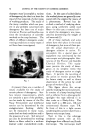
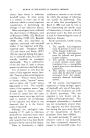
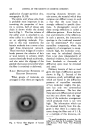
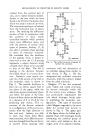
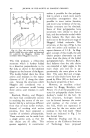
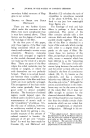
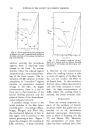
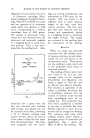
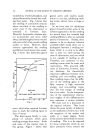
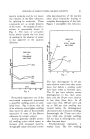
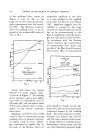
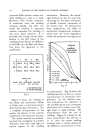
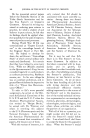
102 JOURNAL OF THE SOCIETY OF COSMETIC CHEMISTS Fig. 4.--Top, the primary stage of the doubly folded structure which was proposed for a-keratin by Huggins. Bottom, the secondary fold of Huggins' structure. This fold produces a ribbon-like structure which is further folded in a direction perpendicular to its flat side, as shown in the idealized diagram at the bottom of the figure. This doubly-folded chain has three amino acid residues in the repeat distance of 5.1 • along the chain axis. Among the structures which Huggins also considered was a spiral or corkscrew model having three amino acid residues in each turn. Barnford, Hanby, and Happey (6) have had considerable success in studying the nature of the mo- lecular fold by a technique different from that of most earlier workers. Instead of working with native proteins, they have prepared a number of synthetic polypeptides. These materials can be made from a single amino acid, so that the side chains are all alike. This greater regularity in constitution makes it possible for the polypep- tide to attain a much more nearly crystalline arrangement than is possible in most native keratins, and more x-ray evidence of the mo- lecular structure can be obtained. Some of their polypeptides have structures very similar to that of hair, and the molecular model which they believe fits their data best turns out to be the primary stage of Huggins' folded molecule. This structure, at the top of Fig. 3, has only two amino acid residues in a repeat distance of 5.1 ill. In Hug- gins' concept of this model, the side chains project alternately up and down from the plane of the folded polypeptide chain. However, Barn- ford believes that the side chains are extended at right angles to the main chain axis and lie in ap- proximately the same plane as the fold. The same fold and arrange- ment of side chains have been pro- posed by Zahn (30) on the basis of the elastic properties of hair. However, an excellent critical review by Bragg, Kendrew, and Perutz (7) of all the possible struc- tures for polypeptide chains favors Astbury's model for the fold. In this structure, hydrogen bonds can be formed between the amino acid residues at the corners of the fold, which are separated in each case by the two amino acid residues in the fold itself. These bonds are indicated in Fig. 2 by the dotted lines. Recently Pauling and his as- sociates at the California Institute of Technology have proposed

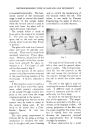
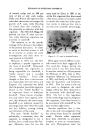
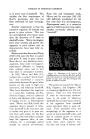
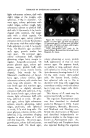
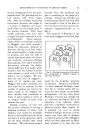
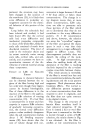
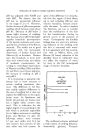
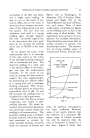
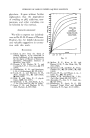
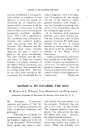
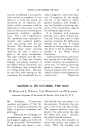
DEVELOPMENTS IN STRUCTURE OF KERATIN FIBERS 103 several configurations for the poly- peptide chain (24), including one for hair keratin (23). They began their study by carefully measuring interatomic distances and angles in a number of peptides and amino acids which are the simple units of the protein molecule. With these simple molecules, they were able to apply the exact methods of x-ray crystallography. (Some measure- ments of this sort had been available to Huggins 'and other workers.) Using the dimensions obtained in this way and the x-ray data which had accumulated for a large number of proteins, and with the help of certain hypotheses about the neces- sary molecular symmetry, Pauling has proposed a new spiral model for the keratin molecule. Its funda- mental difference from earlier spiral models is that the number of amino acid residues in each turn of the spiral is not an integral. For nor- mal hair and wool he suggests a spiral of 3.7 residues per turn. Huggins had earlier remarked (17) that there was no necessity for the number of residues per turn in his spiral model to be integral, but most workers had continued to think of spiral models in terms of an integral number of amino acid residues per turn. Pauling conceives of wool and hair keratin molecules as having a spiraling backbone of amino acid residues, each linked by hydrogen bonds to the residues directly above and below it in the spiral, but which are the third residues away along the chain. The side chains project laterally from this backbone and give it something of the shape of a cylinder. These long cylinders are closely packed side by side with their axes parallel to that of the fiber so that the final structure may be rep- resented diagrammatically as in Fig. 4. This proposal of Pauling's is the most recent suggestion that has been Fig. 5.--Pauling's conception of the molec- ular arrangement in ordered regions of a-keratin materials. made for the molecular structure of a-keratin. Barnford and Hanby (5) have disputed Pauling's claim that his 3.7 residue spiral will ac- count for their results on synthetic polypeptides. On the other hand, Pauling's structure has already led to a discovery by Perutz (26) of an important x-ray reflection which had been completely overlooked in previous keratin fiber studies. It is probably too soon to decide whether Pauling's structure is more nearly true than that of Astbury or than the primary fold of Huggins which has been supported by Barn- ford however, it is clear that the
Purchased for the exclusive use of nofirst nolast (unknown)
From: SCC Media Library & Resource Center (library.scconline.org)