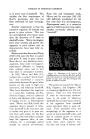
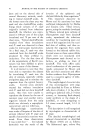
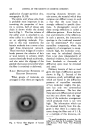
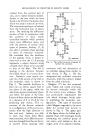
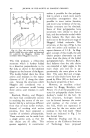
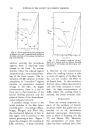
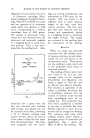
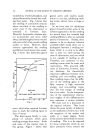
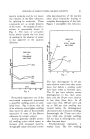
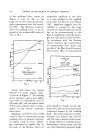
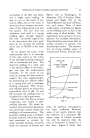
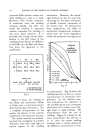
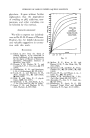
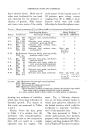
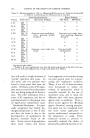
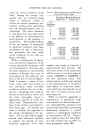
112 JOURNAL OF THE SOCIETY OF COSMETIC CHEMISTS morpholine, triethyl phosphate, and ethanolformamide showed less swell- ing than water. Fig. 2 shows that the swelling of acetonitrile remains about one-third of the swelling in water even if the observation is extended to fourteen days. Dimethyl formamide, ethylene gly- col monomethyl and mono ethyl ether, diethylene glycol mono methyl and mono ethyl ether caused swelling similar to water. However, these solvents approached the swelling equilibrium much slower than water. Fig. 3 shows that diethylene glycol ,.9 I I I 3 T 14 34) •g. $ mono ethyl ether required fourteen days to reach the swelling equal to that of water. The third group finally is com- prised of solvents which gave swelling stronger than water. Acids and some of the amines were in this group. Figure 7 shows that glacial acetic acid reaches equili- brium in one day, exhibiting swell. ing action almost twice as large as water. As we have seen for diethylene glycol monoethyl ether some of the solvents appeared to be less swelling for several days, but revealed high swelling efficiency after an extended period of immersion. Indeed, there appears to be no absolute criterion available which would allow one to distinguish between a swelling me- dium which is so slow in its effect that it does not swell during the time of observation, and one which is not capable of swelling at all. Therefore, any statement of non- swelling nature must be made with reservations. This practical diffi- culty of distinction, however, does not eliminate the theoretically important difference between slow- swelling and non-swelling agents. Slow swelling means that the diffu- sion of the swelling agent in the fiber requires a high activation energy, and non-swelling means that the free energy of swelling has a low value. In the interpreta- tion of the experi/nental observa- tions neglect of this differentiation may represent a serious mistake. We come now to a discussion of the aqueous solution. They have shown the same variety of behavior as the undiluted solvents, but with the exception of the amines and acids, to a lesser degree. Some of the solvents diminished the extent of swelling. This is to be expected for those compounds which do not exert attractive forces toward the

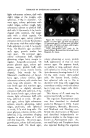
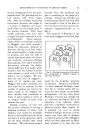
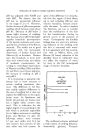
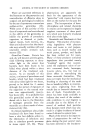
SWELLING OF HAIR IN MIXED AQUEOUS SOLVENTS 113 keratin molecule and do not lessen the cohesion of the fiber substance by splitting its molecules. These compounds act as simple diluents of the water. An example of such a solvent is acetonitrile shown in Fig. 2. The lack of attractive forces which caused the low level of swelling in the absence of water is also apparent in the aqueous dilutions. 5WF=LLINCt IN I:ORMAMID• SOLUTION5 Formamide represents one of the non-ionized compounds possessing a powerful swelling action in undi- lured form. Fig. 4 shows that all of its solutions cause higher swelling than water (in spite of the probable extraction of some of the fibrous substance by solvent action). Amines generally exhibit power- ful swelling action which seems to increase with increased basicity. At high pH values obviously irrever- sible decomposition of the keratin takes place frequently leading to complete disintegration of the hair. Figure 5 exemplifies this behavior. The hair disintegrates in 10 per cent solution some time after seven days, but before a reading could have been taken at fourteen days. The 25 per cent solution causes disintegration in less than seven days and the 50 per cent solution in less than three days. In all cases more than 100 per cent and up to 340 per cent swelling was noticed before the disintegration advanced too far to measure swelling. Interestingly the 72 per cent solu- tion, while also strongly swelling, did not lead to disintegration even after fourteen days. Triethanolamine represents a weaker base. The low swelling
Purchased for the exclusive use of nofirst nolast (unknown)
From: SCC Media Library & Resource Center (library.scconline.org)