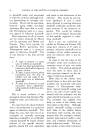
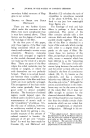
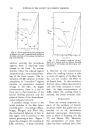
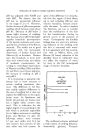
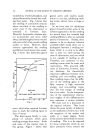
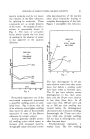
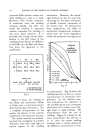
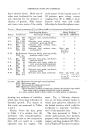
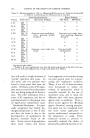
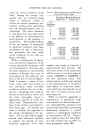
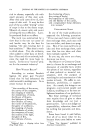
114 JOURNAL OF THE SOCIETY OF COSMETIC CHEMISTS of the undiluted base, shown by Figure 6 may be due to the large size of the molecule, prevent- ing its penetration into the unswol- len fiber. The dilutions, however, show the swelling action to be ex- pected at the attained pH values of 11.5 to 12.5. ,SWELLING- IN I•TI-I A, klQLA, MI N re. &OLUT•ON$ ß -- -- .... loo 7, T 14 $0 • F•g, 6 Acetic acid shows the typical behavior of weak organic acids, as shown on Figure 7. Its swelling action appears a great deal higher than that of hydrochloric acid of the same pH, and the gentle slope of the curves indicate that no serious attack on the keratin molecules takes place. Speakman and Stott (9) in 1934: were the first to observe the strong swelling action of aqueous solutions of organic acids on wool. Speak- man attempted to explain this on the basis of the Donnan theory of membrane equilibria in the form as it was applied to the swelling of proteins by Proctor and Wilson (10). Speakman suggests that the swelling is caused by the large amount of undissociated acid which has to be accommodated in the fiber in equilibrium with the hydro- gen ions and anions inside the fiber. In accordance with the Donnan theory however, the concentration of undissociated acid inside and outside of the fiber should be equal. The osmotic effect of undissociated SWELLING IN ACgTIC ACID SOLUTIONS ?s• 1,1.1 o.B acid, therefore, should not be dif- ferent from that of anyundissociated compound present in the swelling bath. Since the presence of undis- sociated acid reduces the activity and the vapor pressure of the water, it should reduce its swelling action. Nevertheless undissociated acid like any other dissolved compound might

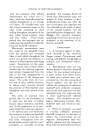
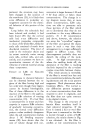
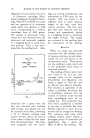
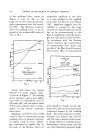
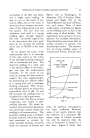
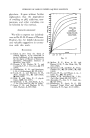
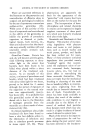
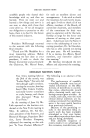
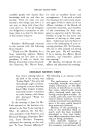
SWELLING OF HAIR IN MIXED AQUEOUS SOLVENTS 115 accumulate in the fiber and there- fore it might cause swelling. It does so, not as the result of any osmotic effect, but as the result of attractive forces between the mole- cules of the undissociated acid and the keratin. The fact that the anhydrous acid itself is a strong swelling agent strongly supports this view. (A further support lies in the observation that some weak bases do not increase the swelling above that of NaOH of the same pH). In our opinion the action of the undissociated acid is in principle of the same nature as the action of any hydrogen bonding compound such as formamide and urea. The observed swelling of a weak acid is the additive effect of the hydro- gen ions plus the undissociated molecules. In the course of our study an attempt has been made to support this view experimentally, by determining the additive effect of a strong acid and a hydrogen bonding compound. With $0 per cent ethylene glycol, we found that hydrochloric acid of pH 1.9 and 0.8 increased the swelling twice as strongly than it did in pure water. Neutral salts, like the un-ionized compounds, vary widely in their swelling behavior. We found for instance, that ammonium phosphate and ammonium aceraCe reduce the swelling in all concentrations. The powerful swelling action of lithium bromide solutions, which have been used previously as solvents for water insoluble 15roteins, attracted lately the attention of Sookne and Harris (11) in Washington, P. Alexander (12) of London, Ham- braeus and Steele (13) of the Textile Research Institute of Prince- ton, and others. None of these authors gave comprehensive figures on the swelling action on hair of the whole series of alkali halides. Our experiments were carried out to com- plement the available information. Time limitations necessitate that we confine ourselves to present only the principal results. The observa- tion of strong swelling action of concentrated lithium bromide solu- 1011 40 •0 •O $W•LL•NG / IN •.•t-- 60 7. (wT/vo•.) " WAT g: I•, I I I i 3 7 •4 •o Fig. 8 tions, by previous investigators, has been confirmed. However, some of our results indicate that the existence of a maximum effi- ciency range of lithium bromide can only be observed when the time of immersion is limited to a few days. Figure 8 shows that
Purchased for the exclusive use of nofirst nolast (unknown)
From: SCC Media Library & Resource Center (library.scconline.org)