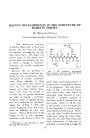
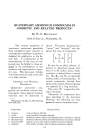
QUATERNARY AMMONIUM COMPOUNDS IN COSMETIC AND RELATED PRODUCTS* By W. E. BOTWRIGHT Rohm & Haas Co., Philadelphia, Pa. THE VmQVE properties of quaternary ammonium germicides have stimulated much research to evaluate their usefulness in products designed for application to the hu- man skin. A consideration of the characteristics of this class of com- pounds may be helpful to those en- gaged in the development of new products and improvement of pres- ent ones. This discussion includes only those materials used on the skin or in body cavities. CHEMICAL AND PHYSICAL PROPERTIES Quaternary ammonium com- pounds are synthetic cationic wet- ting agents whose general chemical structure may be illustrated as * Presented at the May 15, 1952, Meeting, New York City. shown. The terms "quaternaries," "quats," and "cationics" also des- ignate this class of compounds. R1-- 1•4--Ra] X R4 _l R• may be an alkyl, alkenyl, al- kylaryl or alkaryloxy group, with from 8 to 20 carbon atoms, either synthetic or derived from a natural fat. R2, R3, and R4 are generally methyl, ethyl, or benzyl groups. In certain compounds, derived from heterocyclic amines, the latter groups are replaced by a ring structure. The anion (X)- is generally chlo- ride or bromide. Thousands of compounds have been described in the literature. However, the following are most generally used at the present time. Trade Name 1. Ceepryn 2. Cetab 3. Hyamine 10-X 4. Hyamine 1622 5. Hyamine 2389 6. Zephiran Chemical Name cetyl pyridinium chloride cetyl trimethyl ammonium bromide di-isobutyl cresoxy ethoxy ethyl dimethyl benzyl ammonium chloride di-isobutyl phenoxy ethoxy ethyl dimethyl benzyl ammonium chloride alkyl (C0to C•a) tolyl methyl trimethyl ammonium chloride alkyl (CsH• to C•sH•) dimethyl benzyl ammonium chloride 118 '

AMMONIUM COMPOUNDS IN COSMETIC AND RELATED PRODUCTS 119 A more complete list of com- pounds and their trade names may be found in a monograph by Law- rence (1). Several are listed in the "U. S. Pharmacopeia" and in "New & Non-OfFicial Remedies" (2, 3). The first four of these products are pure compounds and are avail- able as crystalline powders the last two are mixtures which cannot be crystallized and are therefore sold as concentrated aqueous solutions. These compounds are stable salts of strong acids and strong bases they are neither volatile nor af- fected by light or temperature ex- tremes. They are very soluble in water, the lower alcohols, and gly- cols. Solubility in hydrocarbons is rather limited. Quaternary ammonium germi- cides are surface-active. This prop- erty assists them to contact and kill organisms which are embedded in surface films and in cracks and crevices. In aqueous solution, they ionize to an organic cation and a halide anion (4). Anion-active com- pounds, such as soaps, anionic sur- factants, some complex phosphates and silicates, and acidic dyestuffs re- act with the cation to form insoluble compounds. Thus, antimicrobial activity may be reduced by removal of the germicidal cation from solu- tion. However, these complexes dis- sociate to provide varying degrees of antiseptic activity depending on their solubility. For example, about ten equivalents of soap are necessary for complete inactivation. Under certain test conditions, such metallic ions as calcium, magnesium, iron, and aluminum interfere with germicidal action. However, some products containing high concentra- tions of iron and aluminum salts have shown good activity. De- tailed information on compatibility may be obtained from the basic manufacturers of these products. The positive quaternary cation is adsorbed by many surfaces, such as cellulose, glass, and ceramics. This property is utilized to confer anti- septic properties to baby diapers and other cotton fabrics which pref- erentially adsorb the germicide from solution. Quaternaries are loosely adsorbed by certain mate- rials such as clay and calcium car- bonate. Antibacterial effectiveness is generally decreased, but such combinations may act as a reservoir for the germicide, releasing it slowly into the surrounding medium. ANTIMICRO BIA L ACTIVITY Many workers have investigated the physical and chemical aspects of the reaction between quaternary ammonium compounds and the bacterial cell in an effort to elucidate the mechanism of antimicrobial ac- tion. Among the effects observed is the alteration of the permeability of the cell wall with release of cell contents into the surrounding medium. Vi- tal enzyme reactions are inhibited, and there appears to be a correlation between enzyme sensitivity and kill- ing of various species of organisms. Inhibition and killing of the cell is proportional to the germicide-or- ganism ratio rather than to the
Purchased for the exclusive use of nofirst nolast (unknown)
From: SCC Media Library & Resource Center (library.scconline.org)