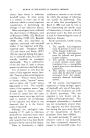
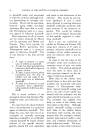
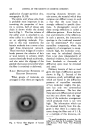
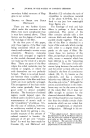
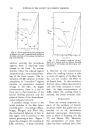
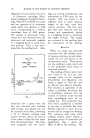
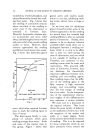
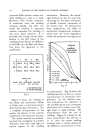
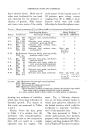
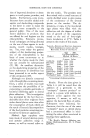
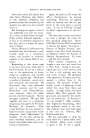
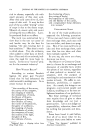
110 JOURNAL OF THE SOCIETY OF COSMETIC CHEMISTS 100 grams of total solution (wt./wt.) A laboratory centrifuge (Clay- Adams Safeguard Standard Centri- fuge, Model CT-1130/D) was used, and was operated at its maximum speed which was checked at 2740 r.p.m. corresponding to a relative centrifugal force of 1042 grams. The sample of previously condi- tioned hair was removed from the desiccator and accurately weighed in a weighing bottle to avoid mois- ture pick-up. Then it was intro- duced into the swelling bath. After _J •o SWEL LING IN 14YbROC14LO•3C ACIb ANb SOblUI4 H¾1)I•OXIDE • 14 DAYS DA'fS MYD•OCULORiC ACID l z • 4 s 6 T 8 g •o 11 1Z B 14 Fig. 1 immersion for a given time the hair was removed with stainless steel forceps, and placed into 50- ml. stainless steel tubes, containing a 32 X 32-mesh stainless steel strainer 30 mm. above the bottom of the tubes to keep the hair apart from the drained liquid. The tubes were stoppered and the centri- fuge was started immediately, and maintained at 2740 r.p.m. for ten minutes. This was found to be sufficient time to reach constant weight of the hair, even with viscous solutions. The hair sam- ples were then removed with dry forceps and immediately placed in a weighing bottle to determine the weight increase. The sample was returned to the swelling bath for continuation of the swelling. RESULTS While our study was primarily concerned with the swelling action of aqueous solutions, we also deter- mined the two end points of the concentration curve. These points are the swelling in pure water and in the undiluted liquid solute or saturated solutions. The swelling of hair in pure water was found to be 31.1 per cent (average value of two samples). Chamberlain and Speakman (3), found a regain of 31.18 per cent at 100 per cent relative humidity. The closeness of agreement of the values is probably fortuitous, but it nevertheless indicates that the amount of external water retained after centrifuging must be ex- tremely low. It is noteworthy that with water, equilibrium is reached in one day or probably less time. Further exposure to water for two months did not change the swelling. This contrasts with some other swelling systems which require a prolonged period of immersion for equilibrium. Fig. 1 shows the effect of pH on the swelling. The

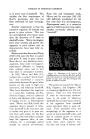
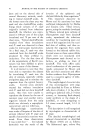
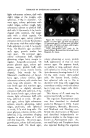
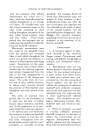
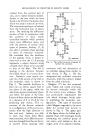
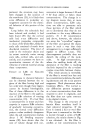
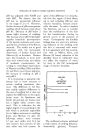
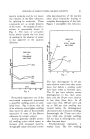
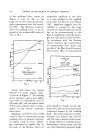
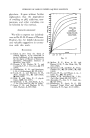
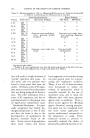
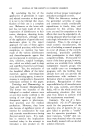
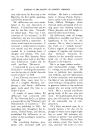
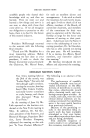
SWELLING OF HAIR IN MIXED AQUEOUS SOLVENTS 111 pH was adjusted with NaOH and with HC1. We observe that the pH has no perceivable influence in the range of 2 to 9. However, further increase of pH causes greater swelling which becomes steep above pH 10. Decrease of pH below 2 causes slight increase of swelling. The increase above pH 10 probably signifies hydrolyric decomposition of the keratin molecule, and conse- quently loss of cohesion of the fibrous material. The results are in good agreement with the microscopic observation of Jordan Lloyd and Marriott (4) on horsehair. Human hair, like horsehair, is more inert than wool toward acids and alkalis of moderate concentration. Ac- cording to centrifugal observations of Meunier and Rey, EliSd and Silva (5) and Stott, wool shows apprecia- ble increase of swelling at pH 2 and pH 9. It is interesting to speculate why human hair is more resistant to certain swelling treatments than wool. The difference in the fine- ness readily explains differences in the rate of swelling but it does not explain the differences in the equili- brium state. As Speakman and Smith (6) pointed out human hair has a higher sulfur content than wool. This is indicative for the higher degree of cross-linking in the hair which is probably responsible for its higher resistance to swelling. Jones and Mechan (7) give the following values: wool contains 3.7 per cent sulfur and 11.4 per cent cystine hair contains 4.7 per cent sulfur and 16.6 cystine. In spite of this difference it is remarka- ble that the regain of both fibers, up to and including 100 per cent relative humidity, remains practi- cally the same. In order to explain this behavior, one has to consider that the stabilization of the hair by the keratinization during its growth occurs in the presence of water. Consequently the disulfide linkage does not exert any restrain- ing influence on the swelling until the hair is saturated with water. It is in agreement with this assump- tion that as Mellon, Korn, and Hoover (8) found, reduction of the disulfide bond to sulfhydryl does not affect the sorption of water' by wool in the full investigated range of relative humidity. $W•.LLIN G IN ACc-TONITRIL•- $OLUT ION S WAr F. R DAYS I I I I T 14 30 60 The undiluted solvents exhibited a wide variety of swelling behavior. Acetonitrile, glycerol, N-acetyl-
Purchased for the exclusive use of nofirst nolast (unknown)
From: SCC Media Library & Resource Center (library.scconline.org)