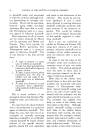
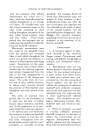
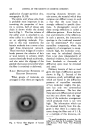
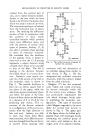
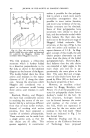
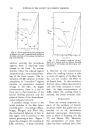
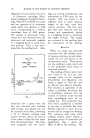
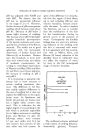
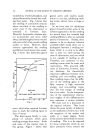
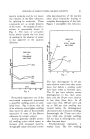
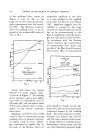
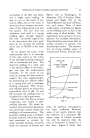
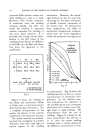
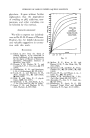
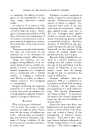
106 JOURNAL OF THE SOCIETY OF COSMETIC CHEMISTS ,6[ 0 2 4 6 8 10 12 MOLARITY Fig. &--Force required for 20% elongation of human hair and Cotswold wool in lithium bromide solutions of increasing and decreas- ing concentration. solution entering the amorphous regions, there is relatively little change in the force. At concen- trations where the ordered regions are penetrated, a very marked lower- ing of the force occurs. The in- teraction of LiBr solutions in either amorphous or "crystalline" regions involves no permanent chemical change in the fiber. At higher concentrations, there is a rise in force due to the interaction of the lateral swelling pressure and the physical limits of the three-dimen- sional molecular network. A parallel change occurs in the initial modulus of the fiber below its yield point. According to Ham- burger, Morgan, and Platt (14), the mechanical behavior of hair in this region only is involved in the normal grooming of hair. Figure 7 shows the change in this modulus in LiBr solutions. A deep minimum 1.0 kL•B• kHao O6 HAIR _••SWELLING DE SWE LLIN•"G• • V \ / t / , I , I , I ¾"/I I I i I 0 2 4 6 8, 10 12 MOLARITY Fig. 7.--The relative modulus (kLiB4/- k•2o) of a human hair in lithium bromide solutions of increasing and decreasing con- centration. is observed at the concentration where the swelling solution is able to enter all regions of the fiber, bu.t has not yet swollen the fiber to its lateral limit. In this condition, the hair shows rubber-like elasticity and very little resistance .to exten- sion. At high concentrations of LiBr, where the swelling limit is reached, the initial modulus rises. CONCLUSION There are several important as- pects of the problem of keratin structure which this paper has not touched on at all, particularly electron microscope observations such as those of Lindberg (19, 20, 21) and Mercer (22). However, the development of some basic ideas has been outlined, and a few

DEVELOPMENTS IN STRUCTURE OF KERATIN FIBERS 107 of the many questions which remain unanswered have been pointed out. It has been shown that in keratin fibers, as in most proteins, the dif- fraction of x-rays gives evidence of a very orderly arrangement of at least part of the molecular chains. Although there have been some good guesses as to what this arrange- ment may be, there has been no satisfactory measure of how much material is in such well-ordered regions or how these regions may be distributed histologically. How- ever, the use of x-ray technique to observe changes in molecular structure can be useful in interpret- ing the behavior of keratin fibers. LITERATURE CITED (1) Alexander, P., and Earland, C., Textile Research y., 20, 298-300 (1950). (2) Astbury, W. T., and Bell, F. O., Nature, 147, 696-699 (1941). (3) Astbury, W. T., and Street, A., Trans. Roy. Soc. (London), A230, 75-101 (1931). (4) Astbury, W. T., and Woods, H. J., Ibid., A232, 333-394 (1933). (5) Barnford, C. H., and Hanby, W. E., Nature, 168, 340-341 (1951). (6) Barnford, C. H., Hanby, W. E., and Happey, F., Proc. Roy. Soc. (London), A205, 30-47, 47-60 (1951) A206, 407- 424 (1951). (7) Bragg, L., Kendrew, J. C., and Perutz, M. F., Ibid., A203, 321-357 (1950). (8) Consden, R., 7. Text. Inst., 40, 828 (1949). (9) Consden, R., and Gordon, A. H., Biochem. 7., 46, 8-20 (1950). (10) C. onsden, R., Gordon, A. H., and Mar- nn, A. J.P., Ibid., 44, 548-560 (1949). (11) E16d, E., and Zahn, H., Naturwiss., 33, 158 (1946). (12) Hailwood, A. J., and Horrobin, S., Trans. Fara. Soc., 42B, 84-102 (1946). (13) Hambraeus, E., and Steele, R., paper presented at Congr•s International des Sciences appliqu•es a l'Industrie Tex- tile, Ghent (1951). (14) Hamburger, W. J., Morgan, H. M., and Platt, M. M., Proceedings of the Scientific Section of the Toilet Goods Atssociation, No. 14, December, 1950. (15) Happey, F., Nature, 166, 397-398 (1950). (16) Harris, M., Mizell, L. R., and Fourt, L., Ind. Eng. Chem., 34, 833-838 (1942). (17) Huggins, M. L., Chem. Revs., :32, 195- 218 (1943). (18) Lehmann, E., Kolloid-Z., 108, 6 (1944). (19) Lindberg, J., Textile Research St., 19, 43-45 (1949). (20) Lindberg, J., Mercer, E. H., Phillip, B., and Gralen, N., Textile Research •., 19, 673-677 (1949). (21) Mercer, E. H., Lindberg, J., and Phil- lips, B., Textile Research 7., 19, 678- 685 (1949). (22) Mercer, E. H., and Rees, A. L. G., Atustralian 7. Exper. Biol. Med. Sci., 24, 147-158, 175-183 (1946). (23) Pauling, L., and Corey, R. B., Proc. Natl. Atcad. Sci., 37, 261-271 (1951). (24) Pauling, L., Corey, R. B., and Branson, H. R., Proc. Natl. Atcad. Sci., 37, 205- 211 (1951). (25) Peacock, N., Sikorski, J., and Woods, H. J., Nature, 167, 408 (1951). (26) Perutz, M. F., Nature, 167, 1053-1054 (1951). (27) Speakman, J. B., "Fibre Science," Manchester, The Textile Institute (1949), pp. 280-281. (28) White, H. J., Jr., and Barnard, W. S., private communication. (29) Woods, H. J., Proc. Roy. Soc. (London), 166A, 76-96 (1938). (30) Zahn, H., Z. Naturforschung, 2B, 104 (1947).
Purchased for the exclusive use of nofirst nolast (unknown)
From: SCC Media Library & Resource Center (library.scconline.org)