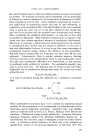
TALKING OF PERFUMES AGAIN matching of a blend. Most people visiting a perfumery laboratory show a great interest in the identification of ingredients from a complex mixture, and I should like to spend some time on giving my own particular approach to the problem. IMITATING A PERFUME The imitation of an existing perfume may be undertaken simply as an exercise to keep one from becoming rusty, to keep one up to date, as a training technique, but more often from commercial necessity. Of course, one may by chemical or physical analysis obtain a certain amount of information regarding the constituents of a sample. Thus chromatography, which briefly depends upon the separation of individual ingredients from a mixture by means of selective absorption on powder from solvents, offers some help. In this case, it is necessary to keep very much in mind the possible effect of the powder upon the ingredients. Nevertheless, the approach simpli- fies the identification of the mixed ingredients, although it is time-consuming and calls for a delicate handling of an established technique. Some separa- tion may be made (providing the sample in question is sufficiently large) by fractional distillation. The physical constants in certain cases may be of help, although such cases are rare. To know the total alcohol, ester, carbonyl (aidehyde and/or ketone) contents may be of some help, but it is very important to realise that chemical changes are continually taking place in a mixture of chemicals. This is our chemical blending effect. In terms of simple chemical changes we can expect a combination of alcohols and alde- hydes to produce hemi-acetals, aldehydes may oxidise or polymerise, esters may break down or more likely interchange (for instance, alcoholysis may occur). The presence of a high boiling alcohol with an ester formed from a low boiling alcohol may result in a partial exchange of the alcohol radicals. Benzyl alcohol may replace the methyl radical from methyl salicylate to yield methyl alcohol and benzyl salicylate. Such a change in constitution means a considerable change in odour, from the strong wintergreen note of methyl salicylate to the almost odourless benzyl salicylate. Naturally, equilibrium will be reached. In much the same way, radical exchange in esters may occur. Ethyl phenyl acetate and geranyl propionate may well change in part to ethyl propionate and geranyl phenyl acetate. It must therefore be understood that one is not necessarily imitating a mixture as originally compounded. In point of fact, one rarely or never achieves perfection in matching that is, one may arrive at a satisfactory imitation by a route quite different from that pursued by the originator. The final effect is the important thing, and although obviously one must be somewhere in the right region regarding correct ingredients and proportions, different approaches may well bring success. By success is meant the production of an imitation sufficiently close in odour and performance to satisfy both customer and investigating perfumer. 189

JOURNAL OF THE SOCIETY OF COSMETIC CHEMISTS It is not necessary to tell perfumers, but it may be news to some, that when a perfume is made to a definite formula by two or more people the final result may be different as far as odour is concerned. Mainly, this is due to the fact that whereas commercially pure true synthetics are reasonably standard in quality, essential oils, and more particularly, isolates from these oils, vary with each supplier. What hope then has a perfumer of matching a blend made from materials differing from those he intends employing ? Here we come back to the previously expressed suggestion that one may achieve good results by an alternative route. Each perfumer will have his or her own technique where matching is concerned, dictated by the nature of his training experience and perhaps prejudices. One can only offer one's own ideas. Let us consider we are in possession of a small sample (1 mi. may be sufficient if the task is not too complicated) of a perfume and that the examination is restricted to olfactory analysis only. In the first place, take advantage of every available piece of information regarding the perfume. Can you ascertain its selling price, its origin and very importantly its intended use ? These points may at first glance have little to do with analysis by the nose, but this is a game and every piece of information must be used intelligently and effectively. There is much of the detective to be found in the successful perfumer. This may require further enunciation, but it is helpful to know in advance that the price automatically reduces or cuts out the use of expensive ingredients. Knowledge of the origin of the compound helps because one recognises indi- vidual types and approaches as clearly as one identifies a handwriting. Knowledge of intended use obviously helps to delete products unsuitable to that particular product and to indicate the most likely ingredients. Using only slips of absorbent paper by way of apparatus, one might approach an olfactory analysis in the following manner: (In the selection of these "smelling slips" it is important to keep to one grade so that rate of evaporation from the paper is constant for each examination.) The ingredients present in the sample will each have their own rate of evaporation modified as this rate may be by blending with other ingredients. It follows that if the perfume is exposed to the atmosphere and examined at various intervals we are virtually examining individual fractions in much the same way as if we had performed the fractionation by distillation or absorption. In this case we cannot retain the individual fraction other than as an impression in the nose. Further, the identification is complicated by the intimate presence of other volatile substances, but this is our separation and we make of it the best we can. If time is not an important factor dip a "smelling slip" or "blotter" into the sample and leave it exposed to the atmosphere for a few days. At the end of this period the slip will contain only the relatively non-volatile constituents, i.e., the solids, musks, coumarin, heliotropin, vanillin, etc. resoins, e.g., benzoin, labdanum, oakmoss, 190
Purchased for the exclusive use of nofirst nolast (unknown)
From: SCC Media Library & Resource Center (library.scconline.org)