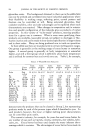
322 JOURNAL OF THE SOCIETY OF COSMETIC CHEMISTS and Michigan) production has now expanded to the eastern part of Wash- ington State. In 1939 the Midwest produced about 375,000 pounds of spearmint oil which was used chiefly in chewing gums. In 1947 chloro- phyll toothpastes appeared on the market and the demand for spearmint oil (with which they were flavored) increased sharply. Since the Midwest was unable to satisfy this demand, progressive large-scale producers began to look toward the Far West for expansion in spearmint acreage. This movement to the Pacific Northwest was encouraged by the fact that yield of oil per acre proved to be much higher in that area than in the Midwest. (In 1955 the average yield of oil per acre was 33 pounds in Indiana, 26 pounds in Michigan and 95 pounds in eastern Washington.) As a result of new plantings, production of spearmint oil in eastern Washington increased to 218,000 pounds in 1955, against 211,000 pounds for Indiana and 156,000 pounds for Michigan. Total U.S. production of spearmint oil in 1955 was therefore 585,000 pounds. Like the peppermint plant, spearmint is exposed to wilt and rust. lfilt has done much damage to the spearmint fields in the Midwest, this being one of the reasons for the low yield of oil per acre. Spearmint rust, on the other hand, flourishes only in areas exposed to cool and humid weather, for which reason cultivation of spearmint would be a risky business in the Wil- lamette Valley for example. Since rust does not thrive in hot and dry areas, cultivation in the Yakima Valley has proved most successful. In general, it is easier and more economical to grow spearmint than peppermint, substantially higher yields of oil per acre being obtained. For this reason cultivation of spearmint in eastern Washington (Yakima Valley) is still increasing. BIBLIOGRAPHY (1) Abe, Y., Harukawa, T., Ishikawa, H., Miki, T., and Sumi, M., "Nomenclature of Santonin and Related Compounds," Chemistry & Industry, 91 (1955). (2) Abe, Y., Harukawa, T., Ishikawa, H., Miki, T., Sumi, M., and Toga, T., "A New Racemic Stereoisomeride of Santonin," Proc. )rapan ,qcad., 29, 113 (1953). (3) Abe, Y., Harukawa, T., Ishikawa, H., Miki, T., Sumi, M., and Toga, T., "The Syn- thesis of Two Optically Inactive Stereoisomerides of Santonin," 5 t. •lm. Chem. $oc., 75, 2567 (1953). (4) Abe, Y., and Sumi, M., "Configuration of the Santonins," Chemistry & Industry, 253 (1955). (5) Aebi, A., Barton, D. H. R., Burgstahler, A. W., and l.indsey, A. S., "The Stereochem- istry of the Tricyclic Derivatives of Caryophyllene," )t. Chem. Soc., 4659 (1954). (6) Aebi, A., Barton, D. H. R., and Lindsey, A. S., "The Nature of v-Caryophyllene," Chemistry & Industry, 487 (1953). (7) Aebi, A., Barton, D. H. R., and Lindsey, A. S., "The Relationship Between Clovene and •-Caryophyllene Alcohol," Ibid., 748 (1953). (8) Aebi, A., Barton, D. H. R., and Lindsey, A. S., "The Stereochemistry of Caryophyl- lene," )t. Chem. Soc., 3124 (1953). (9) Arigoni, D., and Jeger, O., "Ueber die absolute Konfiguration des Zingiberens," Helv. Chim. dcta, 37, 881 (1954). (10) Atwater, N. W., and Reid, E. B., "On the Nature of •-Caryophyllene," Chemistry & Industry, 688 (1953). (11) Barton, D. H. R., "Conformational Analysis of Substituted cycloHexanes," Ibid., 664 (1953).

RECENT DEVELOPMENTS IN ESSENTIAL OILS 323 (12) (13) (14) (15) (16) (17) (18) (19) (20) (21) (22) (23) (24) (25) (26) (27) (28) (29) (30) (31) (32) (33) (34) (35) (36) (37) (38) (39) (40) (41) (42) (43) (44) Barton, D. H. R., "The Stereochemistry of Santonin, fi-Santonin and Artemisin," 7. Org. Chem., 15, 466 (1950). Barton, D. H. R., Bruun, T., and Lindsey, A. S., "The Constitution of Caryophyllene," Chemistry & Induttry, 691 (1952). Barton, D. H. R., Bruun, T., and Lindsey, A. S., "Tricyclic Derivatives of CaryophyL lene," Ibid., 910 (1951). ' Barton, D. H. R., Bruun, T., and Lindsey, A. S., "Tricyclic Derivatives of Caryophyl- lene," 7. Chem. Soc., 2210 (1952). Barton, D. H. R., and Lindsey, A. S., "The Constitution of Caryophyllene," Chemistry & Industry, 313 (1951). Barton, D. H. R., and Lindsey, A. S., "Sesquiterpenoids. I. Evidence for a Nine- Membered Ring in Caryophyllene," 7. Chem. $oc., 2988 (1951): Barton, D. H. R., and Nickon, A., "The Absolute Configuration of Caryophyllene," Ibid., 4665 (1954). Barton, D. H. R., and Tarlton, E. J., "The Constitution of Carissone," Ibid., 3492 (1954). Batt, R. D., and Slater, S. N., "The Structure of v-Curcumene," Ibid., 838 (1949). Birch, A. J., Elliott, P., and Penfold, A. R., "Studies in Relation to Biosynthesis. Angustifolionol," dustralian 5 t. Chem., 7, 169 (1954). Birch, A. J., and Lahey, F. N., "The Structure of Aromadendrene. I," Ibid., 6, 379 (1953). Birch, A. J., Mostyn, K. M. C., and Penfold, A. R., "The Sesquiterpene Alcohols of Eucarya spicata Sprague and Summ.," Ibid., 6, 391 (1953). Birch, A. J., and Murray, A. R., "The Constitution of Lanceol," % Chem. $oc., 1888 (1951). Blumann, A., Cole, A. R. H., Thieberg, K. J. L., and White, D. E., "The Constitution of Globulol," Chemistry & Industry, 1426 (1954). British Standards Institute, London, "Methods of Testing Essential Oils," British Standards, 2073 (1954). Campbell, A., and Rydon, H. N., "The Synthesis of Caryophyllenic Acid," 7. Chem. Soc., 3002 (1953). •ekan, Z., Herout, V., and •orm, F., "A Chamazulene Precursor from Chamomile (Matricaria chamomilla L.)," Chemistry & Industry, 604 (1954). •ekan, Z., Herout, V., and •orm, F., "Isolation and Properties of the Pro-chamazulene from Matricaria chamomilla L., a Further Compound of the Guaianolide Group," Coll. Czech. Chem. Comm., 19, 798 (1954). fi. ts. A. Chiris, "Essence d'eucalyptus citriodora," Parrums France, •3, 72 (1925). Chopra, N.M., Cocker, W., Cross, B. E., Edward, J. T., Hayes, D. H., and Hutchison, H. P., "Constitution of •k-Santonin. Investigations Into the Position of the Double Bond," 5 e. Chem. $oc., 588 (1955). Clarke, P., "The Structure of Humulene, Chemistry & Industry, 661 (1954). Clarke, P., and Ramage, G. R., "The Structure of Some Derivatives of Humulene," 5 t. Chem. Soc., 4345 (1954). Clemo, G. R., and Harris, J. O., "The Structure of Humulene," Chemistry & Industry, 799 (1951). Clemo, G. R., and Harris, J. O., "The Chemistry of Humulene. II," 7. Chem. Soc., 665 (1952). Clemo, G. R., and McQuillin, F. J., "Synthesis in the Santonin Series. I. Some Oxida- tion Products of c•-(2-Keto-4-methylcyclohexyl)propionic Acid," Ibid., 3835 (1952). Clemo, G. R., and McQuillin, F. J., "Synthesis in the Santonin Series. II," Ibid., 3839 (1952). Cocker, W., "The Chemistry of •-Santonin," Chemistry & Industry, 19 (1955). Cocker, W., and Cahn, R. S., "Nomenclature of the Santonins," Ibid., 384 (1955). Cocker, W., Cross, B. E., and Hayes, D. H., "The Structure of•-Santonin: Position of the Double Bond," Ibid., 314 (1952). Cocker, W., and McMurray, T. B. H., "The Stereochemistry of Santonin," Ibid., 1199 (1954). Corbett, R. E., and Hanger, W. G., "The Structure of Metrosiderene," 7. Chem. Soc., 1179 (1954). Corey, E. J., "The Stereochemistry of Santonin, fi-Santonin, and Artemisin," 7- din. Chem. Soc., 77, 1044 (1955). Craig, L. C., in Weissberger, A., "Technique of Organic Chemistry," Vol. III, New York, Interscience Press (1950), pp. 171-311.
Purchased for the exclusive use of nofirst nolast (unknown)
From: SCC Media Library & Resource Center (library.scconline.org)