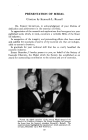
MY FRIEND, ERNEST GUENTHER 283 In my opening remarks I said there were three purposes for our meeting tonight. Now we come to the second, which is to honor this year's Medal- ist. For this portion of our program we are fortunate to have as our toastmaster a man who has been active for several years in the affairs of our SOCIETY. He has been Publicity Chairman for the past three years and an active worker in any capacity where he has been called upon to serve. At our recent elections he was chosen as a director of our SOCIETY for the next year. By this description you have recognized the man to whom I will now turn over the meeting--your Toastmaster, Savery F. Coneybear-- or, as most of us know him, "Ted" Coneybear. Mr. Coneybear introduced the ladies and gentlemen at the head table. He then called on Drs. Emil Klarmann and Edward Langenau to each, in his turn, give their eulogies of the Medalist. MY FRIEND, ERNEST GUENTHER By Evict. G. Kt.^P. Vt^NN "Avbpa laoL •'vwrr•, Mo•aa, rroXOroorrov ..... " "SpE.•K To •, oh Muse, of the much travelled man..." May it not surprise anybody if I invoke here the same Muse whom Homer invoked to help him tell the story of Ulysses. Because Ulysses and Ernest have one important thing in common they are both much travelled men. But here the comparison ends, since Ulysses has been made by the gods to wander around aimlessly, whereas Ernest Guenther's peregrinations all over the globe were planned most purposefully and executed most meticulously. However, in my enthusiastic envy of Ernest's good fortune as a globe trotter, I am getting ahead of myself. Let me pick up the thread at its proper place. To understand my friend Ernest Guenther and all that he stands for, it is almost necessary to have known Munich before the first world war where he was born before the turn of the century, and where he spent his child- hood and adolescence. In those days Munich was known as the Athens of Bavaria. It merited this designation not only because it was a most im- portant center of European arts and sciences, but also because life in Mu- nich, the capital of Bavaria, was replete with charm, grace and that untrans- latable Gumiit/ichkeit. Moreover, Munich practiced real democracy.

MY FRIEND, ERNEST GUENTHER 283 In my opening remarks I said there were three purposes for our meeting tonight. Now we come to the second, which is to honor this year's Medal- ist. For this portion of our program we are fortunate to have as our toastmaster a man who has been active for several years in the affairs of our SOCIETY. He has been Publicity Chairman for the past three years and an active worker in any capacity where he has been called upon to serve. At our recent elections he was chosen as a director of our SOCIETY for the next year. By this description you have recognized the man to whom I will now turn over the meeting--your Toastmaster, Savery F. Coneybear-- or, as most of us know him, "Ted" Coneybear. Mr. Coneybear introduced the ladies and gentlemen at the head table. He then called on Drs. Emil Klarmann and Edward Langenau to each, in his turn, give their eulogies of the Medalist. MY FRIEND, ERNEST GUENTHER By Evict. G. Kt.^P. Vt^NN "Avbpa laoL •'vwrr•, Mo•aa, rroXOroorrov ..... " "SpE.•K To •, oh Muse, of the much travelled man..." May it not surprise anybody if I invoke here the same Muse whom Homer invoked to help him tell the story of Ulysses. Because Ulysses and Ernest have one important thing in common they are both much travelled men. But here the comparison ends, since Ulysses has been made by the gods to wander around aimlessly, whereas Ernest Guenther's peregrinations all over the globe were planned most purposefully and executed most meticulously. However, in my enthusiastic envy of Ernest's good fortune as a globe trotter, I am getting ahead of myself. Let me pick up the thread at its proper place. To understand my friend Ernest Guenther and all that he stands for, it is almost necessary to have known Munich before the first world war where he was born before the turn of the century, and where he spent his child- hood and adolescence. In those days Munich was known as the Athens of Bavaria. It merited this designation not only because it was a most im- portant center of European arts and sciences, but also because life in Mu- nich, the capital of Bavaria, was replete with charm, grace and that untrans- latable Gumiit/ichkeit. Moreover, Munich practiced real democracy.
Purchased for the exclusive use of nofirst nolast (unknown)
From: SCC Media Library & Resource Center (library.scconline.org)