:280 JOURNAL OF THE SOCIETY OF COSMETIC CHEMISTS For obvious reasons, the toe webs and any other part of the foot where sweat evaporation is impeded are the sites of predilection to develop the fetid odor. Certain deformities, moreover, such as superimposed toes or toes which are tightly squeezed together or the missing arch of the soles in subjects with a high degree of flat feet, frequently cause or aggravate sweat stagnation and malodorous decomposition. In subjects of this kind, the bromhidrosis is promptly alleviated by correction of the anatomical anomaly. When sweating is excessive a priori and/or the native sweat's composi- tion, e.g., by a high pH, favors the changes leading to keratin swelling and bacterial growth, the bromhidrosis is linked to these "idiopathic" factors. To Klarmann's discussion: I fully subscribe to what Klarmann has said but should add that clinical trials we thus far carried out with cationic wetting agents, notably with different dilutions of Zephiran chloride in water, were rather disappointing, inasmuch as skin irritation sooner or later ensued, preventing continua- tion of the applications. Concerning the action of exchange resins, preliminary assays appear pertinent in which we (New York Skin and Cancer Unit) applied such resins .externally in powdered form, or incorporated in creams or lotions and observed definite changes in pH. as well as a relatively frequent reduction of sweating in response to these applications. While the anion exchange resins produced an increase in pH, the cation exchange resins caused a decrease which was much more pronounced in the axillary vaults than in all other skin areas under study. The cation exchange resins were con- siderably more effective in diminishing sweat delivery than were the anion exchangers. The powders were the most and the creams the least effective. Despite the early stage of investigation of these agents in the axillary vaults, I feel that their effect is quite complex. To Fredell's paper: In full agreement with Fredell, we frequently observed a transient pro- vocatory effect of single applications of creams containing aluminum salts, prior to manifestation of reduced sweat delivery. We regarded the pro- vocatory action as an effect of the ointment base and as related to the increased outpouring observed in response to topical application of lanolin by Unna and later by Pollitzer, Rothman, O'Brien and ourselves.

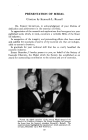
THE EIGHTH MEDAL AWARD and TENTH ANNIVERSARY DINNER December 15, 1955 Hotel Commodore, New York, N.Y. Address by President Russell L^WES ^NV GENTLEMEN, MEMBERS AND FRIENDS OF THE SOCIETY OF COS•tETXC C•EmSTS: As you know, we are here tonight for three purposes. First, to honor the charter members on the occasion of this tenth an- niversary of the SOCIETY'S founding. Second, to honor the eighth Medalist for outstanding contribution to the science and art of cosmetics. Third, to enjoy an evening of good fellowship and fun, and take advan- tage of this opportunity to become better acquainted with each other. On May 23, 1945, a dozen men got together and organized a group which they called the SOCIETY OF COSMETro C•EMISTS. They adopted a con- stitution and by-laws which stated that the objective of the SOCIETY was "to establish a medium through which scientific knowledge of the toilet goods industry can be disseminated, and to improve cosmetic and perfumery technicians' professional standing." Two technical papers were given at that first meeting, and semiannual meetings have been held regularly since that time. As the SOCIETY grew, the technical programs expanded, a proof that the cosmetic industry was becoming ready to accept the thought that scientific knowledge of the in- dustry could be disseminated to the advantage of its members. This was a thought which only a few years before could not be comprehended except in the minds of those twelve foresighted individuals who founded this SOCIETY and a few others in the country. Since that time this SOCIETY has grown from those 12 founders to 463 U.S. members. In addition, a British affiliate has been founded now having over 200 members. The story of this period of growth and recognition of this SOCtET¾.could occupy the whole evening, but time does not permit this. Instead, what we want to do tonight is recognize those 12 individ- uals who envisioned the future of such an organization. Of these 12, nine 281
Purchased for the exclusive use of nofirst nolast (unknown)
From: SCC Media Library & Resource Center (library.scconline.org)