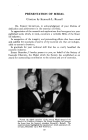
MY FRIEND, ERNEST GUENTHER 283 In my opening remarks I said there were three purposes for our meeting tonight. Now we come to the second, which is to honor this year's Medal- ist. For this portion of our program we are fortunate to have as our toastmaster a man who has been active for several years in the affairs of our SOCIETY. He has been Publicity Chairman for the past three years and an active worker in any capacity where he has been called upon to serve. At our recent elections he was chosen as a director of our SOCIETY for the next year. By this description you have recognized the man to whom I will now turn over the meeting--your Toastmaster, Savery F. Coneybear-- or, as most of us know him, "Ted" Coneybear. Mr. Coneybear introduced the ladies and gentlemen at the head table. He then called on Drs. Emil Klarmann and Edward Langenau to each, in his turn, give their eulogies of the Medalist. MY FRIEND, ERNEST GUENTHER By Evict. G. Kt.^P. Vt^NN "Avbpa laoL •'vwrr•, Mo•aa, rroXOroorrov ..... " "SpE.•K To •, oh Muse, of the much travelled man..." May it not surprise anybody if I invoke here the same Muse whom Homer invoked to help him tell the story of Ulysses. Because Ulysses and Ernest have one important thing in common they are both much travelled men. But here the comparison ends, since Ulysses has been made by the gods to wander around aimlessly, whereas Ernest Guenther's peregrinations all over the globe were planned most purposefully and executed most meticulously. However, in my enthusiastic envy of Ernest's good fortune as a globe trotter, I am getting ahead of myself. Let me pick up the thread at its proper place. To understand my friend Ernest Guenther and all that he stands for, it is almost necessary to have known Munich before the first world war where he was born before the turn of the century, and where he spent his child- hood and adolescence. In those days Munich was known as the Athens of Bavaria. It merited this designation not only because it was a most im- portant center of European arts and sciences, but also because life in Mu- nich, the capital of Bavaria, was replete with charm, grace and that untrans- latable Gumiit/ichkeit. Moreover, Munich practiced real democracy.

284 JOURNAL OF THE SOCIETY OF COSMETIC CHEMISTS While Bavaria had a royal house, princes and commoners went to the same schools and mingled freely with one another. Ernest comes from 'a prominent Murlich family. His father was a famous architect who specialized particularly in two types of structure i, churches and breweries. I have no doubt that this is one of the reasons why Ernest's mind reflects a balanced synthesis of the spiritual and hedo- nist proclivities. Other reasons will appear on further probing. My friend Ernest is a humanist. To this very day he is immensely proud of the fact that in the course of his secondary schooling he has had nine years of Latin and six years of Greek. He thus belongs to that unfortunately diminishing band of men who are conscious of the great benefits derived from a thorough exposure to Greek and Roman classics. To anyone who has had the same opportunity, Ernest's educational back- ground must be immediately apparent. He himself admits that this humanistic upbringing at the time of an adolescent's greatest mental flexibility has been of immeasurable help to him, not only in the extension of his linguistic proficiency, but also in the disciplining of his mind, an indis- pensable prerequisite for the organization and production of his magnum opus, the six volumes of "The Essential Oils." Yet Ernest never lost contact with the pleasurable things of life. He took up sailing at the age of sixteen, mostly to compensate for a much coveted sailor's career which his father persuaded him to abandon. By way of added compensation he also turned to reading stories of adventures and travels, becoming eventually somewhat of an authority on the Ameri- can Indian and the Wild West, as it was then known in Europe. In common with many of his contemporaries, Ernest did not begin and end with the same subject of his professional training. When he enrolled at the University of Munich, he wanted to become a geologist with the idea of working and traveling abroad. He transferred subsequently to the University of Zurich, still pursuing the subjects of geology and mineralogy. Life and work in the liberal capital of Switzerland must have contributed greatly to the broadening of his humanitarian ideals. This is the time when he must have begun to develop into that superlative cosmopolite, the world citizen in the truest sense of the word which he is today, and which he has been for all these years when most of you made his acquaintance. The outbreak of the First World War had a profound effect upon his future career. Feeling that the war reduced the possibilities of world travel, he regretfull) abandoned geology in favor of organic chemistry. Fortunately, he found inspiring teachers of this subject in Zurich, among them the great Werner, Karrer and Ruzicka, Nobel Prize winners all. Incidentally, for a fillip he attended Albert Einstein's lectures on the theory of relativity. At any rate, it was while attending Ruzicka's courses that he became ac- quainted with terpenes and essential oils.
Purchased for the exclusive use of nofirst nolast (unknown)
From: SCC Media Library & Resource Center (library.scconline.org)