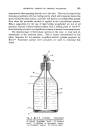
BOTTLE CLOSURES acid or alkali are frequent, and it is not unknown for efforts to remove obstinate stoppers to result in accidents. A little soft paraffin on glass stoppers, particularly those used commercially, will invariably prevent this trouble. RIGID COMPOUND SCREW STOPPERS WITH RUBBER WASHERS As a carbonated beverage and ammonia closure, these stoppers have been in common use in Britain for some years. A point of interest is that they are not used for beer or mineral water bottling in the United States. Generally speaking, re-use closures are not permitted for food products in that country. Although this type oi closure has been criticised as being possibly unhygienic for carbonated beverage bottling, one must take into consideration that it has been used satisfactorily by our bottling trade for some considerable time. Other types of closures may replace these stoppers in time, but at present it can be said that the annum quantity used is going up. Important points with the use of this type of closure are: 1. They should be thoroughly cleansed and sterilised before re-use. 2. Any that are contaminated with objectionable foreign matter such as kerosene should be scrapped. 3. Rubber rings should be renewed if there are any signs of deterioration. RUBBER PLUGS Use of these is on the whole restricted to laboratories and the bottling of a few chemicals, probably because of expense. They are mainly used for the bottling of alkaline solutions and certainly are preferable to normal corks for this purpose. Their shape is of conventional tapered corks. When referring to size, however, it is usual to refer to the number found embossed on all plugs. One type of plug that has found some favour in industry is that which is made of somewhat soft rubber and has lateral serrations which add to sealing efficiency. This type Mso has a built-on rubber cap that is fashioned to fit around bottle top. Another type of rubber plug that is used is that which is shaped to form bottle plug and primary cap liner it is used in the bottling of such materiMs as spirituous perfumes to prevent evaporation. POLYTHENE STOPPERS The use of polythene stoppers in industry appears to be gaining favour points in the advantage of their use are: 1. Polythene is inert to the acids and alkalis normMly encountered.

368 JOURNAL OF THE SOCIETY OF COSMETIC CHEMISTS 2. A polythene stopper that will fit a given bottle will fit any number of similar bottles. 3. The fact that they are hollow does minimise air compression in bottle necks. Points in criticism of their use are: 1. Cost.--On this angle it is doubtful if they will ever displace moulded caps or corks also it is very doubtful if they will ever entirely displace glass stoppers. 2. Difficulty of removal.--One hesitates to tackle, as advised, the removal of stoppers with pliers, where bottles of acid are concerned. 13. They are not generally accepted as being efficient for the purpose of bottling volatile solvents. PORCELAIN SWING STOPPERS WITH RUBBER RINGS This type of stopper was once commonly used in the milk bottling trade, but nowadays its use is chiefly confined to the mineral water trade. It is more expensive than other types of re-usable closures, and is not very satisfactory on modern fast and fully automatic bottling lines. It will hold pressures of carbonated drinks quite well, but is now much less popular than in former years. CLOSURE CAPS The following widely used types of closure caps and seals come under this heading: aluminium foil as used on milk bottles, crowns, moulded caps, metal screw on, metal screw rolled on, metal spring or clip on, aluminium foil with cork liner. ALUMINIUM FOIL CAPS These have a firm place in the bottling trade, and are without doubt eminently suitable, because of cheapness and hygienic application, for the purpose of capping very short shelf life and short journey consumer goods, as will be seen in the everyday bottling of milk and orange juice. The main criticism of this type of closure are: 1. Containers on which this is used can only travel upright. 2. This type of seal will not withstand any appreciable pressure. CROWNS These are probably the most efficient common type of closures made, besides being one of the cheapest. Containers sealed with crowns will usually withstand internal pressures of 100 lb./sq. in. Proof of the recog-
Purchased for the exclusive use of nofirst nolast (unknown)
From: SCC Media Library & Resource Center (library.scconline.org)