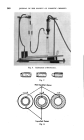
BOTTLE CLOSURES 369 nised sealing efficiency of crowned containers is that they are regularly used for export bottling. A particular feature of the international use of crowns is that the dimen- sions of crowns used in North America and Great Britain are within the same dimensional tolerances, as also are those used in most other countries: these dimensional tolerances, in particular overall height and width, being within 0'010 in. This may appear incredible considering the vast numbers used, but even more so is the fact that individual manufacturers aim at tolerances of 0'005 in." This dimensional accuracy of crowns is made not only to ensure good sealing performance a further important reason is to encourage faultless running in high-speed bottling machines, where even minor hold-ups can be costly in regard to output lost, and also with beer bottling, where stoppages can result in faulty material being bottled. Decoration is in the form of coloured coating, or printing and varnishing in all instances a sanitary lacquer is used on the inside of crowns. Liners used are natural or composition cork discs of such thickness that there are 9 to 11 per inch in most instances these are glued in, but in some Continental and South American countries are friction fitted. Some crowns are assembled with vinylire, aluminium or ceresine spots. In general, when used, aluminium spotted crowns are used for beer bottling, vinylire and ceresine for soft drink bottling. Of great importance with the use of crowns is the accurate dimensions of closure finish and the efficient performance of crowning machine. There are two recognised standard crown glass bottle finishes, one for U.S. and one for Great Britain, although some English bottlers use U.S. finish glass bottles. The main advantages and disadvantages of crown closures are as follows: 1. When efficiently used on a good container they can travel with safety under normal conditions to any destination. 2. A crowned container withholds considerable internal pressure without venting. 3. With crown closures the highest bottling speeds can be achieved. 4. When removed from a container, a crown cannot be efficiently re-used. 5. An instrument is always needed for the convenient removal of crowns from containers. MOULDED CAPS The bulk of moulded caps are made from thermosetting moulding powders a few are made from thermoplastic materials, but these are very much in the minority at present. Moulding powders usually used are phenol formaldehyde wood filled,

370 JOURNAL OF THE SOCIETY OF COSMETIC CHEMISTS urea formaldehyde wood filled urea formaldehyde paper filled and Melamine formaldehyde is also used, but to a less extent than others mentioned. Thermoplastic materials used are polythene and polystyrene. Caps from various of these materials can be made in practically any shape and colour, also they can have trade marks or letters embossed upon them. In the manufacture of caps from thermosetting materials either heated flat-bed presses or automatic rotary presses are used. With either type of production an excess charge of powder, sometimes in the form of a pellet, is delivered to each mould, which after the moulding has taken place, causes a flash ring to be produced on the caps. This is either removed by a separate operation or automatically in the case of rotary machines, immediately after the caps have been moulded. A point worth noting here in regard to the cost of caps is that the heat and time cycle needed to manufacture them is broadly in accordance to weight and thickest section. A conventional well- designed cap will mould without difficulty, but if a customer, for some decorative reason, requires a cap with a thick section, difficulties will be experienced. The essential characteristics of moulding powders are as follows: 1. The strongest is wood-filled phenol. This can only be supplied in black, brown and some red colours it is not so easy to use as wood- or paper-filled urea. 2. Most deeply coloured caps are made from wood-filled urea and the pastel type paper-filled urea. 3. Melamine formaldehyde moulding powder is appreciably more expen- sive than phenol or urea and is generally only used for specialised purposes. Caps made of thermoplastic materials are mottided by conventional injection moulding methods, polythene being used for the manufacture of snap-on caps and polystyrene used for the manufacture of caps used for the bottling of certain acids. An important feature of screw caps is the liner material used. With moulded caps the majority of liners are glued in place, and it is found in practice that for specific bottling purposes the use of definite types of liner materials is preferable. These liner materials are usually composed of one of the following alternatives: 1. A backing material of white wood pulp or composition cork with a facing material. 2. Wax impregnated white wood pulp or composition cork. 3. A homogenous rubber or plastic material. Reasons for and against the use of either backing material are as follows: (a) Composition cork has the greatest resiliency and gives a better sealing effect.
Purchased for the exclusive use of nofirst nolast (unknown)
From: SCC Media Library & Resource Center (library.scconline.org)