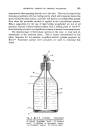
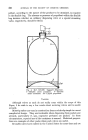
374 JOURNAL OF THE SOCIETY OF COSMETIC CHEMISTS and has its place in industry for use on containers of certain types of heavy lubricating oils and like materials. An asset in its use is that it can be conveniently re-used, but in re-use, however, it would be unsuitable for journeys unless a fresh sealing ring is put on. ALUMINIUM FOIL SEAL WITH COMPOSITION CORK LINERS These are being used to some extent in the sterilised milk bottling trade and to a limited extent in the wine bottling trade, in the latter principally on miniature bottles. Foil caps are made in situ from strip aluminium, a composition cork disc being automatically inserted and the cap rolled on filled bottles. A tab is made on the cap for easy tear-off removal. The cork liner in this instance does play a very important part, and unless it is of good quality an effective seal for sterilisation purposes, in particular, will not be made. Although it is suitable for the bottling of sterilised milk, this type of closure is not used for any other large-scale bottling purpose in Britain, probably because of its fragility and because it will not withstand the internal pressures encountered in carbonated beverage bottling. PLASTICS FOR PACKAGING A Lecture delivered to the Society on Thursday, February 9th, 1956 L. F. BULL, M.I.E.I., A.M.I.E.E.* PLASTICS IN many different forms have very rapidly become established in the field of packaging because of properties which make them particularly valuable for such applications. The term "plastics," moreover, is a generic one like metals, which covers a very wide variety of dissimilar materials ranging from those for really solid containers to coating solutions, trans- parent film and expanded substances for the protective embedment of articles. Methods of producing completed packages with these materials are equally varied. They can be compression, transfer, or injection moulded, extruded, calendered, or cast into sheet, extrusion blown and used as a medium for dip coating. This range of techniques includes both those capable of producing to close tolerances the smallest mouldings such as a closure cap for a scent bottle to a very large container or housing. * British Resin Products, Ltd., Mayfair Place, London, W. 1.

PLASTICS FOR PACKAGING 375 Plastics are man-made materials which, in the space of the last 25-30 years, have evolved from their laboratory cradles to a relatively prominent position in world economy. Not only can they compete with natural products as primary materials of construction, but often they can outstrip them in versatility and outstanding performance in one direction or another at no greater cost. They lend themselves to methods and rates of multiple produc- tion not to be achieved by the use of other materials. For hundreds of years containers have been formed from stone, glass, composite mineral products and metals. They have served mankind well because by alloying or varying the process of working they have yielded products that have satisfied the demands imposed by changes in industry and marketing. In plastics a deliberate exercise of chemical knowledge is yielding a range of products tailor-made for the functions they have to perform in service and to suit the working-up methods employed in forming them. Plastic products are often modified, as in the case of metals, by alloy- ing, but additionally they may be modified by adding plasticisers and fillers the variety of compounds so obtainable being almost unlimited. The plastics industry needs not only chemists and physicists, but engineers, toolmakers, designers, craftsmen and financiers, all of whom must understand the nature of the products. Plastics are relatively new entrants into the packaging field, having intrinsic strength, durability in form and colour, and freedom from corrosion among the features which distinguish and commend them and make their use worthwhile in the effort to apply a new material to the age-old problem of keeping one material apart from many others. In addition to ease of mass production, plastics incorporate other proper- ties inherently valuable for packaging purposes. Among them may be found materials, for exan•ple, possessing excellent resistance to water and chemical attack. Some are of low density, with a strength-to-weight ratio that is higher than steel. Many have good dimensional stability in difficult condi- tions and can withstand either high or low temperatures. The majority are non-toxic and therefore suitable for use in connection with foodstuffs and pharmaceuticals. Some are available in transparent grades, others in trans- lucent or opaque grades only, while most provide a complete colour range. Not all of the materials possess all of these characteristicq, but usually one with the combination required for a specific application can be found. To this width of choice is allied a facility of mass production which when necessary permits packages of extremely attractive design to be economically produced. There are some sixteen to twenty distinct chemical types of plastics of commercial importance. Their performance is determined by both the chemical properties, that is molecular structure, and by modifiers such as fillers, reinforcing fibres and/or plasticisers.
Purchased for the exclusive use of nofirst nolast (unknown)
From: SCC Media Library & Resource Center (library.scconline.org)