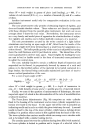
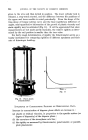
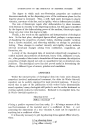
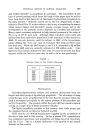
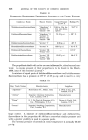
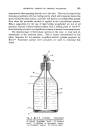
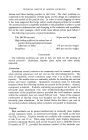
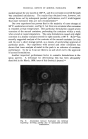
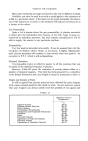
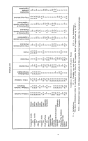
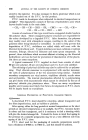
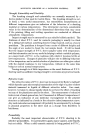
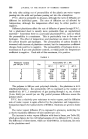
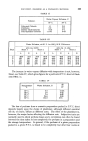
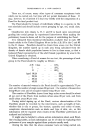
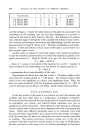
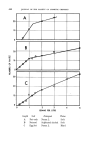
DEVELOPMENT OF A DETERGENT TEST 417 Figure A represents the data of the previous table. The plates in B were from a canteen after use for a meal of pies, potatoes, gravy. The hard water of C was prepared by adding 1,140 p.p.m. CaCI• and 710 p.p.m. MgCI• to distilled water. CONCLUSION The relationship between the concentration of a detergent solution and the number of plates washed is not a simple one, but shows a marked change in characteristics below what is identified as the critical micelie concentration. For a full evaluation of any detergent, therefore, it is necessary for a range of concentrations to be studied, and tests on different materials made at a single arbitrary concentration, particularly if this is in the critical region of about 0.025 per cent active matter, are liable to give misleading results. The effect of different quantities of soil on the plates is also complex. The fat/flour soil previously used shows an increase of about 40 per cent in the number of plates when only half as much soil is used, but an egg/fat soil shows roughly a two-fold increase, whereas a simple fat, most surprisingly, gives results nearly independent of the amount of fat on each plate. W. B. Smith, 'A. Taylor, J.S.C.C., ¾I, 96 (1955). Idem. 235.. Lloyd E. Weeks, Jay C. Harris, Earl L. Brown, J.A. Oil Chemists S., $1, 254 (1954). Clifford Pugh, Applied Statistics, 2, 172 (1953). Louis E. Wells, Soap • Chemical Specialties, $1, 54 (1955). SOCIETY OF COSMETIC CHEMISTS OF GREAT BRITAIN COSMETIC COURSE. 2nd YEAR EXAMINATION, 1956 This examination was held at Acton Technical College on Friday, June 22nd, 1956, one two-hour paper being set as follows: Answer Five Questions 1. Describe the difference between the sodium soaps made from (a) Coco- nut Oil and (b) Ground Nut Oil. 2. What are the principal criteria of rancidity of a vegetable oil ? 3. Describe how you would estimate traces of iron in a sample of soap. 4. What do you understand by the term Solubility Product ? Illustrate your answer by reference to a solution of Sodium Chloride and explain

DEVELOPMENT OF A DETERGENT TEST 417 Figure A represents the data of the previous table. The plates in B were from a canteen after use for a meal of pies, potatoes, gravy. The hard water of C was prepared by adding 1,140 p.p.m. CaCI• and 710 p.p.m. MgCI• to distilled water. CONCLUSION The relationship between the concentration of a detergent solution and the number of plates washed is not a simple one, but shows a marked change in characteristics below what is identified as the critical micelie concentration. For a full evaluation of any detergent, therefore, it is necessary for a range of concentrations to be studied, and tests on different materials made at a single arbitrary concentration, particularly if this is in the critical region of about 0.025 per cent active matter, are liable to give misleading results. The effect of different quantities of soil on the plates is also complex. The fat/flour soil previously used shows an increase of about 40 per cent in the number of plates when only half as much soil is used, but an egg/fat soil shows roughly a two-fold increase, whereas a simple fat, most surprisingly, gives results nearly independent of the amount of fat on each plate. W. B. Smith, 'A. Taylor, J.S.C.C., ¾I, 96 (1955). Idem. 235.. Lloyd E. Weeks, Jay C. Harris, Earl L. Brown, J.A. Oil Chemists S., $1, 254 (1954). Clifford Pugh, Applied Statistics, 2, 172 (1953). Louis E. Wells, Soap • Chemical Specialties, $1, 54 (1955). SOCIETY OF COSMETIC CHEMISTS OF GREAT BRITAIN COSMETIC COURSE. 2nd YEAR EXAMINATION, 1956 This examination was held at Acton Technical College on Friday, June 22nd, 1956, one two-hour paper being set as follows: Answer Five Questions 1. Describe the difference between the sodium soaps made from (a) Coco- nut Oil and (b) Ground Nut Oil. 2. What are the principal criteria of rancidity of a vegetable oil ? 3. Describe how you would estimate traces of iron in a sample of soap. 4. What do you understand by the term Solubility Product ? Illustrate your answer by reference to a solution of Sodium Chloride and explain
Purchased for the exclusive use of nofirst nolast (unknown)
From: SCC Media Library & Resource Center (library.scconline.org)