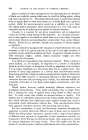
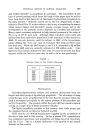
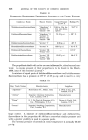
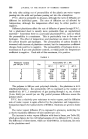
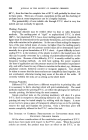
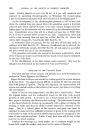
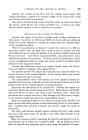
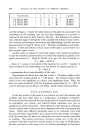
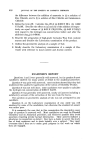
388 JOURNAL OF THE SOCIETY OF COSMETIC CHEMISTS the only risks arising oat of permeability of the plastic are water vapour passing into the solid and perfume passing out into the atmosphere. P.V.C. sheet is permeable to all gases, although the rates of diffusion are different for individual gases. The rates of diffusion are all affected by temperature, although the temperature effect may be either positive or negative. Different plasticisers affect the rate of diffusion of gases through P.V.C., but a plasticised sheet is usually more permeable than an unplasticised material.' Sometimes there is a particular plasticiser/P.V.C. ratio at which the permeability is a maximum. This is particularly true in the case of hydrogen. The effect of temperature and plasticiser are shown in Table I,' for carbon dioxide and hydrogen. The permeability of carbon dioxide is increased with increase of plasticiser content, but the temperature coefficient changes from positive to negative. The permeability of hydrogen shows a maximum at 5 per cent plasticiser content, at which point the temperature coefficient is negative. Each side of this maximum, it is positive. TABLE I Plasticiser content Permeability (P X 109) per 100 pts. P.V.C. Gas. 20 ø C. 30 ø C. 40 ø C. --, __ 0 CO 2 0' 096 0' 102 0' 109 5 CO2 4'00 3'85 3'70 20 CO• 140'0 130'0 ll8'0 0 H• 0'32 0'36 0'40 5 H• 12'20 11'30 10'80 20 H• 8'50 8'60 8'80 The polymer is 100 per cent polyvinyl chloride the plasticiser is di-2- ethylhexylphthalate the permeability (P) is expressed as the number of standard ccs. (0 ø C., 1 atmosphere) of gas passing through 1 sq. cm. of sheet (1 cm. thick) per second per cm. Hg. partial pressure difference across the polymer sheet. P.V.C. has a relatively poor resistance to water vapour, and the diffusion rate of water vapour is again affected by the plasticiser and temperatree. Comparison figures for typical sheets of 0.010 in. thickness are given in Table II. The water vapour diffusion (P) is expressed in grams/sq. metre/day for a relative humidity difference of one hundred per cent. The increase in water vapour diffusion with time is linear, see Table III, which gives figures for two individual samples of two different P.V.C. sheets. The difference of these sheets, which are both 0.010 in. in thickness, lies only in the plasticiser used.

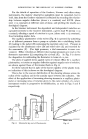
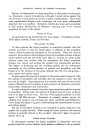
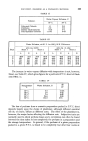
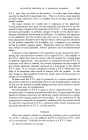
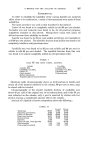
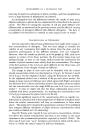
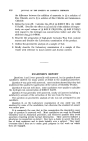
POLYVINYL CHLORIDE AS A PACKAGING MATERIAL TABLE II Water Vapour Diffusion, P. Polymer. 15 ø C. 37 ø C. Polyvinyl Chloride 1.1 2.0 Polythene 0.2 0.9 Rubber Hydrochloride 0.15 0.7 Polyvinylidene Chloride 0.01 0.05 TABLE III Water Diffusion, at 60 ø C. for 100% R.H. Difference. gms./sq. metre. gms./sq. m./day, Days Sheet 1 Sheet 2 Sheet 1 Sheet 2 A B A B A B A B 2 88-0 97-1 74-4 64.6 44.0 48.5 37.2 32.3 3 132 145 108 98'6 44-0 48-3 36.0 32.9 4 170 191 143 125 42.5 47-7 35-7 31.2 6 284 328 240 210 47'3 54'7 40.0 35.0 7 331 365 274 236 47.3 52' 1 39.1 33.8 389 The increase in water vapour diffusion with temperature is not, however, linear, see Table IV, which gives figures for a particular P.V.C. sheet of thick- ness 0.012. in. TABLE IV dP Temperature Water Diffusion, P. -- T. dT 20 ø C. 0.3 0-075 30 ø C. 1.9 0.42 37 ø C. 7.4 0.85 50 ø C. 24.8 2.28 60 ø C. 104.2 37.5 The loss of perfume from a cosmetic preparation packed in P.V.C. sheet depends largely upon the choice of plasticiser, although different essential oils do, of course, diffuse at different rates. The effect of the plasticiser is, however, the major factor affecting the diffusion rate. Subjective tests are normally used to check perfume losses and a correlation can often be found between the time taken to lose completely the perfume in a preparation and the storage temperature. In general, if the perfume of a given preparation packed in a given P.V.C. is found to be completely lost after four weeks at
Purchased for the exclusive use of nofirst nolast (unknown)
From: SCC Media Library & Resource Center (library.scconline.org)