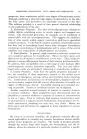
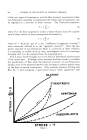
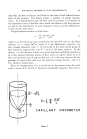
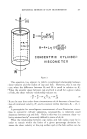
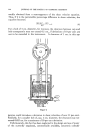
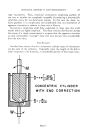
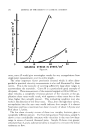
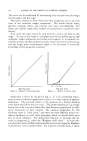
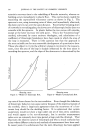
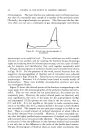
286 JOURNAL OF THE SOCIETY OF COSMETIC CHEMISTS an instrument where a constant shear velocity is obtained, can these pa-• rameters be accurately described. With an instrument yielding a distribu-• tion of shear velocities, the sum of a distribution of 7' values will be rained leading to misinterpretations of the parameters of the equation. SHEAR GRADIENT IN CAPILLARY VISCOMETERS From simple derivations the shear velocity relationships in capillary instruments can be shown to be: dv _ rp (6) dr 2L This equation describes how the shear velocity is a function of the dis- tance, r, from the center of the capillary to the concentrically moving, cy- lindrical flow elements as shown in Fig. 2, and how complicated the flow relationships must become where, in non-Newtonian liquids, n*, becomes an unknown function of dr/dr. A decided deficiency of capillary instruments in measuring liquids with anomalous flow properties consequently becomes apparent: dr/dr varies over the whole of the flowing liquid stream, from the axis of the capillary where dr/dr = 0 to the inside of the capillary walls, where dr/dr attains its greatest value Rp/2Ln. As a consequence, a whole distribution of shear velocities, which again is a function of the degree of deviation from Newtonian flow, is obtained in each measurement of extruded volume, o•, at a given pressure, p. From this a backward inter- polation of the apparent viscosity/shear velocity relationships must be made. Although a number of attempts have been made to carry out this corre- lation between • and p and dr/dr and 7*, respectively, these methods are very complicated and cumbersome and are not always reliable for fluids deviating considerably from Newtonian flow (8-11). SHEAR GRADIENT IN CONCENTRIC CYLINDER VISCOMETERS For properly constructed rotational viscometers, this limitation is not valid and definable. Relatively constant shear velocities can be readily produced over a considerable absolute shear range. This is the fact which has encouraged the use of rotational type instruments despite their comparative complexities, rather than capillaries for the measurement and study of non-Newtonian liquids. In the concentric cylinder viscometer, Fig. 3, the shear relationships, dv/dr, in the cylindrical flow laminae can readily be shown to be: r dr dr • (R? -- R?)3 (7) where//• is the angular velocity, R0 is the radius of the cup, R, is the radius of the bob and Ro r Ri.

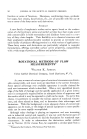
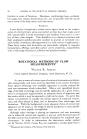
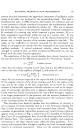
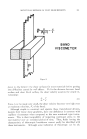
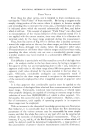
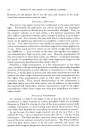
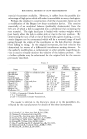
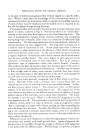
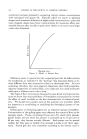
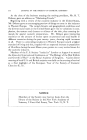
ROTATIONAL METHODS OF FLOW MEASUREMENTS 287 •rr = 2W (R•- R•)_J 2 2 M=4-Lr t ) i,• o i, M CONCENTRIC CYLINDER VISCOME TER Figure 3. This equation, too, appears to yield a complicated relationship between shear velocity and the radius of cup and bob. However, this is not the case when the difference between R0 and Ri is small in relation to Rz. When the annular space between cup and bob is small for a given radius of bob, the shear velocity relationship reduces to: dw dv I• R• - [/F R r dr - dr- Ro -- a• (8) It can be seen that under these circumstances dr/dr becomes a linear func- tion of rotational velocity, H/, and is constant within the limits Ro - R• = AR. A prerequisite for unambiguous measurement of non-Newtonian viscos- ities in concentric cylinder apparatus, consequently, is relatively small clearance between cup and bob. Only in this way is a constant shear ve- locity attained and r•* accurately defined in terms of dr/dr. What the relationship between cup radius and bob radius must be in order to remain within the limits of a given percentage deviation be- tween the shear velocity at the cup surface and at the bob surface can be
Purchased for the exclusive use of nofirst nolast (unknown)
From: SCC Media Library & Resource Center (library.scconline.org)