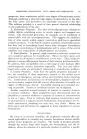
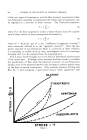
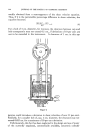
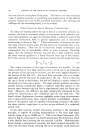
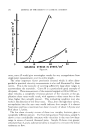
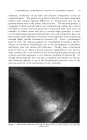
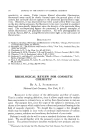
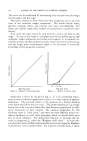
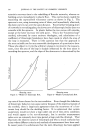
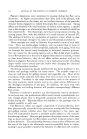
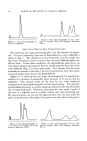
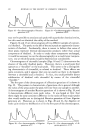
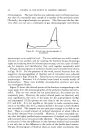
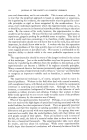
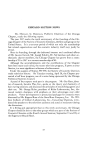
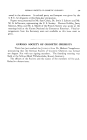
284 JOURNAL OF THE SOCIETY OF COSMETIC CHEMISTS of the two types of instruments, and the flow anomaly encountered when non-Newtonian materials are measured with either type of equipment can be regarded as a function of shear velocity. The Newtonian equation= dv F -- z/-jz 'w (3)1 where F is the force required to attain a shear velocity dv/dz for a given area of shear surface z/, must consequently be altered to: d• 'v* (4)1 F=A'•z where rt* = 'I'(dv/dz) and rt* is the "coefFicient of apparent viscosity,'", more commonly referred to as the "apparent viscosity." Since the parent viscosity of non-Newtonian fluids is a function of shear velocity,I it is necessary to confine dv/dz to close, unambiguous limits if a meaning- 1 ful value of 7' is to be extracted from the measured data. This is most clearly brought out on the basis of theoretical achievementsl of the recent past. Although many attempts had been made to correlatel the mechanisms of flow with the physical structure of non-Newtoniam liquids, most of the proposed theories only attempt to explain special casesl on the basis of special assumptions. Only recently, however, Eyring andl Ree (6, 7) have proposed a generalized theory which apparently welll OlLATENT z I THIXOTROPIC ! •o •o• ø NEWTONIAN ß PSEUDOPLASTIC STRESS - "r' Figure 1.

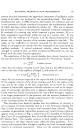
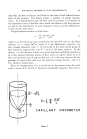
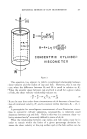
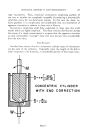
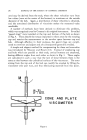
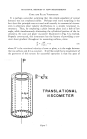
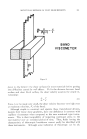
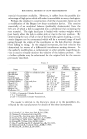
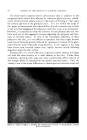
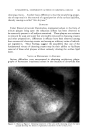
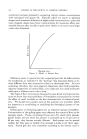
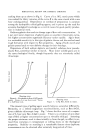
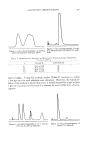
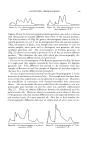
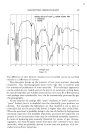
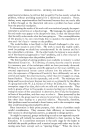
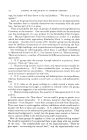
ROTATIONAL METHODS OF FLOW MEASUREMENTS 285 describes the flow of plastics and fluids on the basis of well defined param- eters of the systems. The theory makes a number of simple assump- Itions. It is hypothesized that the flow rate of a system is a function of Ithe relaxation times of the flow units which contribute to the flow process, las well as the distribution of such relaxation times, and the deformation Iof the system with stress. The generalized equation is of the form: rl* = • x,,fi,• sinh -1 l•nD (5) •where x• is the fractional area occupied by the nth flow unit on the shear isurface d• = (XX2Xa/2kT)n, where k is the Boltzmann constant Ithe average relaxation time = {1/[(X/X•)2k']} for each related group of I flow elements, respectively and F = dr/& is the shear velocity. In the labove: X is the distance a flow unit moves between equilibrium positions IX• is the distance between planes of flow units of a given kind X3 Xa is the cross-sectional area of a given flow unit k' is the rate constant for the passage of a given flow unit over the potential energy barrier and T is the absolute temperature. Since an interpretation of x, a and fi can, at the present time, be made only in terms of r/* and D, it becomes immediately apparent that only in dv dr CAPILLARY VISCOMETER Figure 2.
Purchased for the exclusive use of nofirst nolast (unknown)
From: SCC Media Library & Resource Center (library.scconline.org)