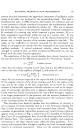
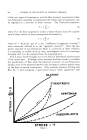
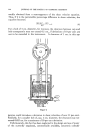
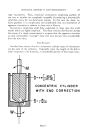
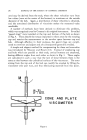
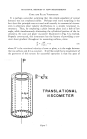
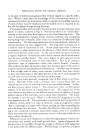
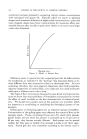
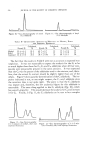
294 JOURNAL OF THE SOCIETY OF COSMETIC CHEMISTS tained by changing the length of the shear surface, this procedure is cum- bersome, and more adequate, theoretically valid, results can be obtained with the true rotational instruments on thixotropic fluids. N•.•.D FOR VaRious The Ree-Eyring equation (5) shows how the apparent viscosity of anom- alous flow systems is a function of the average relaxation time, fi•, of the flow element involved. For many non-Newtonian fluids, the general equation takes the specific form: •/* $1/•1 -1- x2/52 sinh -1/g2D xs/Ss sinh-•/5, D (13) where the first term of the equation refers to the NewtonJan contribution, often signified as r•, the viscosity at infinite shear velocity, whereas the second and third terms contain the elements contributing to the flow anom- aly due to the different relaxation times. Ree and Eyring have found that three terms are usually sufficient to characterize the majority of non- . NewtonJan fluids, although often only the first two terms are required. If the relaxation times •5, and •a are fairly close together and are of an . intermediate value, a viscosity measurement in the intermediate shear ' range will suffice to characterize the liquid. If, however, as is often the case, •, and •Sa are substantially different, and one is very small and the other very large, viscosity measurements in the range covered by a single instrument are often not enough to adequately characterize the system. This is true because the shear velocity range of most, even very good, viscometers is limited to a range of about 200:1 or 1/2 per cent of the maxi- mum value. Thus, if the upper shear range limit of a device is, for ex- ample, 2000 sec. -1, the lowest values identifiable will be about 10 sec. -1. Similarly a viscometer with an upper range of 10 sec. -1 will have a lowest range of 0.05 sec.-1. If only the higher shear device is employed, the com- ponent with the long relaxation time may consequently be missed com- pletely, whereas if the lower shear instrument were employed for measuring the same material, the short relaxation time material would not be found. Although this point may appear to be only of academic interest, it has a very profound practical significance. As in many other commercial fields dealing with fluids and pastes, the cosmetic industry is concerned with a surprisingly large shear velocity range for the practical application of its products. Thus, the act of applying hand creams or face creams may subject the material to shear rates as high as 10,000 sec. -1. This is due to the extremely thin layers being applied which cause these high shear ve- locities according to equation (12), even with moderate movement of the hand. Furthermore, for aesthetic appeal and other reasons, these ma- terials may often be formulated with considerable' rheological structure

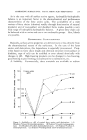
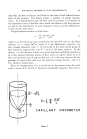
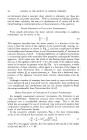
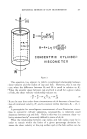
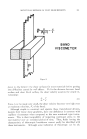
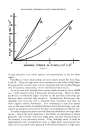
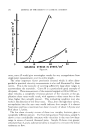
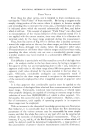
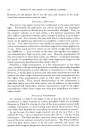
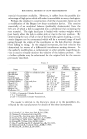
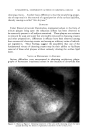
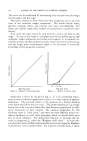
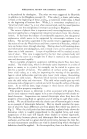
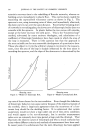
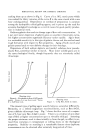
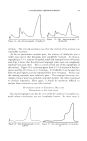
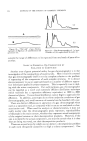
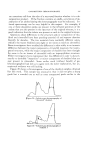
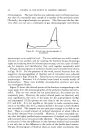
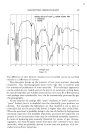
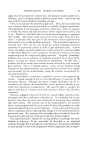
ROTATIONAL METHODS OF FLOW MEASUREMENTS 295 IO B o I 5 5 SHEARING STRESS IN DYNES/CM a X II• s Figure 9. of long relaxation time which appears most prominently in the low shear region. The effects of these relationships are more clearly discernible from Figs. 9 and 10. These are high shear curves produced on the Asbeck High Shear Viscometer (16) and low shear curves, measured with the modified Bergen (14) Viscometer, respectively, of two commercial hand creams. As can be seen from the high shear curves, which extends to about 10,000 sec. -• both materials show a thixotropic hysteresis loop. However, Sam- ple B has a considerably higher viscosity at the practical commercial ap- plication shear velocities than sample A. Furthermore, B possesses con- siderably more structure with a relatively short relaxation time than A, which appears almost NewtonJan. It is interesting to note that repeat runs on the same batch of material eliminate the hysteresis loops, and sub- sequent up and down curves lie on the down curve produced on the first run. A number of pertinent points are well illustrated with these two high shear curves. One of the most important is the futility of attempting to obtain generally valid viscosity data from single point viscosity measurements if the material is not previously known. Thus, although curve .4 could be approximated with extrapolations from a single point measurement be- cause of its reasonably close approach to NewtonJan behavior at high shear
Purchased for the exclusive use of nofirst nolast (unknown)
From: SCC Media Library & Resource Center (library.scconline.org)