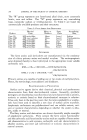
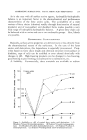
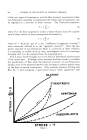
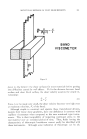
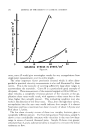
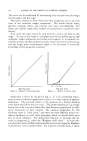
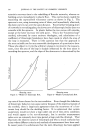
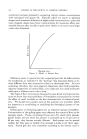
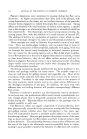
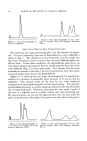
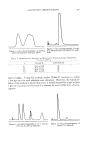
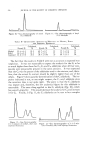
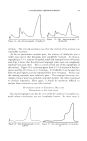
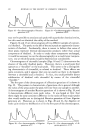
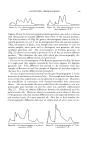
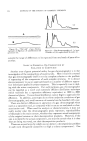
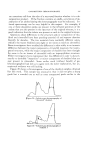
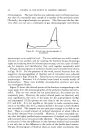
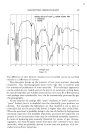
308 JOURNAL OF THE SOCIETY OF COSMETIC CHEMISTS The curve can be established by determining only one point and drawing a line through it and the origin. Most pure substances show NewtonJan flow properties, and so do solu- tions of low molecular weight compounds. This would include water, glycerin, alcohols, ethers, and common oils, esters, and aldehydes. For these, any reliable single point method of measurement is perfectly satis- factory. Now comes the major reason for such extensive work in the field of the- ology. As soon as you begin to add pigment particles, gelling agents, high molecular weight substances, and surface active agents, or to emulsify im- miscible systems, the flow properties nearly always become non-Newtonian• and the single point measurement ought to be discarded if reasonable knowledge of flow properties is desired. Shearing stress Figure 1.--Model of NewtonJan flow. ,, 1 Shearing stress Figure 2.--Model of plastic flow. Plastic flow is shown by the plot in Fig. 2. It is of considerable impor- tance in many industrial applications, since it is so often typical of pigment dispersions. The essential feature is the presence of a limited shearing stress below which flow does not occur. The system behaves as if an energy barrier has to be overcome before flow then becomes proportional to addi- tional increments of force exerted. The common designation for this minimum stress is "yield value," and there are three different points con- sidered significant as yield value intercepts, which we should settle upon here to avoid confusion. The dotted line extension to intercept the ab- scissa is designatedfB, called the "Bingham yield value." It is the only one which has been justified mathematically and was developed by Bingham in his pioneer work on plastic flow. On a purely scientific basis, it seems

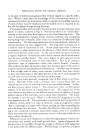
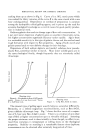
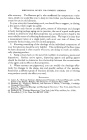
RHEOLOGICAL REVIEW FOR COSMETIC CHEMISTS 309 to be preferred by rheologists. The other two were suggested by Houwink in addition to the Bingham concept (2). The valuefL, a lower yield value, is fixed at the beginning of shear, andf•f, a maximum yield value, is fixed at the beginning of laminar flow. While fL is sometimes employed as a "practical yield value,"fu is not often encountered, and the usual practice today is to use the extrapolated intercept according to Bingham. The nature of plastic flow is important and interesting because so many practical applications of pigmented industrial products have this charac- teristic. It has been the sub•iect of considerable argument, but the general explanation which seems to be supported by microscopic evidence is as follows. The particles suspended in the system tend to aggregate through the action of van der Waals forces and form a network of floccules, which in turn are broken down through shearing. During shear both breaking down and reformation are taking place, and a steady state can be achieved if the shear rate is held constant. A type of equilibrium will be reached at each rate of shear. This view is supported by the fact that a plastic body will come down the curve in a straight line if shear is started at the maximum rate and decreased rapidly. Many examples of pigment suspension exhibiting plastic flow have been studied. The yield value, which is obviously quite important in a tube of paste or cream, or in a paint, for example, can be varied in a given sys- tem by a number of factors. The addition of surface active agents will lower yield values, as a rule, by improving the wetting of the particles. Agents which defiocculate particles give lower yield values flocculating agents raise yield values. Materials which increase interfacial tension will raise the yield value and vice versa. The yield value usually goes up with increasing ratio of pigment to vehicle and with the specific surface of the pig- ment. As we will see later, large changes in these factors will often alter the type of flow property completely. The property known as thixo/ropy is often associated with plastic flow, and in some respects would appear to be a sort ofsubspecies with closely re- lated character. Suspensions are termed thixotropic when they have the property of becoming fluid on agitation and of setting to a gel when undis- turbed. We are all familiar with the classic case of bentonire gels in water as an example of thixotropic behavior. But we should consider the ques- tion of what the basic differences are from plastic flow which was shown in Fig. 2. When the yield point has been exceeded, a plastic body shows de- formation which is roughly proportional to the applied force, and many suspensions of this type will liquefy when shaken or stirred vigorously. The similarity between plastic and thixotropic flow has been a source of confusion, and has led to a great deal of controversy, because the time fac- tor and measurement conditions are vital in determining which theological definition should be applied. In thixotropic flow, there is a finite and char-
Purchased for the exclusive use of nofirst nolast (unknown)
From: SCC Media Library & Resource Center (library.scconline.org)