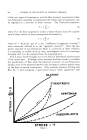
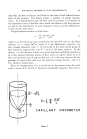
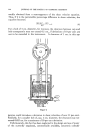
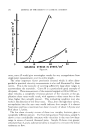
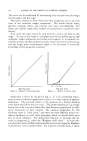
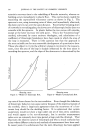
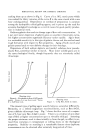
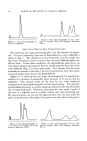
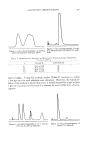
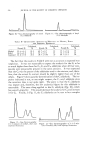
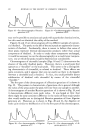
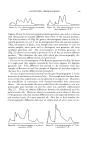
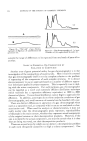
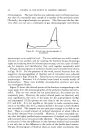
310 JOURNAL OF THE SOCIETY OF COSMETIC CHEMISTS acteristic recovery time in the rebuilding of floccule networks, whereas re- building occurs immediately in plastic flow. This can be shown readily by examining the cup-and-bob viscometer curves as shown in Fig. 3. The upcurve is run, using increasing rates of shear, and immediately afterward, the down curve is run over the same distance. Since further breaking down of networks is not taking place, the downcurve of thixotropic bodies does not coincide with the upcurve. In plastic bodies the two curves will coincide, except at the lower end near the yield point. This is the "hysteresis loop" method, advocated by many eminent rheologists, and calculations of a coefficient of thixotropic breakdown have been made in which the area of the loop is measured. There is little question but that the approach is the most suitable one for any reasonable development of quantitative data. Those who object to it cite the arbitrary elements involved in the measure- ment, since the area of the loop is sharply influenced by the time taken in recording the upcurve, and the slope of the downcurve is determined by the Shearing stress Figure &--Model of thixotropic flow. Shearing stress Figure 4.--Model of pseudoplastic flow. top rate of shear chosen for the test condition. Even though this definition of thixotropic behavior may seem narrow because of the empirical nature of the method, there is large-scale agreement that the occurrence of a hys- teresis loop should be the deciding factor. It is understood that certain suspensions would not show a loop under one set of time-stress conditions and would appear to be non-thixotropic but in another measurement taken over an extremely short time period, a loop could be obtained. That illustrates the relative nature of thixotropy and why so much confusion has arisen where different criteria and methods of measurement have been used. In recent years it is unfortunate that the term thixotropy has been applied

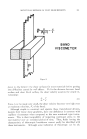
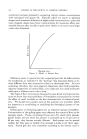
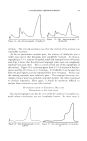
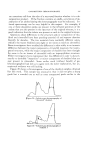
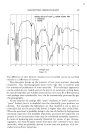
RHEOLOGICAL REVIEW FOR COSMETIC CHEMISTS 31I to all types of bodies having plastic flow without regard to a specific defini- tion. Where a need exists for knowledge of the time-recovery factor in a commercial product, an instrument which is capable of controlled variation of rates of shear must be employed and the double curve is required to de- fine the rheological change during shearing. tseudoplasticflow starts out like Newtonian flow and then becomes more plastic in nature, as shown in Fig. 4. Notice that there is no "yield value" concept in this case, since flow begins at a very small shearing stress. The class of pseudoplastics includes mostly resinous materials and compounds having long chain molecules, either alone or in solutions of sufficiently high concentration. The following explanation of the pseudoplastic behavior in resinous products has been suggested (3). The long chain molecules are in a random state of orientation at rest. At low shear rates there is little or no tendency to align themselves in the direction of flow which corresponds to the lower portion of the curve. As the rate of shear increases, however, a regular alignment of molecules starts which reduces the frictional resist- ance between parallel chains. The curve begins to turn upward as the resistance to increasing rates of shear diminishes. This is, of course, a speculative type of explanation rather than strictly factual. Consider- able evidence has been advanced to show that the lower part of the curve is actually non-linear and therefore non-Newtonian. Another note of interest is that at high rates of shear, some resinous materials have been shown to give hysteresis loops in the upper portion of the curve only, though the up- and down-curves coincide over the rest of the range. There is one other generally recognized type of flow which is not New- tonian. Materials which tend to become more viscous when they are sheared and to revert to a flowing state at rest are called all/atari/. A dilat- ant flow curve is shown in Fig. 5. The consistency curve at first glance appears to be the reverse of a pseudoplastic one. The original use of the term dilatancy was based on the dilation and increase in rigidity of closely packed masses of fine particles, such as sand, when disturbed. The famil- iar example is wet sea sand. When it is disturbed by stepping on it, the area appears to dry off. The explanation is postulated that the particles of a dilatant system settle to a state of minimum voids, and agitation causes them to rearrange to a larger void volume, causing any free suspending liq- uid to be drawn into the mass. Actually, the dilation of the mass on shear- ing is not considered a primary requirement today, since it is considered likely that materials exist with consistency curves of this type which do not show volume changes (4). Dilatancy occurs most frequently at relatively high pigment volume con- centrations and usually with small particle sizes. Aging of pigment dis- persions has a strong effect, though the change in dilatancy with aging time is not predictable for different cases. Particle shape is important, and good
Purchased for the exclusive use of nofirst nolast (unknown)
From: SCC Media Library & Resource Center (library.scconline.org)