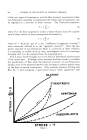
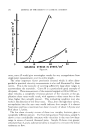
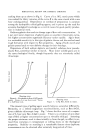
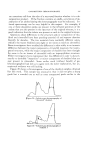
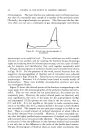
298 JOURNAL OF THE SOCIETY OF COSMETIC CHEMISTS However, for the present this is not the case, and recourse to the tradi-i tional flow measurements must be taken. Im)US•'RIA•. RUEOLOGY This picture may appear excessively complicated to the industrial rheol-I ogist. Fortunately, for application and control purposes, the rheologicall information required or desired may be considerably abridged. Thus, inl the cosmetic industry, as in most others, a few behavior parameters will often suffice to determine whether a given sample of product is up to speci- fication or not. For instance, the ease with which a hand cream or face cream can be applied may determine its suitability or reject it for commer-: cial sale. Very often this factor can readily be ascertained by a few vis-• cosity measurements carried out in the shear range of the actual application • or use. Thus, hand and face creams can be tested at high shear rates of, I say, 10,000 sec.-L Low viscosity at this shear rate signifies easy applica-• tion characteristics, high viscosity, poor ones. However, measurement ofl this characteristic at lower shear values, say 500 sec. -• could give meaning-'• less results if extrapolated into the high shear application range for the l reasons previously described and illustrated in Fig. 9. Similarly, a single measurement, or a few measurements at low shear l rates, suitable to the particular parameter controlling industrially desirable i structure of the product may be sufficient to characterize it in this region., However, it should again be pointed out that these measurements must be l made in the shear range of practical interest, and that extrapolations into l this region from measurements made at other shear rates may lead to• erroneous results. Thus, several determinations on two instruments, a l high shear device and a low shear device, may be sufficient to characterize 1 the material well industrially, whereas measurements made in the region intermediate to these shear ranges may often give insignificant and mean- ingless results. AVAILABLE VISCOMETERS No attempt is made in this paper to list or describe all the rotational viscometers or those working on similar principles which are available. However, in Table I is a listing of a few of the more common commercially available viscometers, or those having some special characteristics which may make them desirable for some phase of cosmetic research or control. As can be seen, the shear ranges covered vary all the way from a low value of 10 -ø sec. -• up to a maximum of more than 104 sec. -• for the various instruments. The shear gradient constancy leaves much to be desired in some of the more common commercial instruments. The Ferranti-Shirley cone and plate device seems to be the most versatile and covers' the greatest shear range at the greatest shear rate constancy of any of the corn-

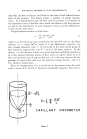
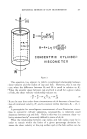
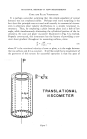
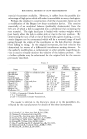
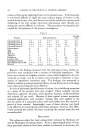
ROTATIONAL METHODS OF FLOW MEASUREMENTS 299 i mercial viscometers available. However, it suffers from the possible dis- • advantage of high price which will make it unavailable to many rheologists. Perhaps the simplest in construction of all the viscometers listed can be •a modification of the Bergen low shear translation device. This consists l essentially of an analytical balance (preferably chainomatic) from the I left arm of which a bob is suspended into a cylindrical vial containing the I test material. The right hand pan is loaded with various weights which j just barely allow the bob to either sink or rise in the test medium. By determining the rate of fall or rise of the bob with a given loading, a stress- strain diagram can be constructed which will be a reversed image of itself going through the origin of the coordinates as the bob direction changes from falling to rising. In the original instrument, the bob velocity was determined by means of a differential transformer sensing element. In the author's modification, a cathetometer or other suitable magnifying de- vice is used to visually monitor the velocity of the balance pointer. Also a hollow cylinder may be substituted for the original bob for the reasons previously described. TABLE I Approximate Shear Shear Range Gradient Thixotropy Name Type in Sec. -1 Constancy Measurabe Brookfield CCR* or cylindrical plate 10-•--102 MacMichael CCR 1-10 • Stormer Paddle Undefined Interchemical CCR 100--3 X 10² Hercules Hi-Shear CCR 10--5 X 10 a Ferranti-Shirley Cone and plate 20--2 X 10⁴ Merrill (17) CCR 3 X 10=-6 X 10 a Asbeck (18) CCR 10=2 X 10⁴ Band (15) Band, Tt 10--5 X 10⁴ Bergen (14) CCT:• 10 ø-10-2 Pochetino (13) CCT 10 6-10 2 Poor Yes Poor Yes Very poor No Fair Yes Fair Yes Very good Yes Very good Yes Very good Yes Very good No Fair No Fair No * CCR = Concentric Cylinder Rotational. t T = Translational. :• CCT = Concentric Cylinder Translational. The reader is referred to the literature cited, or to the pamphlets dis- tributed by the manufacturers for details of the other instruments. REFERENCES (1) Coulomb, C. A., Mere. inst. Natl., 3, 261 (1798). (2) Newton, I., Principia Lib. ii, Sect. IX. (3) Couette, M., Atnn. chim. phys., 21,433 (1890). (4) Stokes, G. G., Math. and Phys. Papers, 1, 75 (1880). (5) Reynolds, O., Philo. Trans., 177, 171 (1886). (6) Eyring, H., •7. Chem. Phys., 4, 283 (1936). (7) Ree, T., and Erring, H., •7- AtppliedPhys., 26, 793 (8) Rabinowitsch,'B., Z. physik. Chem., A-145, 1 (1929). (9) Mooney, M., y. RheoL, 2, 210 (1931).
Purchased for the exclusive use of nofirst nolast (unknown)
From: SCC Media Library & Resource Center (library.scconline.org)