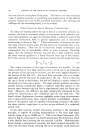
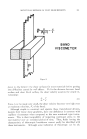
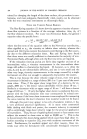
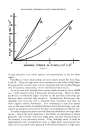
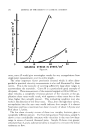
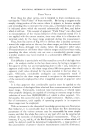
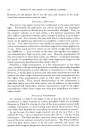
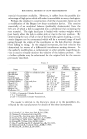
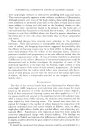
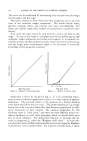
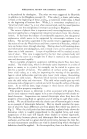
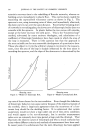
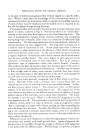
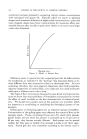
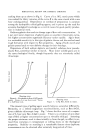
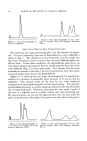
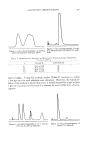
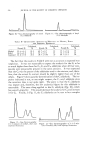
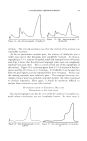
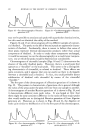
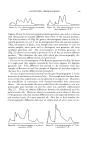
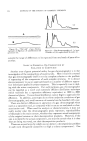
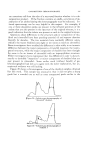
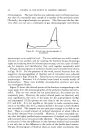
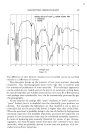
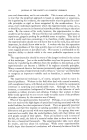
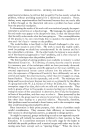
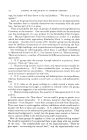
326 JOURNAL OF THE SOCIETY OF COSMETIC CHEMISTS chromatogram. The main fraction was collected, and its infrared spectrur• was that of a reasonably pure sample of a member of the menthone series Obviously, the original sample was spurious. This illustrates the fact thai very often one can use a ccrnbination of gas chromatography and infrare0 Figure 30.--Isolative gas chromatography of citronellol I. spectroscopy as an analytical tool. The two techniques are really comple-I mentary to one another, and by isolating the fractions by gas chromatog-I raphy and studying them by infrared spectroscopy, one has a pair of meth- ods for isolation and identification that work together remarkably well. The gas chromatograms of authentic rhodinol and citronellol were shown in Figs. 16-19. For the purposes of this work, several fractions from the respective chromatographies of rhodinol and of citronellol were collected as illustrated in Figs. 29 and 30. These fractions were examined by infrared spectroscopy. Fractions 1-4 of rhodinol were found to consist mostly of hydrocarbons. These were probably decomposition products and were: not investigated further. Figure 31 shows the infrared spectra of the fractions corresponding to the major peaks from the chromatographies of the authentic rhodinol and citro- nellol. They are very similar but not quite identical the isolates are not completely pure. However, the major infrared peaks are identical, and, most significantly, the ratios of the peaks for the isopropylidene (12.0/•) and isopropenyl (11.25u) groups are very close in the two curves that is, 0.57 and 0.49. It is not possible at this point to make conclusive state- ments to the effect that the C•0 terpene alcohol is the same in both rhodinol and citronellol. The samples are not quite pure enough to be able to say that. There is a small amount of carbonyl absorption at about 5.85/• in the alcohol obtained from citronellol. However, it seems reasonably cer- tain that the highly purified major components of rhodinol and citronellol will eventually prove to be practically identical. The important conclusion at this point is that the difference in odor between rhodinol and citronellol is not only due to the difference in the ratios of the double-bond isomers. The gas chromatogram of rhodinol shows so many other constituents that

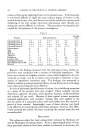
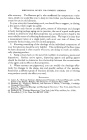
GAS-PARTITION CHROMATOGRAPHY INFRARED SPECTRA OF A•AJOR C10 TERPENE ALCOHOL FROA• A CITRONELLOL B RHODINOL 327 2 3 4 S 6 7 8 9 10 11 12 13 14 i$ Wa•eJength, microns Figure 31. Ithe difference in odor between rhodinol and citronellol cannot be ascribed •merely to a difference in isomers. This discussion brings up the question of how pure aromatic chemicals i should be. Gas chromatography shows every sign that it could be used l for commercial purification of some materials. The technique apparently I can be scaled up very readily and can be put on an automatic cycling basis. I It may develop that any suitable chemical that costs over $5 or $10 a pound, land perhaps even considerably less, can be commercially processed by gas I chromatography. All the essential oil catalogs offer "pure" rhodinol, or "pure" geraniol or '"pure" linalool, but it is doubtful that the chemically pure products are desired. For example, the indications are that rhodinol is not as pure as citronellol and yet the price of the former is higher than that of the latter. What the purchaser is probably doing in the case of rhodinol is buying some extremely expensive and desirable impurities, and since the impurities are present in low concentration they may be considered extremely expensive. In terms of producing pure aromatic chemicals by means of gas chroma- tography, one must be quite certain how pure one's customers want these materials what are probably desired in most cases are products with con- trolled and uniform impurities.
Purchased for the exclusive use of nofirst nolast (unknown)
From: SCC Media Library & Resource Center (library.scconline.org)