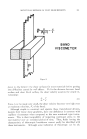
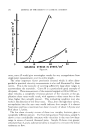
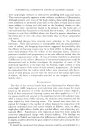
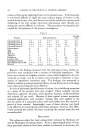
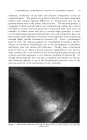
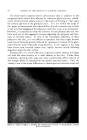
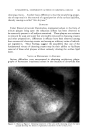
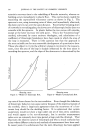
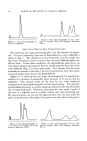
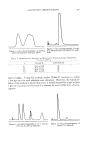
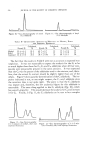
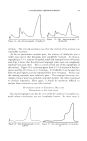
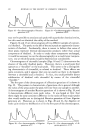
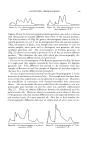
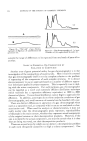
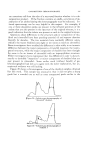
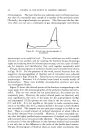
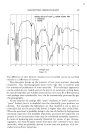
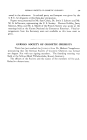
FUNDAMENTAL, COMPARATIVE ACTIONS OF CLEANSING CREAMS 305 cleansing creams. Another basic difference is that the emulsifying proper- ties of soap result in the removal of a good portion of the surface lipid film, thereby causing so-called "skin dryness." SUMMARY Under filtered ultraviolet illumination, inspissated sebum in the form of minute plaques lying upon the sebaceous orifices has been observed to be commonly present in all subjects examined. These plaques are resistant to removal by soap and water but are readily removed by cleansing creams and other preparations differences in efficacy have been observed among four commercial cleansing creams and among an arbitrary series of individ- ual ingredients. These findings suggest the possibility that one of the fundamental virtues of cleansing creams may be their ability to facilitate removal of these sebal plaques without seriously altering the surface lipid layer. . NOTES IN REFERENCE TO FIGURES Serious difficulties were encountered in obtaining satisfactory photo- graphs of fluorescent inspissated sebum in vivo because of ultraviolet film Figure &--Same as Figure 1 following treatment of the area with cleansing cream for sixty seconds showing the absence of glandular excretions in the surface pores.

306 JOURNAL OF THE SOCIETY OF COSMETIC CHEMISTS sensitivity, et cetera. Under intense filtered ultraviolet illumination, fluorescent areas could be clearly focused upon the ground glass of the camera but curiously did not appear in the processed panchromatic nega- tives. However, it was discovered that when a pale yellow filter was used on the lens during exposure, the fluorescent sites were recorded in excellent detail and were greatly dependent upon the density of the particular filter used. The accompanying figures are presented as general examples of sebum fluorescence and glandular excretion. All were photographed by Lewis J. Sunny, B.P.A., using filtered ultraviolet light as the sole source of illumination. BIBLIOGRAPHY (1) Rothman, Stephan, "Physiology and Biochemistry of the Skin," Chicago, The University of Chicago Press (1954), pp. 284-336. (2) Montagna, W., "The Structure and Function of Skin," New York, Academic Press, Inc. (1956), pp. 255-293. (3) Weitkamp, A. W., •. •lm. Chem. Soc., 67, 447 (1945). (4) MacKenna, R. M. B., Wheatley, V. R., and Wormall• A., 7. Invest. Dermatol., 15, 33 (1950). (5) Wheatley, V. R., St. Bartholomew's bjrosp. 7, 57, 5 (1953). (6) Rothman, S., and Schaaf, F., in Jadassohn, "Handb. d. Haut- u. Geschlechtskr.," Vol. 1, Berlin, J. Springer (1929), p. 161. (7) Peck, S. M., Rosenfeld, H., Leifer, W., and Bierman, W., dcrh. Dermatol. and Syphilol., 39, 126 (1939). (8) Burtenshaw, J. M. L., 7. Hyg., 42, 184 (1942). RHEOLOGICAL REVIEW FOR COSMETIC CHEMISTS* By A. L. SeARBROUGH National Lead Company, New York, N.Y. RHF. OLO•V is the science of the deformation and flow of matter. That is a rather sweeping definition, since it allows ample room for studies from mayonnaise to volcanic lava, as well as from blood serum to wet sea sand. Our purpose here, since the scope of the subject is enormous, is to choose a few aspects which might have a direct and practical bearing in the field of cosmetic chemistry. We should like to suggest a few thoughts which may be helpful in your work of continual improvement of various pastes, creams, solutions and emulsions, the bulwark of your trade. Perhaps it would also be well to enter a standard disclaimer clause at this point. We are all familiar with the necessary custom in the chemical in- dustry. The printed brochure describes wonderful new products and rec- * Presented at the October 24, 1956, Meeting, New York Chapter, New York City,
Purchased for the exclusive use of nofirst nolast (unknown)
From: SCC Media Library & Resource Center (library.scconline.org)