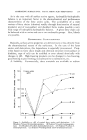
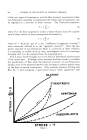
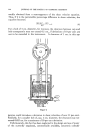
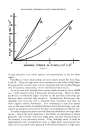
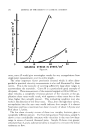
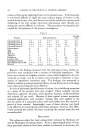
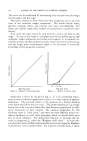
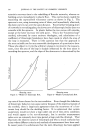
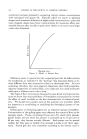
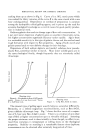
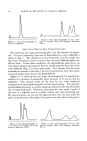
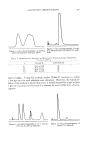
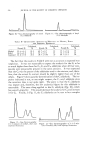
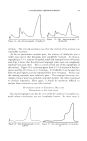
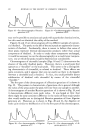
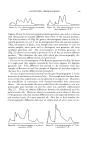
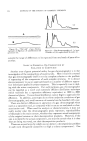
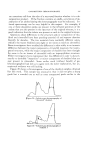
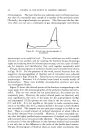
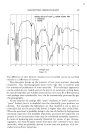
296 JOURNAL OF THE SOCIETY OF COSMETIC CHEMISTS B I 0 I0 20 SHEARING STRESS IN DYNES/CU Figure 10. rates, curve B would give meaningless results for any extrapolations from single point measurements over its entire length. The other important factor previously stressed which is often disre- garded in practical viscosity measurements is also well illustrated by these curves. This is the necessity of covering sufficiently large shear ranges to accommodate the materials. Curve B is a particularly good example of this point. Were measurement of the material stopped at 500 to 1000 sec. -• shear velocity, a completely erroneous picture of the viscosity at the ap- plication shear rates would result, with apparent values some four or five times higher than actually present. This misleading condition may also work in the direction of low shear rates. Thus, from the high shear curves, extrapolation into the zero axes would indicate that sample A is almost Newtonian and has a maximum low shear viscosity of about 1.8 poise and B of about 5.5 poise. The low shear viscosity curves of these two samples, however, give a completely different picture. Far from being almost NewtonJan, sample A shows a very considerable structure with viscosities in the very low shear range in excess of several thousand poise. Sample B shows even greater structure than A, and a substantial stress is required to overcome the initial resistance to flow.

ROTATIONAL METHODS OF FLOW MEASUREMENTS 297 YIELD VALUE From these low shear curves, one is tempted to draw conclusions con- i cerning the "Yield Values" of these materials. By laying a tangent to the I steeply rising portion of the curves where it appears to become straight land extending this to intersect the stress axis, a threshold value of stress i is indicated above which the material substantially will flow, and below i which it will not. This concept of apparent "Yield Value" can often lead I to misconceptions of the viscous behavior of the materials tested if it is •not applied with the utmost caution, since very often it is a function de- I termined solely by the shear range employed during the measurement. Thus, from the curves of Fig. 10 it is obvious that a decided curvature toward the origin exists at the very low shear ranges, and that the material obviously flows, although very slowly, below the apparent yield value. If measurements at still lower shear velocity ranges could have been made, spreading the shear velocity axis out over a considerably greater range, a similar analysis may have resulted in a substantially different apparent yield value. This difficulty is particularly well illustrated by curve B of the high shear plot. An analysis similar to the low shear curve, by laying a tangent to the upcurve of this run and extrapolating down to the r axis, indicates an apparent yield value in this shear range about 180 times greater than the apparent yield value obtained for the same material in the low shear re- gion. Obviously, considerable ambiguity can consequently result if some regard to the shear range covered is not given in the interpretation of the commonly employed but often misapplied concept of apparent yield value. It is thus apparent that considerable caution must be applied to the interpretation of theological data obtained from measurements in a limited shear range. Fortunately, rotational type instruments, or related types when properly designed, are capable of covering an extreme range in shear velocities of more than 10,000,000,000 to 1 which is often required. Un- fortunately, this cannot be done by a single instrument. Rather, a num- ber of instruments, each capable of operating properly in its respective shear range must be employed. With an increase in the theoretical knowledge governing non-Newtonian flow behavior, it is conceivable that in the future the flow determining parameters of the various systems may be measurable by some simple means, and that the whole flow curve or any part of it can be constructed without the necessity of obtaining rheological measurements. Thus, for instance, if x•, •,•, and 3•, of the Ree-Eyring equation or others which will surely be derived could be determined independently, a large portion of the uncertainties of present viscosity measurements could be eliminated.
Purchased for the exclusive use of nofirst nolast (unknown)
From: SCC Media Library & Resource Center (library.scconline.org)