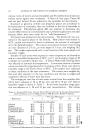
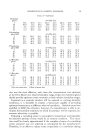
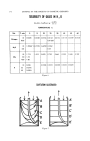
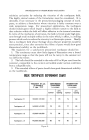
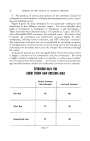
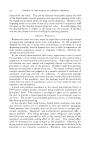
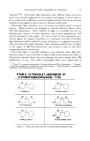
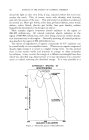
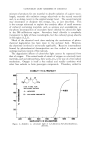
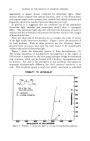
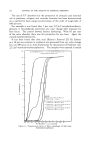
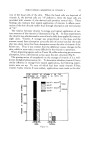
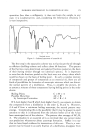
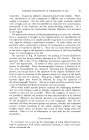
366 JOURNAL OF THE SOCIETY OF COSMETIC CHEMISTS The use of UV absorbers for the protection of aromatic and essential oils in perfumes, colognes and cosmetic formulas has been demonstrated on a qualitative basis using concentrations of the order of magnitude of 0.05 per cent. For example it was found that 1 per cent 2,2',4,4'-tetrahydroxybenzo~ phenone in benzaldehyde prevented any color change after exposure for four hours. The control showed distinct darkening. With 0.1 per cent of the same absorber there was fair protection for one hour. Again the control darkened distinctly. It has been found that oleic acid (Emery's Emersol 233 LL Elaine) as a 50 per cent solution in methanol was protected from any color change for over 280 hours in an Atlas Fadeometer by the presence of 0.025 per cent 2,2',4,4'-tetrahydroxybenzophenone. The samples were exposed in sealed • 40 % FRANSMISSION OF 0 q rail FILMS OF PVP/VA E-755 CONTAINING UVINUL D-S0 VA E-7i •, J D: Glass Slid(' Coat½.d with PVP, VA oe-735 I Containing 50• Uvlmll D-•O ZIR0 )00 3,1'0 .I •0 3t•0 380 4t,0 420 q ,r,. .It•0 480 •,0" WAVIr[,IrNGTII N MIL. L,MICRON.5 I:igure 8.--Transmission curves of films containing 2,2•,4,4'-tetra- hydroxybenzophenone.

ULTRAVIOLET LIGHT ABSORBERS IN COSMETICS 367 glass cylinders. The control showed a distinct color change in twenty hours. This indicates that pastes, creams, etc., containing oleic acid or similar materials may possibly be protected from yellowing or darkening in the package by the inclusion of a UV absorber in the formula. A typical hand lotion formulation containing hexachlorophene (G-11, Sindar Corporation) and 0.6 per cent 2,4-dihydroxybenzophenone did not show any surface darkening as did the control after 20 hours' exposure in a Fadeometer. Combination soap-synthetic bars with a pH of 7 were made up containing 0.1 per cent 2,2',4,4'-tetrahydroxybenzophenone and Rhodamine B Ex. S (red) and Patent Blue VF Ex. Conc. Both colors were protected to a marked degree over the same compositions without the ultraviolet light stabilizer. This product was not effective at the pH (ca. 10) of a straight soap bar. This is because the tetrahydroxybenzophenone forms a sodium salt at this pH which drastically alters its properties. Other compounds which are unaffected by high pH's are under test and should prove effective. A hair rinse (red) was applied to paper and a portion of it was covered with a 1.2 rail. film of cellulose acetate containing 0.5 per cent 2,2'-dihy- droxy-4.4'-dimethoxybenzophenone. The protected portion showed no color change in twenty hours. The unprotected portion showed a distinct break in color. This suggests the use of film forming aerosol formulations containing UV absorbers for the protection of tinted or dyed hair and possibly for the protection of the natural color of the hair and of the hair itself. Figure 8 shows the transmission curves of' some typical films laid down in this manner. Suntan preparations have not been discussed, but reference should be made to the excellent review article on this subject by Klarmann (9) and the work of Knox (10) on 2-hydroxy benzophenones in dermatologic vehicles. Knox found 2,4-dihydroxy benzophenone in alcohol and silicone oil afforded excellent protection for photosensitive individuals. These preparations also prevented tanning. Because of the extremely wide variety of chemicals and applications involved in the cosmetic industry it has been possible only to suggest some of the potential uses for ultraviolet light absorbers in cosmetics. We believe with time they will become an accepted and useful tool of the cosmetic chemist. .4cknowledgment: The authors are indebted to many of their colleagues in General Aniline and Film Corporation who have contributed to the discovery and development of stable ultraviolet light absorbers. REFERENCES (1) Kenyon, A. S., "Polymer Degradation Mechanisms," Circular 525, U.S. Department of Commerce, National Bureau ooe Standards, p. 86.
Purchased for the exclusive use of nofirst nolast (unknown)
From: SCC Media Library & Resource Center (library.scconline.org)