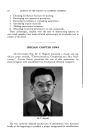
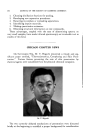
CHICAGO AND NEW YORK CHAPTER NEWS 387 of the relative importance of activity coefficients, diffusivity, viscosity, melting point, etc. After being graduated from the University of California (Berkeley) and the University of Wisconsin, obtaining the Ph.D. degree at the latter in 1943, Dr. Higuchi held a postdoctoral fellowship at the University of Wisconsin in 1943-1944, participated in the rubber program at the Uni- versity of Akron in 1944-1947 and returned to the University of Wiscon- sin to teach in the School of Pharmacy. Dr. Higuchi has held the rank of full professor since 1954. All meetings are held at Henrici's Restaurant in the Merchandise Mart on the second Tuesday of the month. NEW YORK CHAPTER NEWS THE rtRSq' fALL meeting was held on September 3rd at the Brass Rail Restaurant. A discussion of sunscreens was presented by Dr. Saul I. Kreps. Dr. Kreps is technical director of Van Dyk and Company, manufactur- ing chemists. In his talk, "Designing Sunscreens for Cosmetic Use," he discussed the physical and chemical requirements for a successful sunscreen agent in a cosmetic product. Relatively few types have been successful. Dr. Kreps showed how interaction between radiant energy of sunlight and the chemical system of the sunscreen produces changes in the molecular and electron structure of the chemical compound and how these changes affect the usefulness of such compounds as cosmetic sunscreens.

BOOK REVIEWS PHYSICAL METHODS IN CHEMICAL ANALYSIS, Vol. 3, edited by Walter G. Berl. Academic Press, Inc., New York 3, N.Y. 1956. 642 pages, size 6 X 9 inches, illustrated and indexed. Price $15. The tremendous growth in tech- niques available for chemical analy- sis in the last ten years has made it difficult for even the analytical chemist to keep abreast of these new developments. Since most of this expansion has been due to the wide adoption of physical methods of separation and measurement, this new book on "Physical Meth- ods in Chemical Analysis" is par- ticularly timely. This book is especially useful, not merely to the analytical chem- ist, but to all those concerned with the various aspects of chemistry. Each chapter, written by a special- ist, first covers the basic principle involved, a comprehensive biblio- graphical review of the method, and a discussion of the analytical appli- cations. The increasing tendency of tech- nical books to be written by a number of authors, specialists in their fields, is of especial value in a book of this type, which covers subjects as diverse as gas chroma- tography and neutron spectroscopy and neutron interactions. The relatively new subject of gas chromatography is covered ade- quately in a short chapter for those who are not as yet familiar with this subject. It is unfortunate, however, that reference was not made to the growing list of books already published on this subject for those readers wishing more information. Electrochromatography, which is a refinement on the already well known and used field of chromatog- raphy, is very well described and connotated. The chapter on trace analysis deals with all the electroanalytical methods such as polarography, am- perometric procedure, and anodic stripping. The chapter on High Frequency Methods of Chemical Analysis gives the advantages and limitations of this relatively new technique. A particularly welcome chapter in a book of this type is the one on sampling for chemical analysis, which goes with some detail into the theory of sampling. A large part of the book is de- voted to the subjects, neutron spectroscopy and neutron interac- tions in chemical analysis. Since the discovery of neutrons goes back only to 1932, it is easy to see why so little is yet known on this sub- ject. Although this technique at the moment may be of only pass- ing interest to most laboratories because of the expensive equipment involved, it nevertheless will be a subject of increasing interest to the individual analytical chemist who wishes to be well informed on new techniques.--MoRRIS J. RooT, G. Barr and Co. THE CHEMISTRY AND TECHNOLOGY OF LEATHEr., Vol. I., Edited by F. O'Flaherty, W. Roddy and R. 388
Purchased for the exclusive use of nofirst nolast (unknown)
From: SCC Media Library & Resource Center (library.scconline.org)