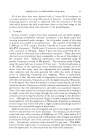
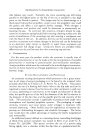
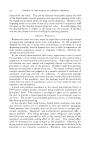
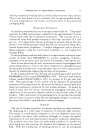
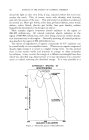
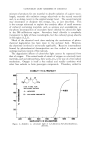
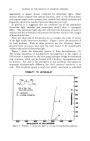
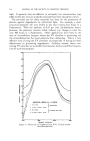
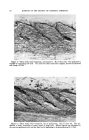
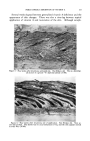
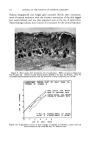
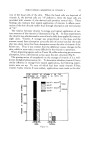
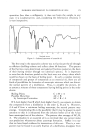
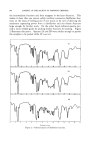
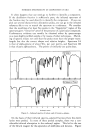
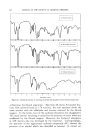
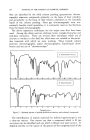
INFRARED SPECTROSCOPY IN COMPOSITION OF OILS 385 impurities. In general, aliphatic compounds absorb only weakly. There- fore, identification of such compounds is difficult and a relatively pure sample is necessary. On the other end of the scale, aromatics absorb very strongly and can often be identified in relatively low concentration, particularly if the impurities are the weak-absorbing aliphatics. As a general rule, terpenes are intermediate between aliphatics and aromatics in this regard. The quantitative features of infrared spectroscopy are also very valuable. Once a compound is brought to the required purity for identification by the separation scheme, it is usually possible to go back to an earlier separa- tion stage for making a quantitative estimate. In other words, one can generally make a quantitative estimate of a compound in a less pure mix- ture than is required to identify it. Since one can make better estimates at the earlier stages in the separation scheme because of the lower handling losses, it is advantageous to do this. The spectrum in Fig. 5A represents the pooling of several distillation fractions and has strong carbonyl absorption at 5.85 microns. The next spectrum (SB) is that of the aldehydes and ketones separated from this "pool" and regenerated. In neither of these cases could any compounds present be identified. Upon chromatography, however, a fraction of al- most pure benzaldehyde was obtained. Knowing that benzaldehyde is present, one can go back to the spectrum of the original distillation frac- tions to make an estimate of the amounts present by means of the bands at 8.33, 13.4 and 14.5 microns. This gives a higher and probably more accurate figure than would be obtained by using the spectrum of the chromatography fraction. The errors which would be caused by losses in the intermediate purification processes are thus avoided. What really makes natural product analyses the challenging problems they are is the frequent need to identify compounds for which reference samples or data are not available. When this happens, of course, it is not possible to identify the material by mere determination of its infrared spectrum. However, the infrared spectrum is an excellent starting point for the elucidation of the structure of a new compound. One can im- mediately tell what functional groups are present, whether the compound amount of chain branching in the carbon skeleton, whether any long straight carbon chains are present and a host of other things about the molecule. That is a lot of information to start with for any structural elucidation. CONCLUSIONS In conclusion let us sum up the advantages of using infrared spectros- copy in conjunction with various separation methods to study the consti- tution of essential oils.

386 JOURNAL OF THE SOCIETY OF COSMETIC CHEMISTS 1. Choosing distillation fractions for pooling. 2. Developing new separation procedures. 3. Detecting incomplete or misleading separations. 4. Identifying impure materials. 5. Making quantitative estimates. 6. Obtaining structural information on new compounds. These advantages, coupled with the ease of determining spectra on very small samples, have made infrared spectroscopy an invaluable tool to studies of this kind. CHICAGO CHAPTER NEWS Os S•.PTEtaBv. R 9TI•, Dr. T. Higuchi presented a timely and sig- nificant paper entitled, "Thermodynamics, Complexing and Skin Pene- tration." Various factors governing the rate of skin penetration by chemical agents were considered from the physical chemical viewpoint. Dr. T. Higuchi The two currently debated mechanisms of penetration were discussed briefly at the beginning to establish a proper background for consideration
Purchased for the exclusive use of nofirst nolast (unknown)
From: SCC Media Library & Resource Center (library.scconline.org)