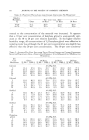
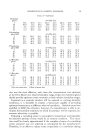
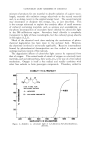
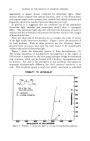
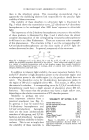
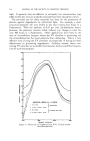
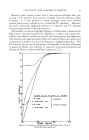
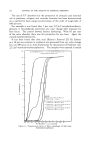
HUMECTANTS IN COSMETIC EMULSIONS 335 water loss and all concentrations increased in effectiveness at slowing the rate of water loss at the lower humidity, except the 5 per cent concentra- tions. The 5 per cent concentration did increase in effectiveness with time however, it lost more water than did the cream without a humectant. All concentrations of this material were effective at the higher relative humidity range. With the exception of the creams containing 5 per cent and 25 per cent polyethylene glycol 400, the effectiveness at slowing the rate of water loss decreased as the exposure time was increased. Table 3 shows that all concentrations of 1,3 butylene glycol, except the 5 per cent concentration were effective in the lower relative humidity range. The efficiency of butylene glycol at slowing the rate of water loss increased as the exposure time was increased, although the 15 per cent concentration showed a slight decrease between the fourteenth and twenty-first days. In the 60 to 70 per cent relative humidity range, all concentrations of bu- tylene glycol were effective at reducing water loss. Its ability to slow the rate of water loss decreased.as exposure time increased. Visual examination of the physical properties produced by the various humectants indicated that 1,3 butylene glycol produced the hardest creams, polyethylene glycol 400 the next hardest and sorbitol, glycerol and pro- pylene glycol produced creams of about the same consistency, which were the softest creams. Propylene glycol and butylene glycol promoted sheen development in higher concentrations almost immediately after prepara- tion. Sheen development was negligible or undetectable in creams con- taining other humectants. Gloss was present in some creams and absent in others. This variety of physical properties indicates that humectant selection must not only be based on an ability to reduce water loss, but also for the physical properties that are desired in the finished product. SUMMARY AND CONCLUSIONS Vanishing creams were prepared containing various humectants in different concentrations and subjected to different relative humidity ranges for a thirty-day period. The effect of the humectants on the physical properties of the cream and on the rate of water release were determined. The following conclusions are made: 1. The physical properties of sheen, gloss and consistency vary with the type of humectant and the amount of humectant employed in the formula- tion. Consideration must be given to the physical properties that are desired for the product when selecting the proper humectant. 2. The rate of water loss appears to be a function of the humectant used, the concentration of the material employed and the water content of the atmosphere surrounding the product the quantity and rate of water loss from creams containing the selected humectants differ with the material used, the concentration of the humectant and the relative humidity range

336 JOURNAL OF THE SOCIETY OF COSMETIC CHEMISTS to which the cream sample is exposed. No humectant material from the list of selected humectants evaluated in this project was the most effective in both humidity ranges. 3. Because the eflqciency of the humectant materials differs with a change in relative humidity, no one product of the group evaluated can be classed as the ideal humectant or the humectant of choice for all creams, but through selective formulation, cosmetic creams with a high degree of water retention can be developed. THE DERMATOLOGIST, THE OLDER WOMAN AND COSMETICS By ALICE E. PALMER, M.D.* Presented Tune 4I, 1955, New York City IT xs AN UNUSUAL challenge and opportunity for me to be asked to speak before you. It is a challenge because, while the dermatologist and the cosmetic chemist have some mutual interests, there remain some aspects of our endeavors which are in need of constructive and unifying thought. We are all aware that a total personality is molded by specific training and experience plus all other facts of his or her life. In my case, I am a dermatologist. But I am also a woman. I would like to divide what I have to say into three parts. First, the changes wrought in the skin with aging secondly, a few suggested things needed in the cosmetic field and thirdly, some of my reflections on the whole topic. In this era, where the average life span has been increased, it is interesting to speculate on whether we end up just working with inevitable age changes or whether we can eventually slow the process. To date, our task centers chiefly on keeping lives attractive, nonaggravated, useful and acceptable to others. From the point ooe view ooe the practice of dermatology, we contend with certain developments which are concomitants of the aging process. To this end, the dermatologist and the cosmetic chemist are working together in trying to slow these aging processes, and of trying to improve people's appearance, morale and comfort. But actually, basic scientists have * Grace Hospital, Detroit 1, Mich.
Purchased for the exclusive use of nofirst nolast (unknown)
From: SCC Media Library & Resource Center (library.scconline.org)