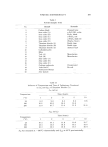
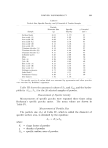
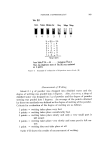
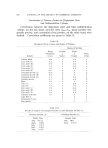
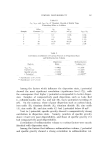
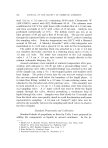
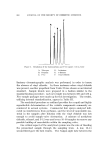
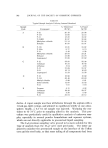
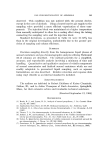
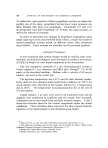
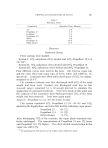
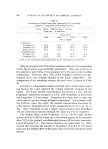
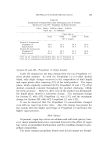
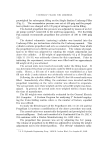
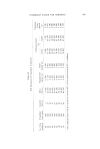
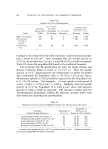
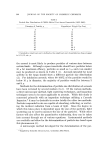
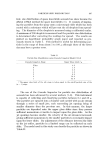
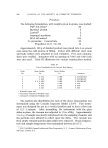
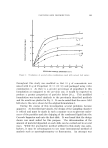
POWDER DISPERSIB1LITY Table iX and ,¾n2o/,5'• 2 of Titanium Dioxide of Rutile Type Containing Silica as Additive Silica ,¾N._, Sawnpie Content (%) (m=/g) (mS/g) _ 1 0 6. I 3.3,5 0.55 2 2 7 6 6.1 0.80 3 5 8.1 9.8,5 1 . 1,5 4 10 8.25 16.25 [.97 5 15 8.0 18. I 2.26 347 Table X Correlatmn Coefficients of Various Factors to Drapersion State and Sedimentation Volume Dispersion Factors State '¾n o/,%'•- -- (). 0622 Particle size --(). 1457 Specific gravity -() 4222 •- Potential (). 4858* * Significance at 50½ level. ** Significance at 1•/• level. Sedimentation Volume (ce) -0,2137 - ()• 2276 ()• 3907 -0. 6370** Among the factors which influence the dispersion state, •(-potential showed the most significant correlation (significance level 5•o), with the consequence that higher .(-potential corresponded to better disper- sion. Samples of comparatively good dispersion, such as Lake Red C, colloidal kaolin, talc (A), and tale (B), had .(-potential exceeding 70 mV. On the contrary, those of poor dispersion such as carbon black, iron oxide (B), titanium dioxide (A), titanium dioxide (B), zinc oxide (A), zinc oxide (B), and zinc oxide (C) had .(-potential below 40 reV. Next to .(-potential, specific gravity showed a comparatively strong correlation to dispersion state. Namely, powders of specific gravity above 5 had very poor dispersibility, and those of specific gravity 2-3 had comparatively good dispersibility. Correlations of sedimentation volume to various factors were nearly identical with dispersion state. Among the factors that influence sedimentation volume, .(-potential and specific gravity showed a strong correlation to sedimentation vol-

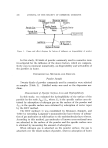
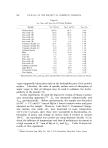
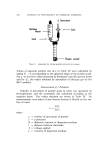
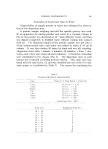
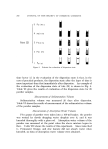
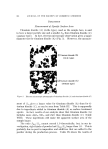
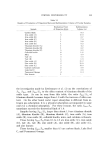
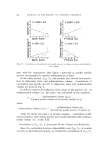
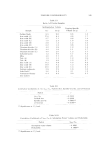
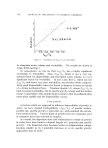
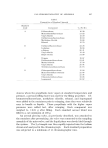
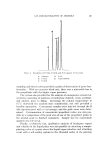
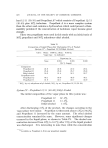
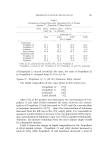
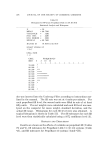
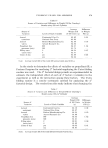
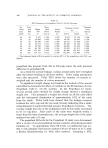
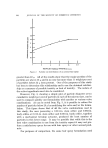
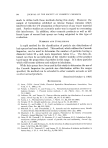
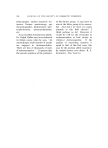
348 JOURNAL OF THE SOCIETV OF COSMETIC CHEMISTS lO !t =-0.59x -I- 5.15 ,_6 •4 1 2 3 4 5 6 0 Specific Gravity y=l.20x + 1.17 Specific Gravitit Y =0.042x + 0.95 2'0 40 60 80 •'-Potential (my) •26t Y=-O.llx + 11.3 *•m•8 ' . o 0 20 40 60 80 g-Potential (my) Figure (5. Correlations of [-potential and specific gravity to (lispersion state and sedimenta- tion volume ume, with the consequence that higher .•-potential or smaller specific gravity corresponded to smaller sedimentation volume. As for other factors, SH20/SN2 and particle size showed low correla•- tion to dispersion state and sedimentation volume. Correlations of •-potential and specific gravity to dispersion state and sedimentation volume are given in Fig. 6. In order to remove the influence of the shape of the particle, etc., on sedimentation volume (cc), the ratio f was calculated by the equation: Sedimentation volume (co/g) Tapping specific volume of the powder sample (cc/g) where Sedimentation volume (cc) Sedimentation volume (co/g) - One-half the specific gravity of sample (g) Table XI shows the ratio f of powder samples. Correlation coeffi- cients between f and various factors were nearly identical with sedimen- tation volume (cc) (Table XII). Correlations of S•o/S•2 to Absorption Water Volume and Weltability Since the correlation between dispersibility and Smo/SN•of powder was low, as described previously, we studied the correlations of Smo/S•
Purchased for the exclusive use of nofirst nolast (unknown)
From: SCC Media Library & Resource Center (library.scconline.org)