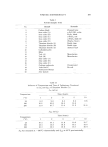
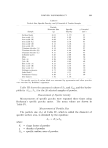
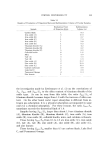
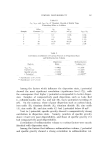
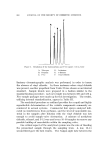
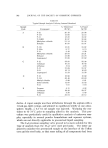
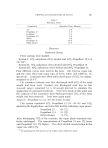
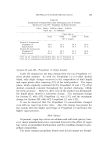
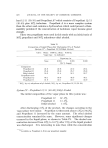
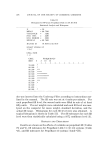
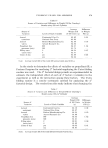
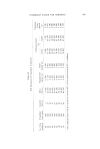
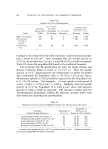
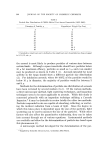
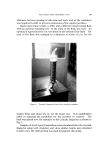
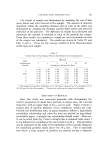
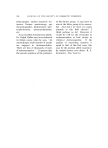
386 JOURNAL OF THE SOCIETY OF COSMETIC CHEMISTS Table I Particle Size Distribution of CSMA Official Test Aerosol Insecticide (1955-1960) Diameter of Particle, u Cumulative a Weight Per Cent 5 4 10 14 15 30 20 50 25 70 30 83 35 92 40 96 45 98.4 50 99.4 a Cumulative weight per cent is defined as the weight per cent of particles less than or equal to 5, 10, 15, etc., u. the aerosol is most likely to produce particles of various sizes between certain limits. Although a space insecticide should have particles below 50 t• for maximum efficacy, particles as small as 5 t• and even smaller may be produced as shown in Table I (1). Aerosols intended for local activity in the lungs should show a different particle size distribution (2). For inhalation aerosols, where 98-100% of the particles would be below 10 t• in diameter, the majority of particles would be between 3 and 4 Methods for the determination of particle size distribution of aerosols have been reviewed by several workers (3-5). Of the various methods, a direct microscopic method, light scattering techniques, and impaction techniques seem to be most applicable to aerosols. While this study is concerned primarily with an impaction technique utilizing a Cascade Impactor,* it may be desirable to review briefly the other two methods. Particles suspended in air are capable of absorbing, reflecting, or scatter- ing the incident radiation from a beam of light. Since the degree to which this takes place is dependent upon the size of the particles, light scattering can be used to measure the size of the particles. While other factors will also affect the quantitative relationship, they can be taken into account through use of various equations. Instrumental methods are available and allow for the determination of particle size based upon this phenomenon (6). A microscopic method developed for the determination of the par- * Supplied by Scientific Advances, Inc., Columbus, Ohio 43212.

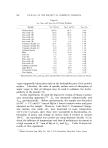
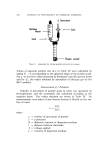
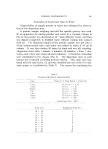
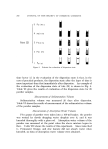
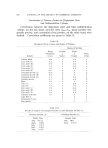
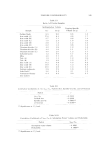
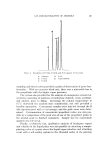
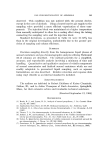
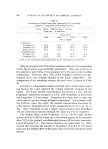
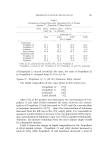
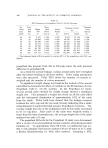
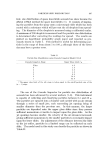
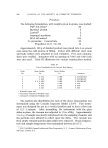
PARTICLE SIZE DISTRIBUTION 387 ticle size distribution of space insecticide aerosols has since become the official CSMA method for space insecticides (1). It consists of imping- ing the particles from the spray onto a microscopic slide which has been coated with a substance which will prevent the oil droplets from spread- ing. The diameter of the droplets is measured using a calibrated ocular. A minimum of 200 droplets is measured and the particle size distribution is determined after correcting the readings for spread. The results are plotted on logarithmic probability graph paper and reported as pre- viously shown in Table I. This method is useful for determining par- ticles in the range of from about 5 to 100 t• although those of the lower size may have a greater error. Table II Particle Size Classification using Cascade Impactor Model CI-S-6 Cascade Impactor, Stage Upper Class Limit, • t• Filter 6 5 4 3 2 1 05 10 2 0 40 80 16 0 32 0 a The upper class li•nit of the nth stage is taken equal to the cutoff particle size of the (n -- 1) stage. The use of the Cascade Impactor for particle size distribution of aerosols has been advanced by several workers (7-9). This instrument is capable of collecting and classifying particles between 0.5 and 32 The particles are sprayed into a chamber and carried with an air stream through a series of small jets, each succeeding jet opening being of smaller diameter than the previous one. In this manner, the larger particles are deposited onto the upper glass slides since they possess sufficient momentum or inertia to impact upon the glass slide. As the jet openings become smaller, the velocity of the air stream is increased, giving sufficient momentum to the smaller particles to eventually impact upon the lower slides. By adjustment of the distance between the slide to the jet orifice, particles in a limited range can be collected on each slide. The model used in this study can classify the particles as shown in Table II.
Purchased for the exclusive use of nofirst nolast (unknown)
From: SCC Media Library & Resource Center (library.scconline.org)