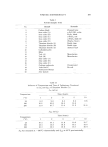
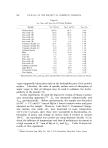
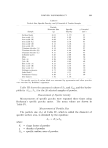
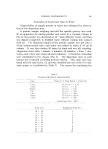
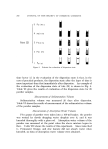
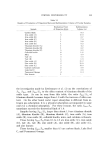
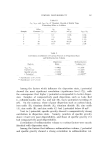
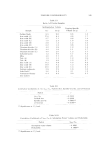
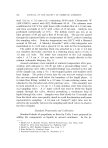
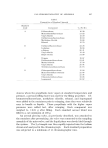
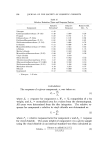
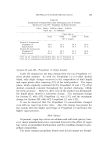
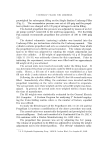
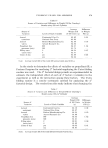
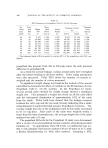
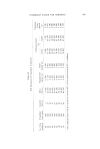
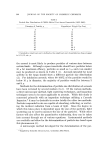
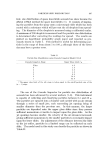
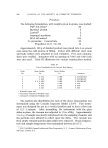
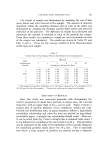
POWDER DISPERSIBILIT¾ 349 Sample Table XI Ratio f of Powder Samples Sedimentation Volulne Tapping Specific (cc) (cc/g) Volume (cc/g) Carbon black 8.5 9.6 6.6 Iron oxide (A) 17.0 8.4 4 9 Iron oxide (B) 2,7 1.1 0.8 Iron oxide (C) 7.0 2.4 1.3 Iron oxide (D) 3.8 1 5 1.2 Iron oxide (E) 3.2 1.2 0.8 Titanium dioxide (A) 4 2 1.9 1.3 Titanium dioxide (B) 4.2 1.9 1.1 Titanium dioxide (C) 4.0 2.0 1.2 Colloidal kaolin 1.2 0.9 1.7 Mica 4.0 2 7 2.1 Talc (A) 1.5 1.1 1.3 Talc (B) 1 3 0.9 1,3 Zinc oxide (A) 11.2 3.8 1.2 Zinc oxide (B) 11 9 4.2 1.2 Zinc oxide (C) 13.0 4,6 1.5 Calcium carbonate 3.8 2.9 1.8 Lake Red C 2,(i 2.5 2.1 Perlnanent Orange 6 4 8.2 3.9 Zinc laurate ....... 1 5 1 T 1 4 19 13 1 5 1 5 1 7 17 O. 5 1 3 O. 9 0.7 3.2 3.5 3.1 1.6 1.2 2,1 ß . . Table X I I Correlation Coefficients of J' to ,5'..2o/,¾x?, Particle Size, Specific Gravity, and •-Potential Factor Particle size Spccific gravity .(- Potential 4' -- o. 2313 - o, 0048 o, 5862'* -0. 5769** ** Significance at 1•7} lcvel. Table XIII Correlation Coefi}cients of ,%'n•o/•¾N• to Adsorption Water Volunle and Wettability ___ Factor Absorption water volrune --0. 4382 Wettability 0. 7668** ** Significance at 1 (•, level.

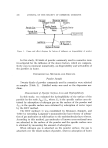
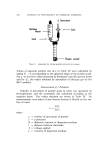
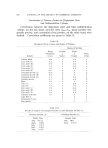
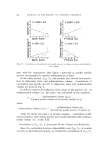
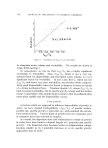
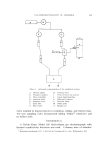
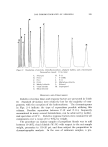
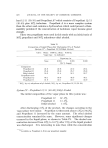
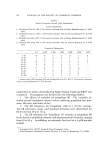
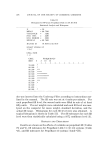
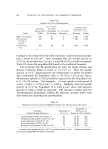
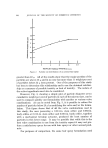
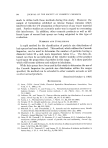
350 JOURNAL OF THE SOCIETY OF COSMETIC CHEMISTS 3 ß , r= O. 7668 ** 0.85 0 0130 0'.60 0'.90 1120 1'.50 SH20/SN2 Figure 7. Correlation of •Ho•O/SN• to wettability to aborption water volume and wettability. The results are shown in Table XIII and Fig. 7. In consequence, we can see that Smo/SN• has a highly significant correlation to wettability. Thus, Smo/SN• which is not a very im- portant factor for dispersibility and absorption water volume, is a very significant factor for wettability. In fact, Lake Red C, which has low Smo/SN• and hence very poor wettability, nevertheless shows compara- tively good dispersibility when it is forced to disperse in water by means of a strong mechanical force. Titanium dioxide (A), whose Sn•O/SN• is high, has good wettability, but its specific gravity is large and the surface charge (F-potential) of the powder grain is small so that its sedimentation takes place rapidly and the dispersibility is poor. CONCLUSIONS As factors which are supposed to influence dispersibility of powder in water, we have studied hydrophilicity (Sn•O/SN,) of powder surface, particle size, specific gravity, F-potential, etc., and examined the correla- tions between them. Twenty kinds of powder that are commonly used in cosmetics have been selected as samples. As a result, the dispersion state and sedimentation volume of powder in water have been found to depend largely on F-potential and specific gravity. The dispersion state becomes better or sedimentation volume becomes smaller as its F-potential increases or as its specific gravity approaches that of water.
Purchased for the exclusive use of nofirst nolast (unknown)
From: SCC Media Library & Resource Center (library.scconline.org)