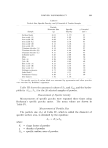
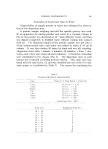
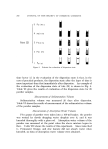
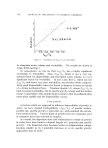
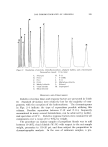
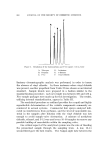
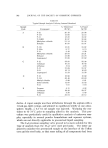
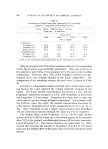
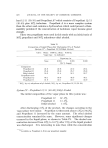
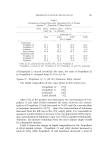
888 JOURNAL OF THE SOCIETY OF COSMETIC CHEMISTS This study has been undertaken in order to ascertain the particle size distribution of two hair spray formulations when packaged using valves having different sized openings. The particle size distribution was determined between these limits so that an evaluation of the product can be made on the basis of the number of particles which are likely to settle on the hair and the number which may become airborne and sub- ject to inhalation. While most particles below 50 u will remain sus- pended in air for relatively long periods of time, only those particles less than 10 u are likely to pass into the respiratory tract. Most of the par- ticles above this size will be retained in the upper portions of the respira- tory tract (10). For deposition in the area of the terminal bronchi and alveoli the particles must be about 2-6 t• in diameter. Particles less than 0.5 t• fail to reach this area (11). Based upon these observations, it is desirable to formulate a hair spray, as well as any other aerosol (other than pharmaceuticals intended for use in this region), so that the particle size distribution will show a greater portion of the particles having a particle size of 10 t• and greater. However, the efficacy of the product must also be considered in regard to the effect of part:•cle size. EXPERIMENTAL Design of Sampling Chamber Several different sampling chambers were studied in order to de- termine the best design suited for this purpose. With aerosols, care must be exerted to allow for release of the propellant force so that the particles are carried through the Cascade Impactor by the flow of the air stream and not by the force of the propellant stream. A cylindrical glass container with a height of about 8 in., diameter of 3•/• in., and an opening of 1 in. was used. The bottom on the container was removed to allow for flow of the particles from the sampling container to the Cascade Impactor. When material was sprayed into this container, a large number of the particles came into contact with the walls of the con- tainer and formed large droplets. Since the entrance to the chamber was located on the top, the aerosol container had to be tilted almost 180 ø. This presented additional problems in regard to obtaining a representative sample. This chamber was then replaced with a con- tainer of similar dimensions except that the entrance to the chamber was located as a side arm extending perpendicularly to the top of the container. While this chamber overcame the problem of obtaining an adequate sample, it was recognized that a distance greater than 5• in.

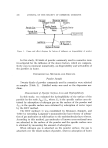
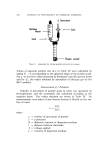
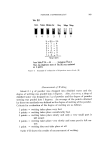
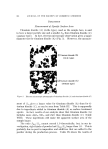
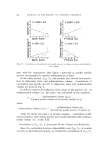
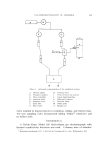
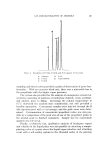
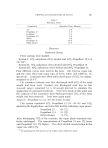
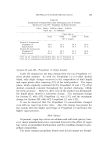
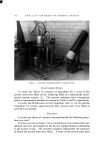
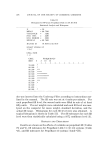
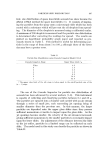
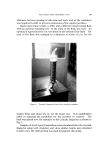
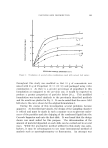
PARTICLE SIZE DISTRIBUTION 389 (distance between opening of side arm and back wall of the container) was required in order to prevent coalescence of the smaller particles. Based upon these results, a 1000- and a 2000-ml round-bottom flask with an opening extending 105 ø to the body of the flask was used. An opening of approximately 3 in. was made in the bottom of the flask. The neck of the flask was enlarged to a diameter of about l a/• in. for the Figure 1. .. •- :..'i• •" •.. ' ?'"'::ill • •-" '7 ß .' ci•,,• i ',..." .: •: •. :.% ß Cascade Impactor fitted with sampling chamber smaller flask and about 21• in. for the larger one. This modification aided in reducing the possibility for the particles to coalesce. The flask was placed over the entrance to the Cascade Impactor as shown in Fig. 1. Samples of a hair spray formulation were introduced into the Cascade Impactor using both chambers and since similar results were obtained in both cases, the 1000-ml flask was used throughout this study.
Purchased for the exclusive use of nofirst nolast (unknown)
From: SCC Media Library & Resource Center (library.scconline.org)