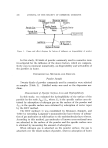
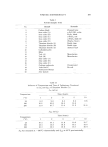
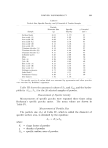
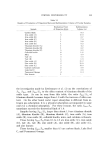
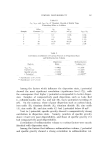
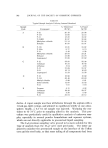
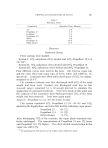
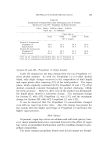
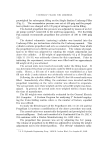
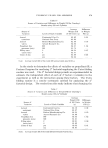
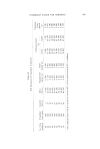
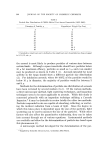
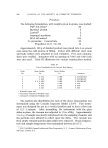
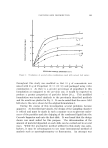
GAS CHROMATOGRAPHY OF AEROSOLS 357 Table I Composition of Standard Aerosols Standard Code Component % (W/W) A Difiuoroethane 16.39 Monochlorodifluoroethane 21.82 Vinyl chloride 13.50 Dichloromonofiuoromethane 16.64 Methylene chloride 15.86 Ethanol 15.79 B Dichlorodifiuoromethane 23.26 Isobutane 18.94 n-Butane 20.41 Vinyl chloride 12.40 Ethyl chloride 24.99 C Propane 19.87 Dichlorotetrafiuoroet hane 21.61 Methyl chloride 17.30 Vinyl chloride 20.04 Trichloromonofiuoromethane 21.18 D Chloropentafiuoroethane 15.90 Monochlorodifiuoromethane 21.66 Vinyl chloride 22.34 Dibrolnotetrafiuoroethane 19.48 Isopropanol 20.62 stances where the propellants were vapors at standard temperature and pressure, a pressure-filling buret was used for the filling procedure. Di- bromotetrafiuoroethane, methylene chloride, ethanol, and isopropanol were added to the containers prior to crimping, since they were relatively easy to handle as liquids. Those propellants with the higher vapor pressures were added last, after crimping. Each component was weighed to m0.01 g after filling. Each standard aerosol blend was filled to a net minimum of 500 g. An aerosol piercing valve, as previously described, was attached to the container after pressurizing the valve was connected to the sampling assembly of the microvalve, and the liquid phase was slowly bled through the system. The 2-tA sample was then rapidly injected into the helium stream and analyzed in the chromatograph. Each standard preparation was subjected to a minimum of 15 chromatographic runs.

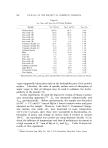
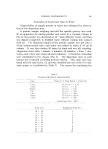
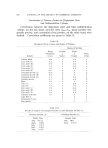
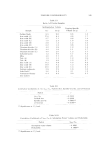
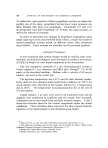
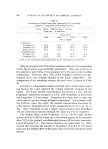
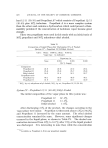
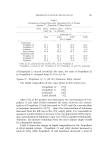
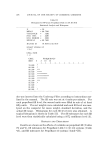
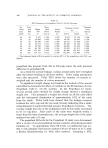
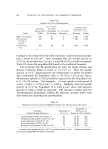
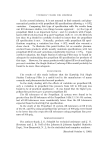
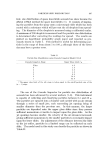
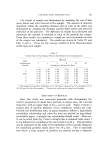
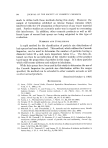
358 JOURNAL OF THE SOCIETY OF COSMETIC CHEMISTS Table II Relative Retention Times and Response Factors Relative Relative Relative Std. Component Retention • Response Dev., % Nitrogen 0.45 Chloropentafluoroethane (P-115) 0.49 Propane 0.59 Difluoroethane (P-152a) 0.62 Dichlorodifluoromethane (P- 12) 0.63 Dichlorotetrafluoroethane (P-114) 0.69 Isobutane 0.72 Monochlorodifluoroethane (P-142b) 0.79 n-Butane 0.85 Methyl chloride 0.86 Monochlorodifiuoromethane (P-22) 0.88 Vinyl chloride 1.00 Ethyl chloride 1.41 Trichloromonofluoromethane (P- 11 ) 1.57 Dibromotetrafiuoroethane (P-114B2) 2.48 Dichloromonofluoromethane (P-21) 2.83 Methylene chloride 4.19 Ethanol 5.43 Isopropanol 6.77 ß . 1 990 0 767 1 179 1 538 1 860 0 886 1 415 O. 800 O. 940 1. 367 1. 000 O. 962 1. 584 2. 593 1. 404 1.218 O. 889 0.935 ß ß . 0.20 1.17 O. 59 O. 43 O. 76 1.30 0.35 1.75 0.63 0.36 ß . . O. 52 0.55 0.19 O. 49 0.57 O. 78 O. 58 Nitrogen: 1.45 min. Calculations The response of a given component, x, was taken as' W• Z•=• (1) where Zx = response for component x, Wx = % composition of x by weight, and A x = normalized area for x taken from the chromatogram. All areas were determined from the disc integrator. The relative re- sponse for component x relative to vinyl chloride was determined as: Zx = -- (2) where F x = relative response factor for component x and Z•c = response for vinyl chloride. The gram weight of component x in a given sample using the vinyl chloride as an internal standard was then calculated as: Gramsx = (Grams vc added) (J •) (F•) (3)
Purchased for the exclusive use of nofirst nolast (unknown)
From: SCC Media Library & Resource Center (library.scconline.org)