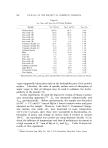
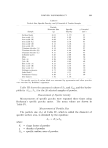
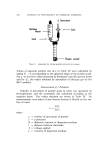
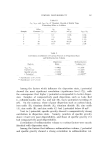
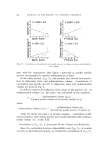
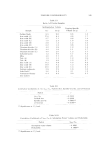
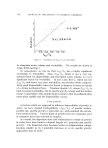
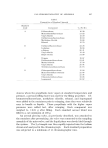
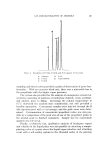
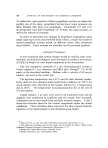
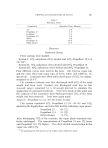
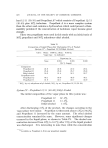
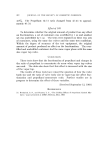
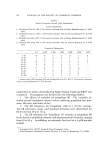
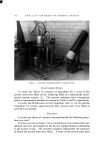
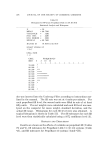
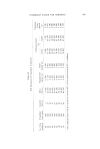
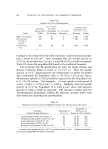
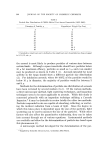
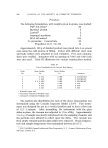
378 JOURNAL OF THE SOCIETY OF COSMETIC CHEMISTS Table II1 Histogram for 80-Gram Propellant 142b/11 (50: 50) Fill Statistical Analysis and Histogram N = 50 MEAN = 80. 7520 VARIANCE = . 1282 STD. DEV. = . 3580 STD. ERROR = .0506 MEDIAN = 80. 7820 RANGE IS 79. 8370 to 82. 0170 START CELLS AT ? 79.7 CELL SIZE ? .2 CELL MID 0 79.800 80.000 80.200 80.400 80.600 80.800 81 000 81 200 81 400 81 600 81 800 82 000 FREQUENCY 5 10 15 ..... 1 .... 1 .... 1 .... 1 .... 1 .... 1 .... 1 .... 1 .... 1 .... 1 der was inserted into the Undercap Filler according to instructions out- lined in the manual. The fill rate was set at 4 units per minute. For each propellant fill level, the aerosol units were filled in sets of at least fifty units. The net weights were calculated and each fill level was ana- lyzed on the computer for mean weight, standard deviation, and the actual fill range. Histograms for each fill level were also obtained. A typical histogram is shown in Table III. The fill tolerances for each fill level were then statistically calculated using a 95% confidence level (3). RESULTS AND DISCUSSION Results are shown on the effects of variables on propellant fill (Tables IV and V), fill tolerances for Propellant 142b/11 (50:50) systems (Table VI), and fill tolerances for Propellant 12 systems (Table VII).

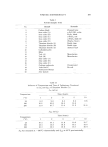
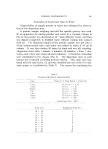
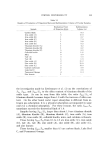
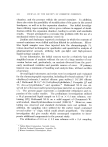
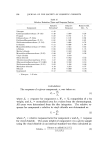
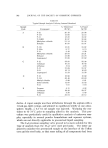
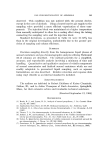
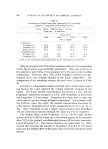
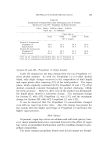
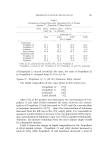
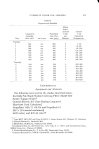
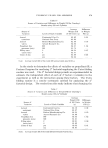
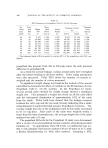
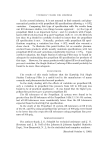
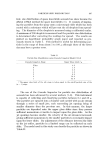
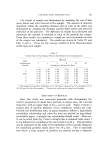
UNDERCAP FILLER FOR AEROSOLS 379 Table IV Source of Variation and Difference in Weight Fill for Tuesday's Results using 550-cm 3 Cylinder Source of Variation Levels of Each Variable Average Weight Fill of 160 Units (g) Difference in Weight Fill (g) Aerosol Continental Can Co. containers National Can Corp. Aerosol Risdon Manufacturing Co. valves Aerosol Research Co. Propellant line 900 pressures (psig) 500 Filling rates 2 (units/rain) 4 Times of day am p•n 62.68 62.89 62.59 62 48 68 27 61 74 62 54 62 47 62 69 62 33 0.24 ß . . 0.16 ß . . 1.53 ß . . 0.07 ß . . 0.36 ß . , Note: Average weight fill of the total 320 aerosol units was 62.51 g. In the study to determine the effects of variables on propellant fill, a Fortran Program for analyzing 2 n factorial employing the Yates folding routine was used. The 2 • factorial design permits an experimentalist to estimate the independent effect of each of /V factors (variables) in the experiment as well as the interaction among these factors. The Yates folding routine is a concise systematic method for analyzing the 2 n factorial design. The results from this study indicate that changing the Table V Source of Variation and Difference in Weight Fill for Thursday's Results using 100-cm 3 Cylinder Average Weight Fill Source of of 160 Units Variation Levels of Each Variable (g) Difference in Weight Fill (g) Aerosol Continental Can Co. 62.16 containers National Can Corp. 62.07 Aerosol Risdon Manufacturing Co. 62.24 valves Aerosol Research Co. 61.99 Propellant lir•e 900 63.03 pressures (psig) 500 61.21 Filling rates 2 62.31 (units/rain) 4 61.93 Times of day pm 62.32 am 61.91 0.09 ß . . 0.25 ß . . 1.82 ß . . 0.38 ß . . 0.41 ß ,, Note: Average weight t511 of the total 320 aerosol units was 62.12 g.
Purchased for the exclusive use of nofirst nolast (unknown)
From: SCC Media Library & Resource Center (library.scconline.org)