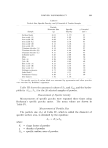
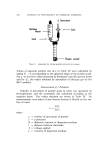
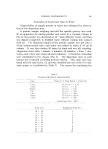
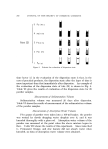
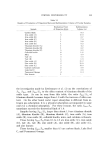
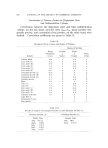
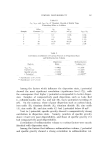
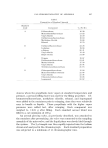
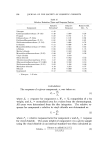
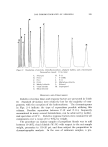
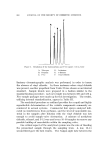
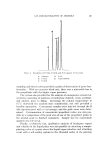
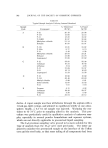
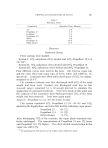
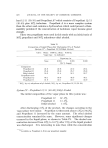
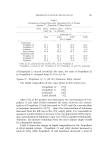
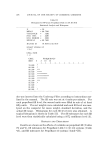
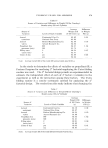
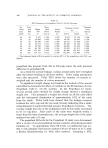
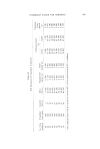
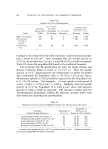
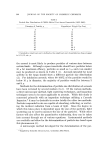
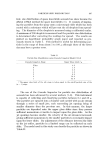
GAS CHROMATOGRAPHY OF AEROSOLS 363 observed. This condition was not noticed with the present device, except in the case of alcohols. Using a heated carrier gas supply to the sampling valve provided a more efficient vaporization of these com- ponents. The injection block was maintained at a higher temperature than normally anticipated to allow for a cooling effect along the tubing connecting the sampling valve and the injection block. Standard deviations, as presented in Table II, were 70-80% less than in the original investigation, undoubtedly due to the greater pre- cision of sampling and column efficiency. SUMMARY Precision sampling directly from the homogeneous liquid phases of aerosol containers and gas ehromatographie analysis utilizing Halleomid M-18 columns are described. The method provides for a simplified, accurate, and reproducible analysis involving a minimum of time and handling. Quantitative and qualitative analyses of volatile components of aerosol concentrates and finished aerosol containers which are not readily adaptable to pressurized liquid sampling, such as aqueous formulations, are also described. Relative retention and response data using vinyl chloride as an internal standard is included. ACKNOWLEDGMENT The authors are indebted to Robert Eiehhorn of Kaiser Chemicals, Dolton, Ill., and to Arden Thompson of Rush Associates, Springfield, Mass., for their extensive advice and invaluable technical assistance. (Received September 12, 1õ68) REFERENCES (1) Brook, R. J., and Joyher, B. D., Analysis of aerosol propellants, J. Soc. Cosmetic Chem- ists, 17, 401 (1966). (2) Applications Data Sheet, GC-69-MI, Beckman Instruments, Inc., Fullerton, Calif. (3) Leibrand, R. J., Atlas of gas analyses by gas chromatography, J. Gas Chromatog., 5,518 (1967). (4) Thonet, T. A., Gas chromatography in the aerosol laboratory, 4, 20 (1950). (5) Jenkins, J. W., and Amburgey, J. M., Determination of the volatile constituents of aero- sols by gas chromatography, Proc. Sci. Sect. Toilet Goods Assoc., 31, 19 (1959). (6) Cohen, S., Quantitative determination of volatile components in pressurized aerosols by gas chromatography, J. Pharm. Sci., 57,966 (1968). (7) Cannizzaro, R. D., Quantitative analysis of aerosol propellants by gas chromatography, Aerosol Techniques, Inc., Milford, Conn., Technicomment Bull., XI (February, 1968).

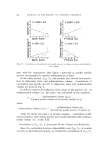
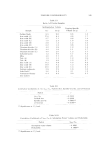
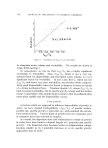
J. Soc. Cosmetic Chemists, 20, 365 372 (May 27, 1969) Effect of Vapor Tap Valves on Propellant/Concentrate Ratio L. T. FLANNER, B.S., and T. J. MATERA, B.S.* Presented September 12-13, 1968, Seminar, Boston, Mass. Synopsis--A study was conducted to determine the effect of vapor tap valves on the ratio of propellant to concentrate in cosmetic aerosol formulations. Fractionation of the propellant blm•ds occurred after 75()• of the product was consumed. Changes in the ratio of propellant to concentrate were also observed at this point. As the size of the vapor tap orifice was in- creased, the ratio of propellant to product decreased. These results are correlated with the spray pattern and chilling effects of personal aerosol deodorants. INTRODUCTION Many factors must be considered in developing a successful aero- sol product. Some of these factors are particle size, chilling effects of spray, and a consistent spray pattern from both full and nearly empty containers. These factors depend on many technical considerations, e.g., the effect of vapor pressure, the use of vapor tap valves, and the ratio of propellant to concentrate. This paper presents the results of our studies on the effect of vapor tap valves on the behavior of aerosol systems, particularly as it relates to the propellant/concentrate ratio. EXPERIMENTAL Propellant 12 and propane both have high vapor pressures and are often used as propellants for cosmetic aerosols or other aerosol products. * Specialty Chemicals Division, Allied Chemical Corp., P.O. Box 405, Morristown, N.J. 07960. 365
Purchased for the exclusive use of nofirst nolast (unknown)
From: SCC Media Library & Resource Center (library.scconline.org)