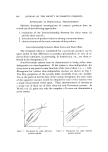
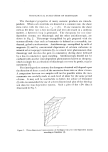
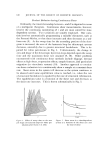
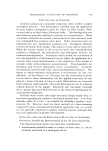
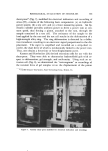
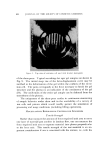
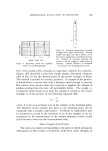
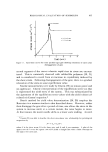
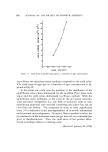
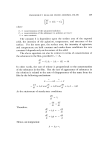
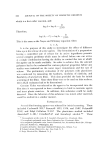
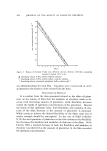
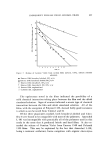
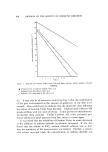
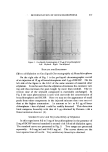
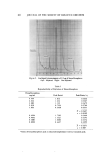
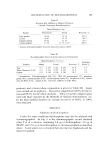
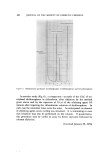
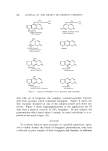
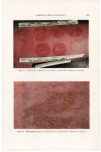
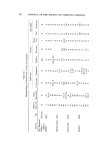
654 JOURNAL OF THE SOCIETY OF COSMETIC CHEMISTS Figure 8. Top view of extrusion cell used with Kramer shear-press of the shear-press. Typical recordings for agar gel samples are shown in Fig. 9. The initial steep rise of the force-displacement curve may be ascribed to the deformation of the gel within the confines of the extru- sion cell. The peak corresponds to the force necessary to break the gel structure and the plateau is an indication of the consistency of the gel (24). The uniformity of the entire gel sample can be deduced from the smoothness of the plateau. The uniqueness of the shear-press resides in continuous monitoring of sample behavior under shear and in the availability of a variety of test cells and pistons which would readily permit the simulation of processing and usage conditions (including filling operations). MISCELLANEOUS RHEOLOGICAL CRITERIA FOR SEMISOLIDS Tensile Strength Rather than measure the amount of force required/unit area to move one layer of material past another in laminar flow, one can measure the force required/unit area to separate material into planes perpendicular to the force axis. This tensile strength of the test material is an im- portant consideration if one is concerned with the texture, i.e., with thc

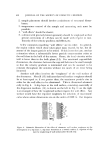
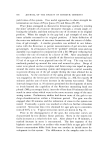
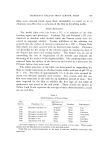
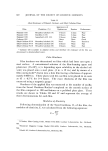
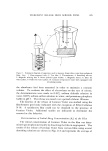
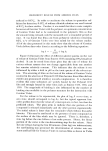
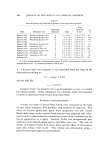
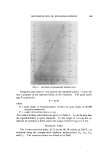
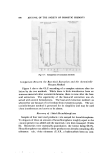
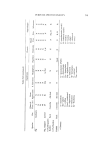
RHEOLOGICAL EVALUATION OF SEMISOLIDS 655 PISTON TRAVEL [IN.) Figure 9. Extrusion curves for replicate 3.0% w/w purified agar gels Figure 10. Schematic illustration of tensile strength device [after Charm (34)]. Product sample with glass tube (B) is forced out of the tube by application of uniform pressure (A). Column of extruded material (C) reaches a critical weight at which point it separates. Column diameter is measured just prior to the breaking point at (D). feel, of the product (25)--certainly an important criterion for cosmetics. Charm (26) described a relatively simple system, illustrated schemati- cally in Fig. 10, for the determination of the tensile strength of fluids. The method is suitable for cosmetic products. If a sample of the product is forced down a vertical tube with a diameter small enough to prevent flow unless a force greater than that of gravity is applied, the column of product exiting from the tube will periodically break. The weight, w, of material which breaks away from the column is related to the tensile strength, St, of the product by the following equation (26)' & - .4' where A is the cross-sectional area of the column at the breaking point. The diameter of the column just prior to the breaking point can be measured with a suitable cathetometer. Problems in replicability may be incurred as a result of the inclusion of air in the samples or by ira- preciseness in the measurement of the column diameter (which would yield incorrect values for the cross-sectional area). Shear Strength (Yield Value) The stress on a system corresponding to the point at which permanent deformation or flow results is termed the yield stress, shear strength, or
Purchased for the exclusive use of nofirst nolast (unknown)
From: SCC Media Library & Resource Center (library.scconline.org)