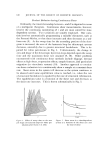
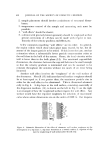
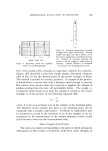
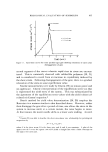
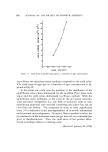
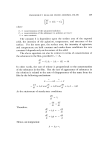
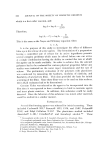
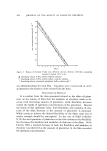
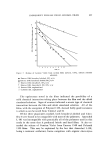
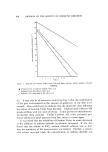
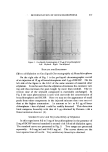
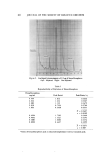
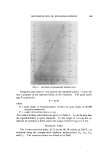
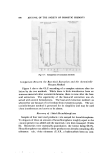
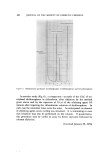
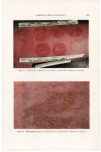
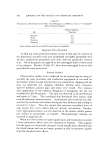
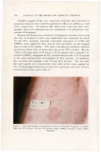
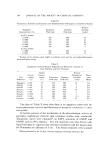
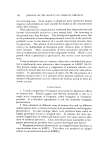
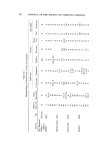
678 JOURNAL OF THE SOCIETY OF COSMETIC CHEMISTS 50 46 42 38 34 30 1 2 3 4 5 6 7 8 9 10 TIME, hr Figure 4. Release of Gentian Violet from Polymid films solvent, 0.45% sodium chloride solution). • Polymid 1155, hcxadecyl alcohol, 10% w/w [] Polymid 1155, Citroflex-4, 10% w/w _.X Polymid 1155, Amerchol-L 101, 10% w/w (6). It may also be of interest to note from Fig. 3 that the nonlinearity of the plot is eliminated as the amount of plasticizer in the film is in- creased. This would seem to indicate that the plasticizer does influence the release of Gentian Violet from this film. Unplasticized Carboset 525 produced films with low rates of release. It also produced unsatisfactory, stream-like spray patterns. Unlike Carboset 525, other polymers pro- duced satisfactory spray patterns from fine, misty to co.arse types. It was noted that the solubility of Gentian Violet in water decreased as the addition of sodium chloride in solution increased. It was also [ound that the release in 0.9% sodium chloride solution was so' slow that the sensitivity of the measurement was limited. Further, a reason- able release occurred when the concentration of sodium chloride was

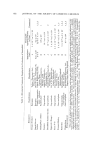
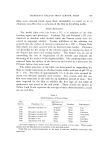
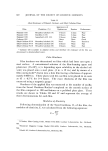
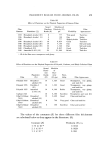
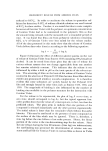
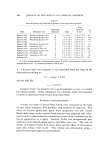
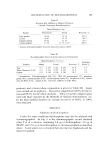
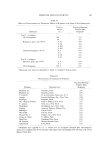
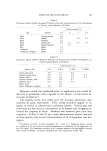
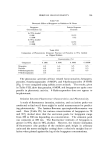
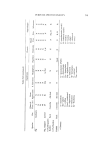
INGREDIENT RELEASE FROM AEROSOL FILMS 679 reduced to 0.45%. In order to accelerate the release in quantities suf- ficient for detection, 0.45% of sodium chloride solution was used instead of 0.9% for these studies. Further, it was noted that due to some complex formation of Gentian Violet with the polymer, an optimum concentration of Gentian Violet had to be maintained in the polymeric fihn so that the amount being released could be measured over a reasonable period of time. It was found that films cast from polymeric solutions containing 0.2% w/w of Gentian Violet were best suited for the release studies. All of the data presented in this study show that the release of Gentian Violet follows first-order kinetics according to the following equation: log A - 2.303 -1- log A0 Figure 2 illustrates the effect of different solvent systetns on the rate of release of Gentian Violet from Emerez 1533 containing 10% hexadecyl alcohol. It can be noted from these plots that the rate of release for various solvent systems does not change appreciably from one another but remains relatively constant. This indicates that the release is not influenced by either a shift in pH or the ionic species of the solvent sys- tem. The screening of fihns on the basis of the release of Gentian Violet resulted in the selection of Polymid 1155 fihns because these films did not exhibit any pronounced tendency towards complexation. It is therefore evident that some substances are weakly bound by the Polymid 1155 fihn and strongly bound by other films such as Emerez 1533, 1536, and 1540. The magnitude of binding is also influenced by the number of binding sites available in the polymer structure for the interaction with Gentian Violet. For the release to be exponential, the plot of log ,4 versus time, at zero time, should correspond to log ,40 but the typical apparent first- order profiles show that the values of y intercepts are, in fact, less than the predicted values. The plots seem to indicate that one portion of the compound is released immediately and the other portion exponentially. The initial release is faster than the remainder which follows first-order kinetics. This may be attributed to the presence of some compound on the surface of the film which may be ignored. There is, therefore, a time lag before the rate follows a first-order process. Hence, the linear portion of the curve is the rate-determining step for the release. Since the rate release during the first 60 minutes (time lag) was indeterminate, the rate-limiting step permitted the determination of relative rate con- stants and half life for Gentian Violet in various fihns as shown in Table
Purchased for the exclusive use of nofirst nolast (unknown)
From: SCC Media Library & Resource Center (library.scconline.org)