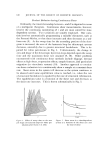
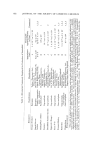
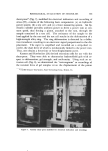
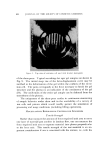
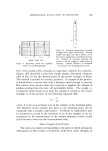
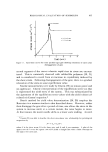
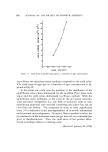
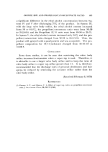
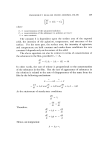
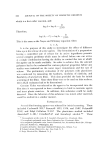
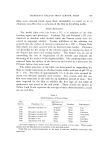
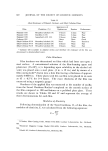
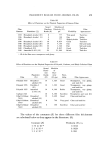
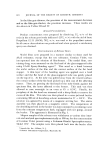
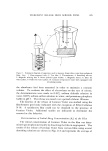
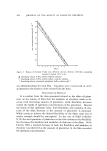
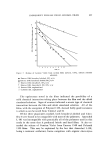
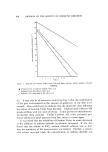
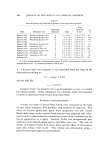
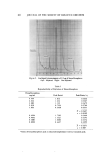
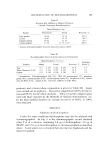
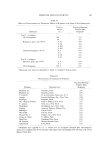
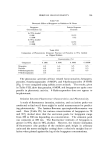
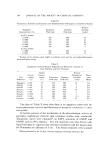
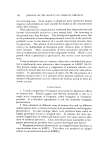
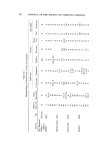
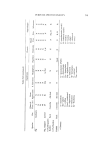
680 JOURNAL OF THE SOCIETY OF COSMETIC CHEMISTS Table V Rate of Release and Half Life of Gentian Violet from Selected Films Film Rate Desorbing Constant t•/.o• Plasticizer (%) Solution • Slope K, hr -• hr Emerez 1533 Hexadecyl alcohol (10) A Emerez 1533 Hexadecyl alcohol (10) B Emerez 1533 Hexadecyl alcohol (10) C Emerez 1536 ... A Emerez 1540 Hexadecyl alcohol (30) A Emerez 1540 Citroflex-4 (10) A Emerez 1540 Amerchol L-101 (10) A Polymid 1155 Hexadecyl alcohol (10) A Polymid 1155 Citroflex-4 (10) A Polymid 1155 Amerchol L-101 (10) A Carboset 525 ... A 65 71 75 40 50 1 9 1 9 27 23 1.2 1.9 X 10 -s 1.50 X 10 -2 46 X 10 -a 1.63 X 10 -2 42.5 X 10 -3 1.73 X 10 -2 40 X 10 -3 9.20 X 10 -a 75 X 10 -s 1.15 X 10 -'ø' 60 X 10 -3 4.30 X 10 -3 161 X 10 -3 4.30 X 10 -s 161 X 10 -2 6.10 X 10 -2 11.7 X 10 -2 5.30 X 10 -2 13 X 10 -2 2.76 X 10 -2 25 X 10 -a 4.30 X 10 -3 161 • A, 0.45% sodium chloride in demineralized water B, 0.45% sodium sulfate (anhydrous) in demineralized water C, potassium phosphate buffer, pH 7. V. The first-order rate constant, h, was calculated from the slope of the linear plot according to' and the half life, K = --slope X 2.303 t•/•= 0.693/k. Gentian Violet was found to be a good substance to use as a model for release studies. Other substances are currently under investigation in order to determine their release from these films. SUMMARY AND CONCLUSIONS A study was made of several films which were evaluated on the basis of their alkali resistance, film hardness, and modulus of elasticity. The effect of various plasticizers upon these properties was also noted. Based upon these results, aerosol formulations were prepared and evalu- ated in order to determine the suitability of each of the combinations for future application as a spray. Gentian Violet was incorporated into solutions of the film-forming agents and films were cast. The rate of release of Gentian Violet from these films and the effect of electrolytes upon this release were noted. This release was determined using a specially developed apparatus and method.

INGREDIENT RELEASE FROM AEROSOL FILMS 681 From the results obtained in this study, it may be concluded that the modulus of elasticity and flexibility of the fihns are a function of both type and concentration of plasticizer. Through choice of plasticizer, the selected physical properties of the film may be varied. From the data presented on the release profiles, it can he seen that Polymid 1155 produced a time release film using Gentian Violet as the model substance. The other films inhibited the release of Gentian Violet and may be useful for producing a prolonged release of substance. Further studies are in- dicated to determine the mechanism of the reaction which is believed to be related to the tendency toward complexation of the substance with the film. This would seem to indicate that the release rate is related to the thermodynamic activity of the substance. (R•ceived December 3, 1969) REFERENCES (1) St. Laurent, G., Mintzer, H., and Weissman, F. T., Pharmaceutical aerosols, Drug Cosmet. Ind., 96, 627 (1965). (2) Bart, M., Percutaneous absorptions, ]. Pharm. Sci., 51, 395-407 (1962). (3) Marcus, E., Kim, H. K., and Autian, J., Binding of drugs by plastics. I. Interaction of bacteriostatic agents with plastic syringes, ]. Amer. Pharm. Ass., Sci. Ed., 48, 457 (1959). (4) Willis, C. R., Jr., and Banker, G. S., Polymer-drug interacted systems in the physio- chemical design of pharmaceutical dosage forms. I. Drug salts with PVM/MA and with a PVM/MA hemi-ester, ]. Pharm. Sci., 57, 1598 (1968). (5) DeLuca, P., and Kostenbuader, H. B., Interaction of preservatives with macromolecules. IX,'. Binding of quaternary ammonium compounds by nonionic agents, ]. Amer. Pharm. Ass., Sci. Ed., 49, 430 (1960). (6) Hurwitz, A. R., DeLuca, P., and Kostenbuader, H. B., Binding of organic electrolytes by nonionic surface-active agent, ]. Pharm. Sci., 52, 893 (1963). (7) Noyes, A., and Whitney, W., The rate of solution of solid substances in their own solutions, J. Amer. Chem. Soc., 19, 930 (1897). (8) Cass, R. A., The sward rocker for measuring the modulus of elasticity of paint films, ]. Paint Technol., 38, 281-4 (1966).
Purchased for the exclusive use of nofirst nolast (unknown)
From: SCC Media Library & Resource Center (library.scconline.org)