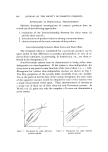
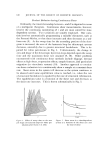
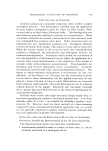
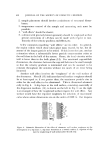
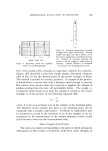
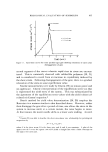
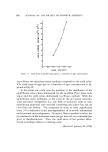
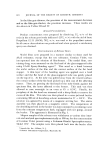
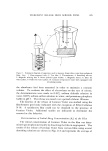
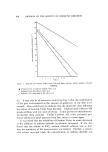
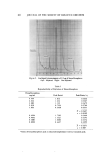
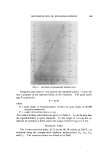
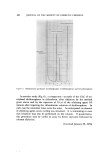
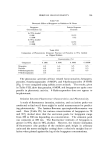
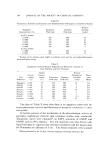
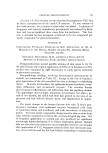
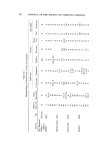
648 JOURNAL OF THE SOCIETY OF COSMETIC CHEMISTS Product Behavior during Continuous Shear Ordinarily, the interrelationship between ß and D is depicted in terms of a multipoint rheogram. Continuous shear measurements, however, involve the continuous monitoring of ß and are most suited for time- dependent systems. Two variations are usually employed. One varia- tion involves automatically programming a suitable rheometer, such as the Ferranti-Shirley, so that shear increases and then decreases at a uni- form rate (9). As the sweep time for the ascending portion of the rheo- gram is increased, the area of the hysteresis loop for thixotropic systems decreases, ostensibly due to greater structural breakdown. This is de- picted for white petrolatum in Fig. 4. Unfortunately, the change in area and shape of the thixotropic hysteresis loops depends upon the sweep time and the maximum shear rate attained (9, 10). Other problems encountered with continuous shear methods include slippage, thermal effects at high shear, evaporation effects, sample fracture, and particulate migration (in viscoelastic systems) (10). Another approach to continu- ous shear evaluation is to continuously shear a sample at a constant shear rate. Shear stress in the system will decrease as the system continues to be sheared until some equilibrium value is reached, i.e., when the rate of structural breakdown is equaled by the rate of structural reformation. The equilibrium value is a function of the shear rate and decreases as the shear rate increases. This is shown schematically in Fig. 5. io $E'C SWEEP TIME Figure 4. Effect of sweep time on the area and shape of hysteresis loops for white pet- rolatum [after Davis et al. (10)] OlO z TIME Figure 5. Shear stress in a time-dependent system as a function of the shear rate and the time of shear

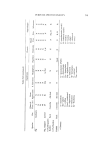
RHEOLOGICAL EVALUATION OF SEMISOLIDS 649 Static Structure of Semisolids Cosmetic products of a semisolid consistency often exhibit complex theological behavior. The deformation resulting from the application of stress seldom corresponds to that for either an ideal viscous (New- tonian) body or an ideal elastic (Hookean) body. The rheologically non- ideal behavior generally exhibited is referred to as viscoelasticity. When viscoelastic semisolids are stressed, a deformation of some structural units into nonequilibrium positions takes place. Other structural units are fieformed into new equilibrium positions (11). Viscoelastic behavior involves deviations from ideality with respect to time and/or stress (12). When the relative motion of the structural units into nonequilibrium positions is hampered, the deformation and subsequent recovery are rendered time-dependent. Techniques which permit the elucidation of the time-dependence of deformation involve either the application of a constant stress (creep measurements) or the subjection of the sample to constant strain (stress-relaxation measurements). Time-dependent de- formation and recovery characterize linear viscoelasticity. Nonlinear viscoelasticity involves both time- and stress-dependent behavior. The degree to which nonlinear viscoelasticity is encountered can vary con- siderably. As Van Wazer et al. (13) point out, the relationship between viscous and/or elastic deformation and the applied stress may be con- sidered a linear function as long as small deformations are incurred. •Vith relatively rigid materials, only small deformations can be achieved without fracture of the sample. Relatively soft viscoelastic materials show a greater departure from !inearity as the extent of deformation be- comes greater and greater. Methods which involve only slight structural change would elicit in- formation regarding the product's theological ground state. Low shear methods, where D 1 sec -•, are suitable for studying a product's static structure (2). However, most low shear methods are time-consuming compared to more conventional theological approaches and, as a result, are not generally employed in quality control programs although they may have application in product development. INSTRUMENTATION FOR THE RHEOLOGICAL EVALUATION OF SEMISOLIDS Rheometers Suitable [or Determination of the r-D Interrelationship The following factors need to be taken into consideration: 1. measurements should be made at a variety of shear rates, i.e., the in- strument used must be a multipoint device
Purchased for the exclusive use of nofirst nolast (unknown)
From: SCC Media Library & Resource Center (library.scconline.org)