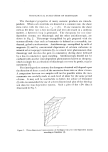
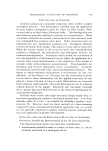
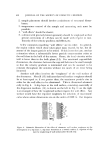
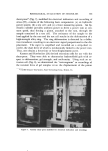
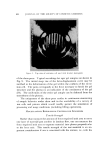
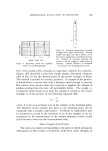
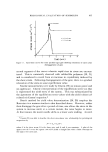
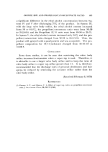
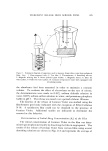
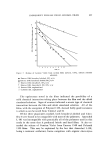
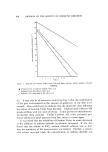
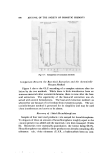
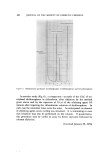
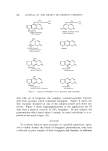
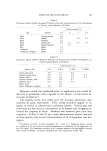
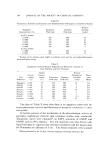
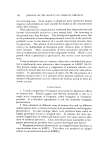
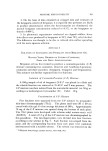
650 JOURNAL OF THE SOCIETY OF COSMETIC CHEMISTS 2. sample placement should involve a minimum of structural distur- bance 3. temperature control of the sample and measuring unit must be possible 4. "wall effects" should be absent 5. a device with precisely known geometry should be employed so that precise corrections of r-D data can be made with respect to non- linearity of the velocity gradient, end effects, etc. A few comments regarding "wall effects" are in order. In general, the region within which shear takes place must exceed, by far, the di- ameter of the largest particle to be tested. If this is not the case, one has a situation where a substantially lower particle concentration exists at the wall than in the bulk of the system. Hence, the local viscosity at the wall is lower than in the bulk phase (14). For rotational cup-and-bob rheometers, the clearance between the cup and bob must be small enough so that the velocity gradient is minimized and can be assumed to be constant throughout the annulus without too much of an error being incurred. Another wall effect involves the "roughness" of the wall surface of the rheometer. Merrill (15) indicates that wall surface roughness should be at least equal to, if not greater than, the maximum particle size in order for the wall effect to be eliminated. This is illustrated schemati- cally in Fig. 6. A slip layer at the wall surface, consisting essentially of the dispersion medium (14), is shown on the left in Fig-. 6 on the right is an example of how the roughened surface negates the wall effect. Any surface would have the requisite roughness for solutions of macromole- cules where solute dimensions are on the order of 1000 •. For disperse iiili WA L t ¸ / 2 Figure 6. Schematic illustration of the effect of rheometer wall surface toughness on the development of a slip layer: 1, slip layer formation at a smooth surface 2, negation of slip layer by roughening of wall surface [after Merrill (15)]

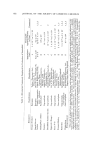
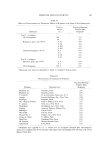
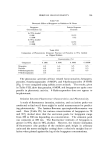
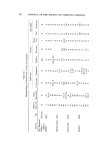
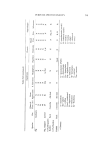
RHEOLOGICAL EVALUATION OF SEMISOLIDS 651 systems in which particles are much greater in size, surface roughness should be a design consideration. In fact, ribbed or roughened bobs have been recommended to avoid wall effects (1, 15-17) and are necessary if valid rheo•ams are to be obtained for semisolids. A very wide range of rheometers has been employed for the accretion of T-D data. Some of the rheometers more commonly employed in the cosmetic, pharmaceutical, and food industries are listed in Table I along with pertinent comments regarding their versatility. Rheometers j•or Continuous Shear Rheometry The suitability of a particular rheometer depends upon whether one is continuously varying the shear rate or one is shearing the sample at a constant rate of shear. If the shear rate varies with time, some sort of automatic programming unit should be employed. One should make certain that acceleration and deceleration are constant for the rotating member. Barry and Shotton (18) noted a considerable deviation from linearity for the incremental increase and decrease in shear rate with the Ferranti-Shirley such that if comparisons of product behavior were to be made, or if different instruments were to be used, the results would be subject to question unless the variations in shear rate increase or de- crease were known. Sample shear at a constant rate necessitates the use of rheometers with well-defined geometry. oevaluation of the Static Structure The viscoelastic behavior of semisolids has been the subject of much attention recently. Wood et al. (1) and Sherman (2) commented on some instrumental approaches to the measurement of viscoelastic defor- mation. More recently, Warburton and Barry (19) and Davis (20, 21) have employed a concentric cylinder modification of the Weissenberg Rheogoniometer which was suitable for creep measurements of oint- ments and creams. Barry and Warburton (12) have described a test method for semisolids which involves little more than the measurement of the penetration of a hard, incompressible sphere into the plane, hori- zontal surface of the product. This method would seem admirably suited for quality control and deserves further investigation. The Kramer Shear-Press In 1950, the shear-press was introduced by Kramer (22) as a means of evaluating the texture and quality of food products. The Kramer
Purchased for the exclusive use of nofirst nolast (unknown)
From: SCC Media Library & Resource Center (library.scconline.org)