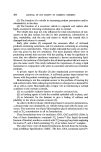
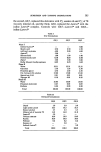
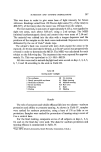
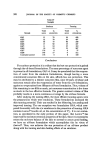
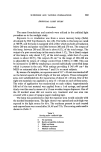
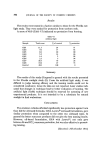
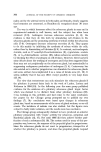
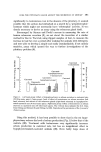
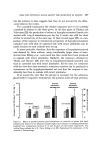
SUNSCREEN AND TANNING PREPARATIONS 387 This was done in order to give some base of light intensity for future reference. Readings varied from 150 Weston light units (5•o of the time) to 400 (95•o of the time) when the meter was 150 mm from the subject. The test materials, in amounts of approximately 0.125 g, were applied to eight test areas, each about 5.08 cm 2, using a 2 ml syringe. The MED (minimal erythematogenic dose) and control sites were areas of 2.54 cm 2. The material was rubbed into the skin with a tongue depressor and the positions of the samples on the back were randomized. Exposure sites were delineated by the use of Duke* elastic tape. The subject's back was covered with terry cloth except the areas to be exposed. At 10 min intervals for 40 min, a 2.54 cm • section was progressively covered in order to determine the MED. The MED was calculated for each subject on the following day. The treatment sites were exposed for approxi- mately 3 h. This was equivalent to 5.5-18.0 x MED. All sites were read in natural daylight and were scored on days 1, 3, 4, 5, 6, 7, 8 and 10 according to the scale in Table III. Table III Scoring scale--sunlight 0 No erythema 1 Barely perceptible erythema 2 Moderate erythema 3 Severe erythema 4 Blistering 5 Peeling 00 No tanning 01 Slight tanning 02 Marked tanning RA Raw area S Scab H Healing Results The role of sunscreen and vehicle efficacy falls into two classes--sunburn protection and ability to promote tanning. As shown in Table IV, samples were ranked for sunburn protection, using a base of 176 as little or no protection. Samples were ranked for promotion of tanning using a score of 8 as a control base. For the final ranking, composite scores of all subjects on days 1, 3, 6, 10, and on the final day were used. The data for sunburn protection and tanning efficacy is summarized in Table IV. *Tape MFG (Duke Laboratories• South Norwalk, Connecticut, U.S.A.).

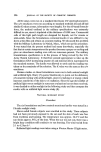
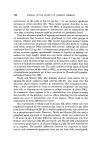
388 JOURNAL OF THE SOCIETY OF COSMETIC CHEMISTS Table IV Sunlight Sunburn Tanning Total % Total % Sample score protection score stimulation GS/1 53 70 36 450 G8/2 52 70 39 487 G8/3 44 75 40 500 G8/4 15 92 35 437 G8/5 11 94 25 312 G8/6 10 95 23 287 G8/7 176 0 6 75 G8/8 146 17 9 112 Untreated control 176 0 8 100 Conclusions For sunburn protection it is evident that the best sun protection is gained through the oil-based formulations. The same percentage of sunscreen agent is present in all formulations, G8/1-6. It may be speculated that the evapora- tion of water from the emulsion formulations, though leaving a more concentrated sunscreen film on the skin, affords less sun protection. This may be attributed to a thinner sunscreen film, since 20 parts oil phase and sunscreen remain after the evaporation of water from the o/w formulation, against no evaporation from 100 parts oil-base formulation. Thus, volume of film remaining is one-fifth as much, yet sunscreen concentration is five times as much in the less effective formula. The greater residual volume of film probably results in a more continuous coverage by the oil-base formula. After studying the tanning effect, the most efficient tanning agents were the preparations which were emulsions. These formulations increased the skin tanning potential. Their use resulted in less blistering, less peeling and improved tanning. The one exception was formulation G8/4, which com- pared favourably with the o/w emulsions in the promotion of tanning. G8/4 contains Lantrol © lanolin oil, at the concentration of 5%. It is our conten- tion, as speculated in the early portion of this paper, that Lantrol © has improved the moisture retention properties of the skin. Since it is essential to return the moisture balance of the skin to normal to assure good healing, we have an oil-base formulation which accomplishes this by virtue of Lantrol ©. Thus, one achieves the sun protection of an oil-base product along with the tanning and skin healing effects of an emulsion.
Purchased for the exclusive use of nofirst nolast (unknown)
From: SCC Media Library & Resource Center (library.scconline.org)