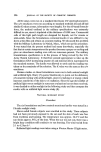
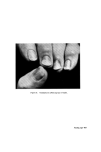
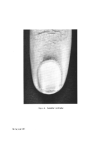
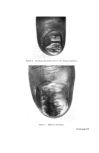
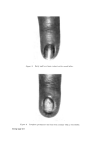
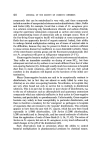
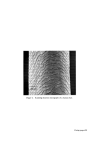
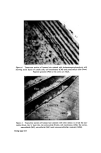
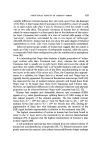
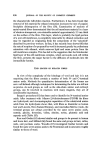
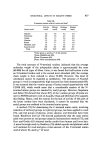
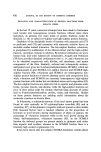
410 JOURNAL OF THE SOCIETY OF COSMETIC CHEMISTS dressings were marketed for a short time some years ago. They caused a great deal of damage very quickly and it seemed probable that this was due to their impermeability. Increased water content of the nail built up as a result of exclusion from the atmosphere so that the nail became soft and was damaged when the dressing was removed. Even so short a time as 48 h of use was sufficient to cause damage (9). False nails, if firmly attached to the nail, are likely to cause similar changes. False nails may be used to hide an underlying defect such as nail biting or psoriasis, but are often used simply for cosmetic purposes. Complete disruption of the nail can result in a few cases. These mishaps from nail cosmetics are very few compared to the damage caused by patients themselves! Nail biting is an extremely common habit and usually results in ugly ragged nails chewed right down to the hyponychium. Greater damage can be caused by biting the cuticle or by biting over the matrix. Pushing back the cuticle is carried out as a routine by many people. Carefully done this will do no harm, but over enthusiasm can cause regular cross white striations (Fig. 6) or cross ridging of the nail. Occasionally it may open up the potential space between the nail plate and dorsal nail fold and initiate chronic paronychia. Another habit which can produce a very ugly nail is playing with a nail, usually a thumb nail, with one of the other fingers on the same hand. This can be done quite un- consciously and produces a nail with a depression down the centre and a number of cross ridges extending from it almost to the sides of the nail (Fig. •). The nail matrix is responsible for the greater part of nail formation whichever method exists, and owing to its anatomical position is well pro- tected so that it is seldom damaged except by severe trauma. Occasionally, however, chemicals manage to get through to it and cause temporary or permanent loss of the nail (Figs. 8 and 9). This has occurred in recent years by accidental exposure to strong solutions of paraquat or diquat, dipyri- dilium compounds used as weed killers. The solutions are not generally available to the public but are used by farmers and foresters (10). The nail matrix is however often involved in skin diseases, especially psoriasis, and its protected position makes treatment very difficult. ACKNOWLEDGEMENTS My thanks are due to the photographic departments of Westminster and St John's Hospital for the photographic illustrations. (Received: 20th February 1971)

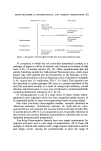
Figure ß ...... . ß . .• .• • -.... ,. .•, Leuchonychia striata due to over zealous manicure. Figure 7. Habit-tic deformity. Facing page 410
Purchased for the exclusive use of nofirst nolast (unknown)
From: SCC Media Library & Resource Center (library.scconline.org)